Originally reported by PANews on December 16, 2025, at 15:00 (UTC+8). This account reflects the proposals and discussion described at that time, not a current governance update.
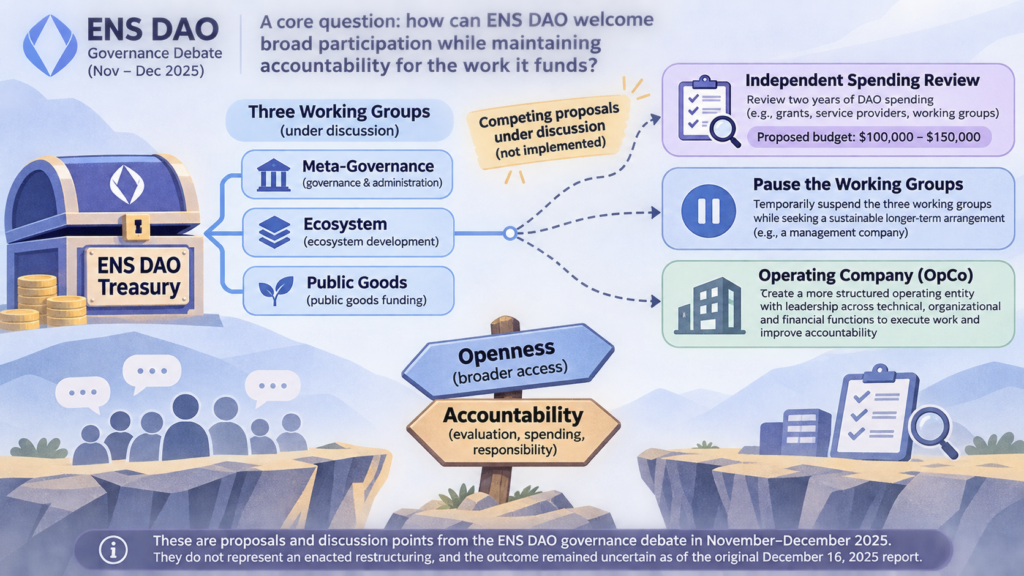
ENS DAO’s governance debate raised a difficult question for an organization built around open participation: how can it welcome contributors while maintaining accountability for the work it funds? In November and December 2025, participants disagreed over whether to end three working groups, review DAO spending first, or give a more structured operating entity responsibility for execution. None of those ideas should be mistaken for an enacted restructuring.
The proposal to end the working groups
On November 14, ENS DAO secretary Limes proposed a temperature check to end the Meta-Governance, Ecosystem and Public Goods working groups when their sixth term ended on December 31, 2025. Limes, who said he had served four years as a steward and two as secretary, argued that dependence on future funding discouraged candid criticism. He also argued that working groups could not adequately select contributors for their roles. Those were his assessments of the structure, not established findings about every participant.
ENS founder Nick Johnson wrote on November 18 that political conflict in the working groups had driven away dedicated contributors and could drive away more. He favored pausing rather than abolishing the groups while seeking a sustainable longer-term arrangement, potentially involving a management company for day-to-day operations. He also expressed concern, as an ENS Foundation director, about whether the DAO could meet its legal obligations without professional contributors.
Other participants described a tension within openness itself. jkm.eth said ENS DAO’s accessibility had helped him enter the ecosystem, while Limes argued that open working groups struggled to screen for capability. Contributor ENSPunks.eth alleged a toxic culture, conflicts of interest and the loss of skilled contributors. His accounts of spending on charter work and a stalled conflict-of-interest policy were allegations made in the discussion, not independently verified conclusions.
Review first, or change the structure?
James proposed an independent review of two years of DAO treasury spending, including grants, service providers and working groups, before a major structural decision. The proposed budget for a review led by Metagov was $100,000–$150,000. Johnson questioned spending more than $100,000 to identify inefficiency; James responded that, against annual DAO spending of more than $10 million, $100,000 would be about 1%. Others, including Limes, argued for acting without waiting for a review.
In a separate analysis, clowes.eth credited the Public Goods group with funding worthwhile projects and Meta-Governance with handling administrative work, but said he saw little growth in active new participation. He stressed that participation had not been measured, so his observation was not a quantified adoption metric. He also questioned whether the DAO had enough visibility into ENS Labs’ work. According to his account, Labs received $9.7 million annually from the DAO and had been authorized to build ENSv2–Namechain; his criticism of its transparency was his own assessment. He proposed an operating company with leadership across technical, organizational and financial functions—a proposal that would trade some distributed decision-making for clearer execution and accountability.
As of the original December 16 report, the initial proposal had been rejected, further proposals remained under discussion, elections had been delayed, and the outcome was uncertain. The debate illustrates a governance constraint rather than a verdict on decentralization: openness can broaden access, but it does not by itself settle who evaluates work, challenges spending or takes responsibility for decisions.
Source: panewslab.com (originally published 2025-12-16 15:00 UTC+8)