Originally published November 14, 2026, at 10:55 a.m. UTC+8. This is a funding proposal, not an operating platform or an enacted set of rules.
What if a crypto project had to show that its technology worked before raising its first round? In an essay attributed to @hmalviya9, translated by AididiaoJP for Foresight News, the author proposes starting with a developer-funded minimum viable product addressing part of the social-technology challenge—identity, reputation or privacy. Only after releasing that MVP would the developer seek 10 ETH.
A small round built around participation
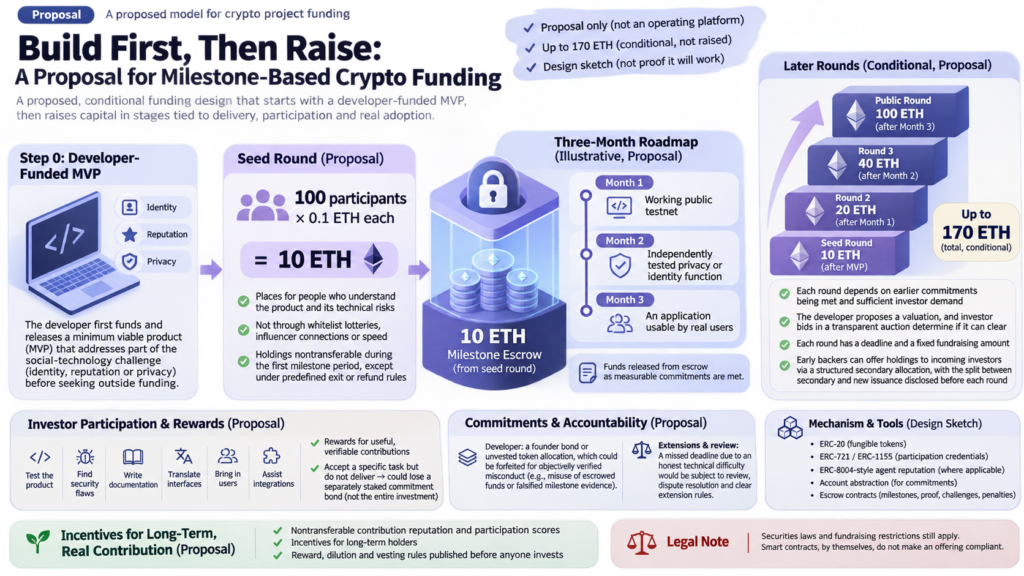
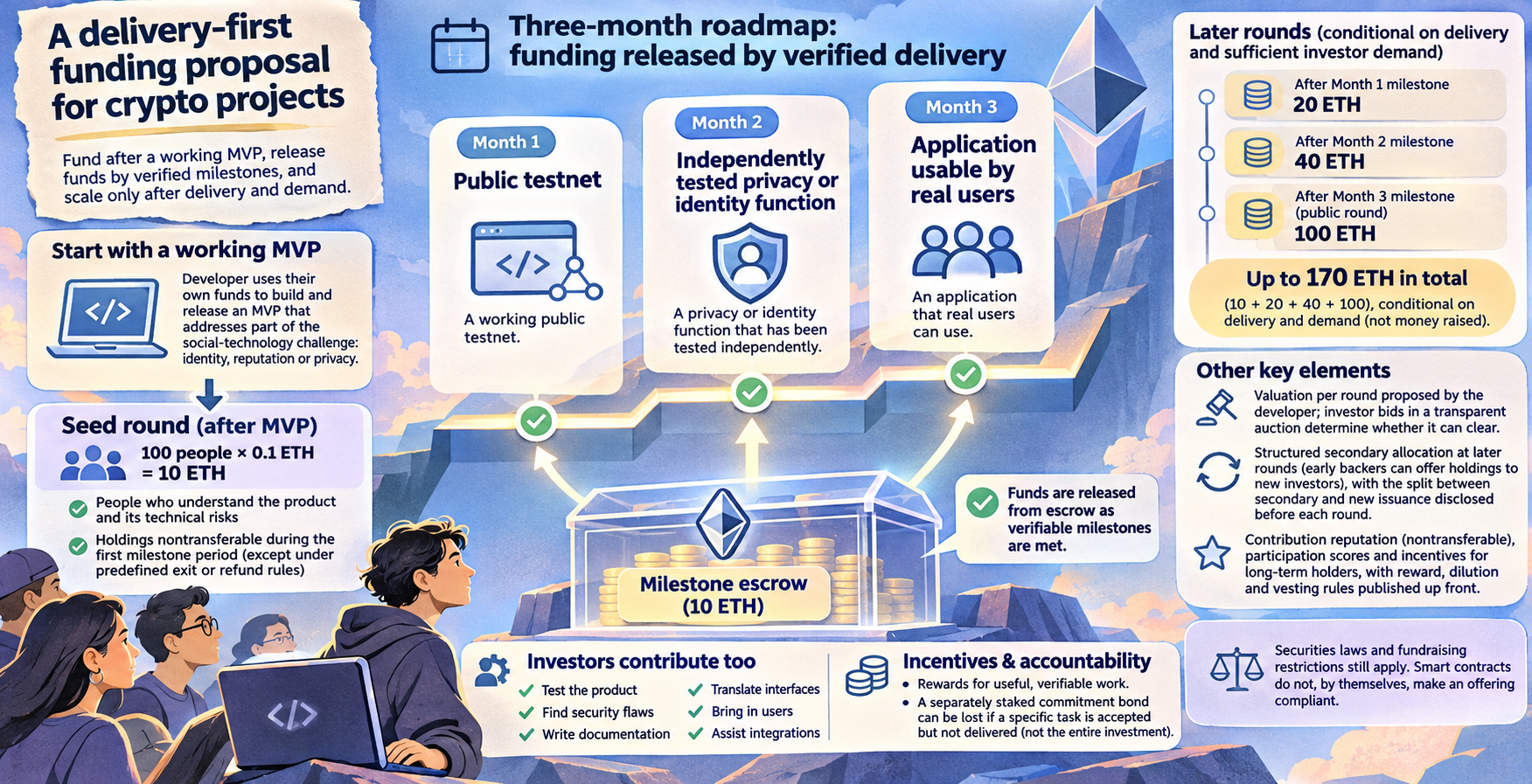
The proposed seed round would admit 100 people contributing 0.1 ETH each. The author argues that places should go to people who understand the product and its technical risks, rather than through whitelist lotteries, influencer connections or speed. During the first milestone period, their holdings would be nontransferable except under predefined exit or refund rules.
Investors would also be asked to help: testing the product, finding security flaws, writing documentation, translating interfaces, bringing in users or assisting integrations. The proposal suggests rewards for useful, verifiable work. Someone who accepts a specific task but does not deliver could lose a separately staked commitment bond—not their entire investment.
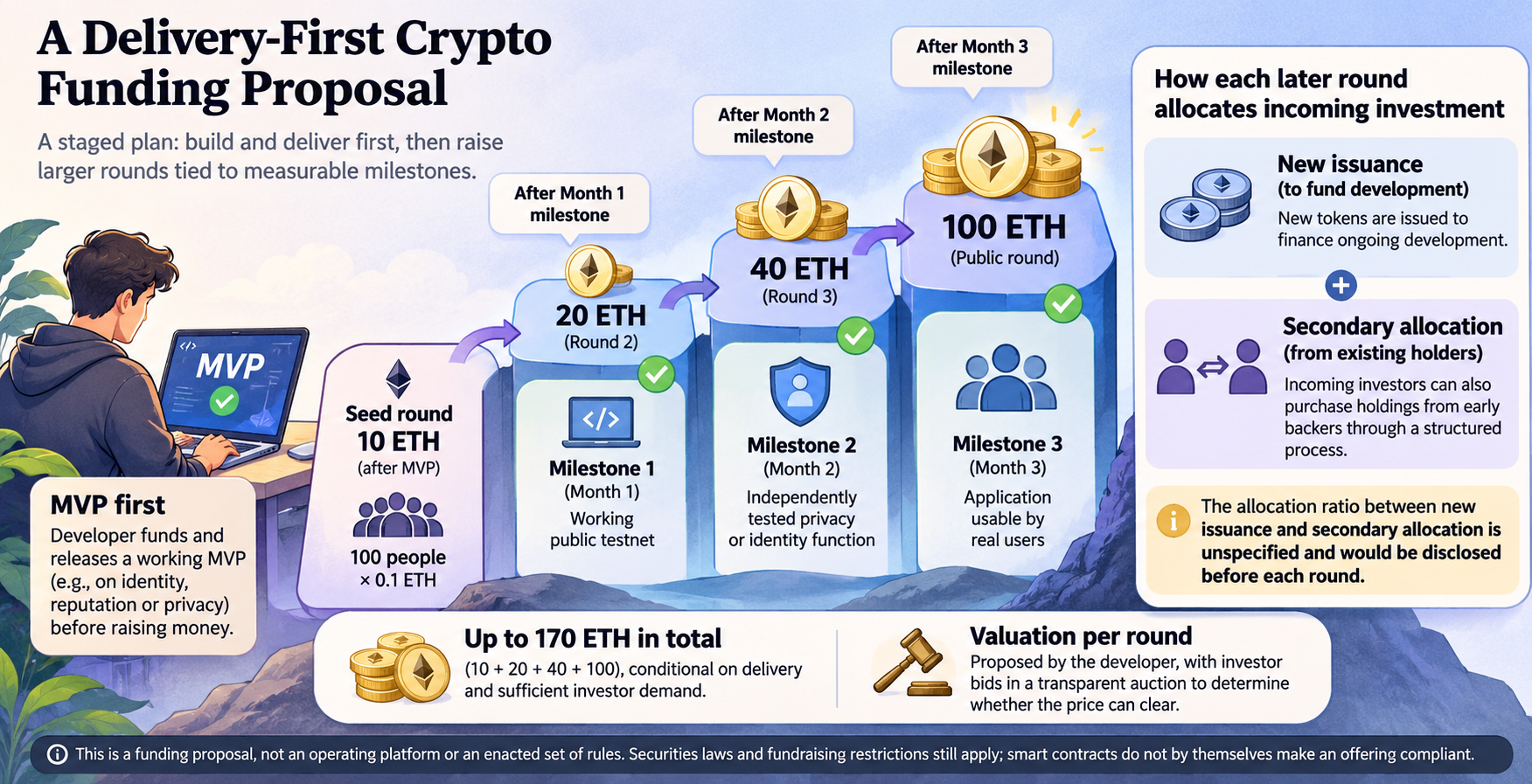
Funding tied to delivery
The initial 10 ETH would sit in milestone escrow and be released as the developer meets measurable commitments on a three-month roadmap. The essay gives illustrative targets: a working public testnet in month one, an independently tested privacy or identity function in month two, and an application usable by real users in month three. It also proposes a founder bond or unvested token allocation that could be forfeited for objectively verified misconduct, such as misuse of escrowed funds or falsified milestone evidence. A missed deadline caused by an honest technical difficulty would instead be subject to review, dispute resolution and clear extension rules.
Later rounds would depend on earlier commitments being met: 20 ETH after the first-month milestone, 40 ETH after the second, and a 100 ETH public round after the third. Together with the seed round, that is up to 170 ETH, conditional on delivery and sufficient investor demand—not money the project has raised. The developer would propose a valuation for each round, while investor bids in a transparent auction would determine whether that price could clear. Each round would have a deadline and a fixed fundraising amount.
At later rounds, early backers could offer holdings to incoming investors through a structured secondary allocation, while new issuance would fund development. The split between those two uses would be disclosed before each round. The author also suggests nontransferable contribution reputation, participation scores and incentives for long-term holders, with reward, dilution and vesting rules published before anyone invests.
The distinction at the heart of the proposal is between attention and demonstrated adoption: a public token round would follow a usable product, testing and real users, rather than precede them. Its suggested tools include ERC-20 tokens, ERC-721 or ERC-1155 participation credentials, ERC-8004-style agent reputation infrastructure where applicable, account abstraction and escrow contracts. Those components are a design sketch, not proof that the system would work. The author explicitly notes that securities laws and fundraising restrictions would still apply; smart contracts would not, by themselves, make an offering compliant.
Source: panewslab.com (originally published 2026-11-14 10:55 UTC+8)