BNB Chain’s November 26, 2026, litepaper proposes a Layer 1 blockchain that would let users trade on supported public decentralized exchanges without directly revealing who owns the proceeds. The network would operate alongside BNB Smart Chain, use BNB as its native token and hold users’ funds in a shielded pool. The exchange itself would stay public.
What an observer could see
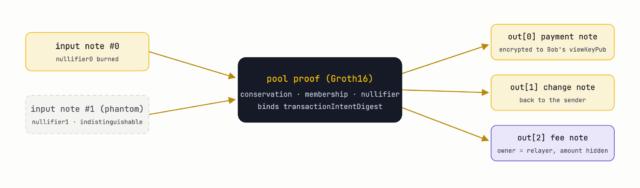
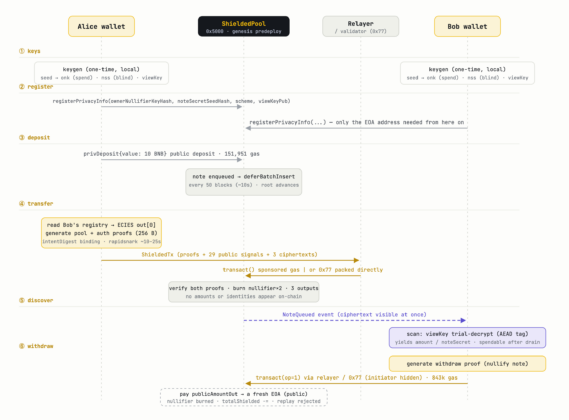
Consider a company depositing 10 BNB into the proposed pool. A block explorer would show the funding address and the amount. If the company then paid a supplier inside the pool, neither party, the asset nor the payment amount would be public. The network fee could still be visible, depending on how the company submitted the payment.
BNB Chain’s design uses encrypted records called notes rather than public account balances to track shielded funds. Zero-knowledge proofs would let the network verify that a payment is valid without disclosing those details.
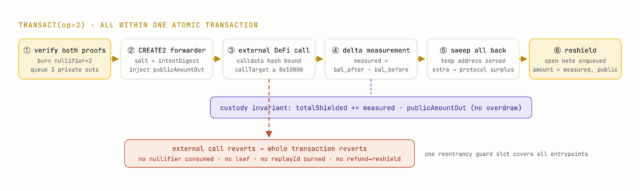
A swap would expose more than a payment. If the company swapped 2 BNB using a proposed mechanism called AtomicCall, the funds would leave the pool, interact with a supported public contract and return as the acquired asset, all in one transaction. An observer could see the exchange contract, the instructions and the amounts traded. An open note would record the asset and quantity returned to the pool without naming the owner.
Where privacy depends on participation
For a business seeking to keep competitors from tracking its treasury, concealing ownership could matter even when trade details remain public. But it would not guarantee anonymity. In a quiet pool, an unusually sized deposit followed shortly by a corresponding swap could help an observer link the two. More users and transactions could make that inference less reliable.
Asset support is another practical limit. The design covers BNB and selected BEP-20 tokens, but the developer documentation identifies only native BNB as a supported deposit asset in the implementation it describes. Stablecoins could make payroll and supplier payments more practical for businesses that want privacy without BNB price exposure; the documentation does not establish stablecoin deposit support.
The litepaper describes how shielded funds could reach public applications. It does not demonstrate adoption or establish the security of the implementation. Independent review of the circuits that verify private transactions, the range of supported applications and assets, and actual participation in the pool all remain relevant to whether businesses could rely on it.