
In reporting published on November 12, 2026, Blockhead examined a change in how publicly listed Bitcoin miners value their power capacity: for sites that can be converted, leasing electricity-backed data-center space to AI customers may earn more than using that power to mine. Of the nine companies it reviewed, three already received more than half their revenue from activities other than mining. That is evidence of a shift among those firms, not a measure of the entire mining industry.
The economics of one megawatt
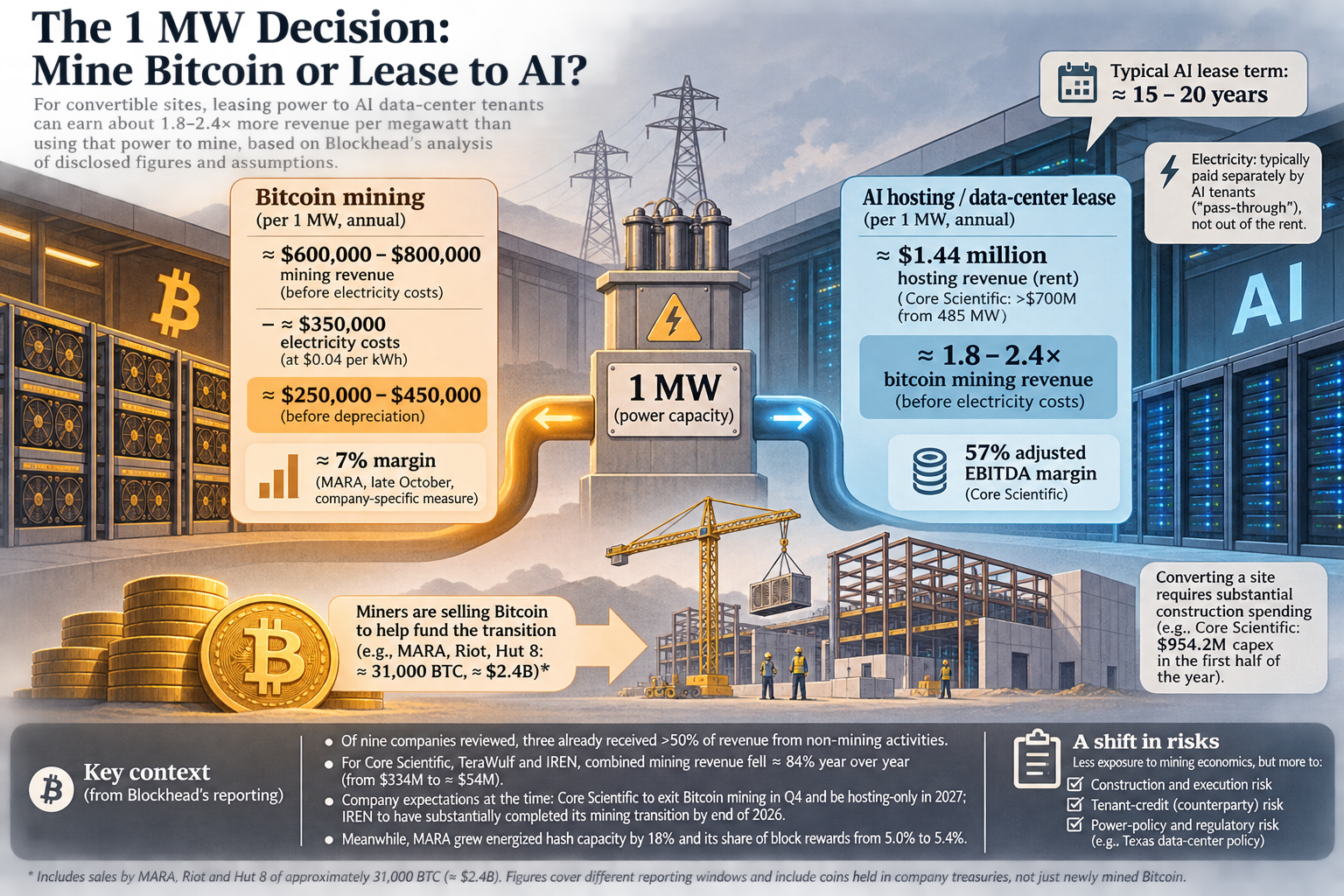
MillionMiner data put hashprice—daily mining revenue per PH/s—at $33.18 at the end of October, down 17.5% from October 1. MARA, described by Blockhead as one of the lowest-cost operators, reported costs of $30.80 per PH/s per day. On that company-specific measure, the late-October margin was roughly 7%.
Core Scientific, by contrast, reported more than $700 million in annualized hosting revenue from 485 MW of billable capacity. That works out to about $1.44 million per MW per year, with a reported adjusted EBITDA margin of 57%. Under Blockhead’s stated assumptions—mining equipment using 15–20 joules per TH, a $33 hashprice and electricity at $0.04 per kWh—one MW would generate about $600,000–$800,000 in annual mining revenue before roughly $350,000 in power costs and before depreciation. The AI hosting figure is 1.8–2.4 times that estimated mining revenue per MW.
These are comparisons built from disclosed figures and assumptions, not a guaranteed return available to every mining site. Contract structures also differ: Blockhead noted that AI tenants typically pay electricity costs separately from rent, while miners pay power bills out of variable mining revenue. Converting a site requires substantial construction spending.
Funding the conversion
Long-term AI leases offer a different revenue profile from mining, whose proceeds move with Bitcoin’s price and network difficulty. The commitments are large but should not be mistaken for revenue already earned: Core Scientific disclosed more than $24 billion in contracted revenue, while Cipher disclosed $16.6 billion. Blockhead cited lease terms of roughly 15–20 years, alongside the capital intensity of bringing facilities up to data-center standards. Core Scientific spent $954.2 million on capital expenditure in the first half of the year.
Some miners are selling Bitcoin to help fund that transition. According to its shareholder letter, MARA sold 17,488 BTC during the quarter, versus 2,247 BTC mined, and planned further sales to finance AI infrastructure and meet note obligations. Riot sold 10,599 BTC in the third quarter; Hut 8 sold about 3,100 BTC across the third quarter and October. Blockhead put their combined sales at approximately 31,000 BTC, worth around $2.4 billion. Those figures cover different reporting windows and include coins held in company treasuries, not just newly mined Bitcoin.
A shift in risk, not an end to mining
Blockhead calculated that the combined mining revenue of Core Scientific, TeraWulf and IREN fell about 84% from a year earlier, from $334 million to roughly $54 million. Core Scientific expected to exit Bitcoin mining in the fourth quarter and become a hosting-only provider in 2027; IREN expected to have substantially completed its mining transition by the end of 2026. Those were company expectations at the time of reporting, not completed outcomes. Meanwhile, MARA reported an 18% increase in energized hash capacity and a rise in its share of block rewards from 5.0% to 5.4%.
Bitcoin’s issuance does not stop when a miner changes business model: Blockhead estimated approximately 450 BTC were being issued daily. What can change is which operators earn those coins and when companies sell holdings to finance new facilities. For convertible sites, AI hosting also gives owners an alternative use for power—but the comparison depends on actual lease terms, conversion costs and whether tenants can meet their commitments.
That replaces some exposure to mining economics with construction, tenant-credit and power-policy risks. Blockhead pointed to CoreWeave’s financing plans and credit spreads, as well as Texas data-center policy, as factors to watch. Its proposed tests for the transition were hashprice relative to efficient miners’ costs, miner Bitcoin sales, the pace at which new leases become operational, and financing conditions for tenants and electricity infrastructure.