Originally reported on November 11, 2026, at 15:29 Beijing time. The MSCI decision discussed below was still pending when the article was published.
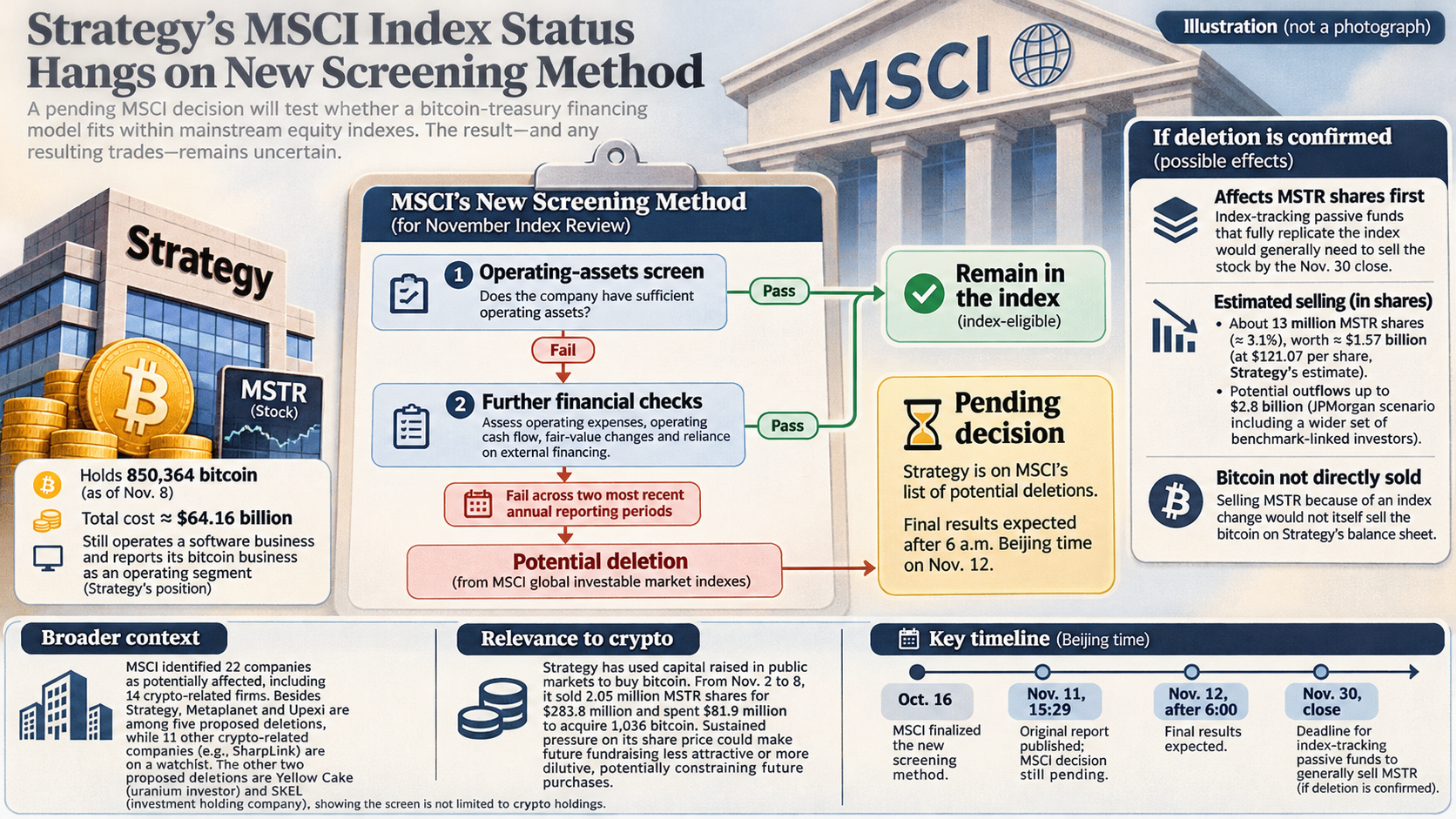
Strategy’s place in MSCI’s global investable market indexes was in question under a new screen for companies that derive most of their value from holding assets rather than operating a business. MSCI had listed Strategy as a potential deletion, not confirmed its removal. The final results were expected after 6 a.m. Beijing time on November 12.
The distinction matters because an index exit would first affect MSTR shares, not the bitcoin on Strategy’s balance sheet. Funds that fully replicate an affected index would generally need to sell the stock by the November 30 close; funds using other tracking methods could respond differently.
Why MSCI is reviewing treasury companies
MSCI finalized the new screening method on October 16 for use in its November index review. Companies that do not pass an initial test of operating assets face further checks involving operating expenses, cash flow, fair-value changes and reliance on external financing. Under the method described in the original report, an existing constituent must fail the screen across its two most recent annual reporting periods before deletion.
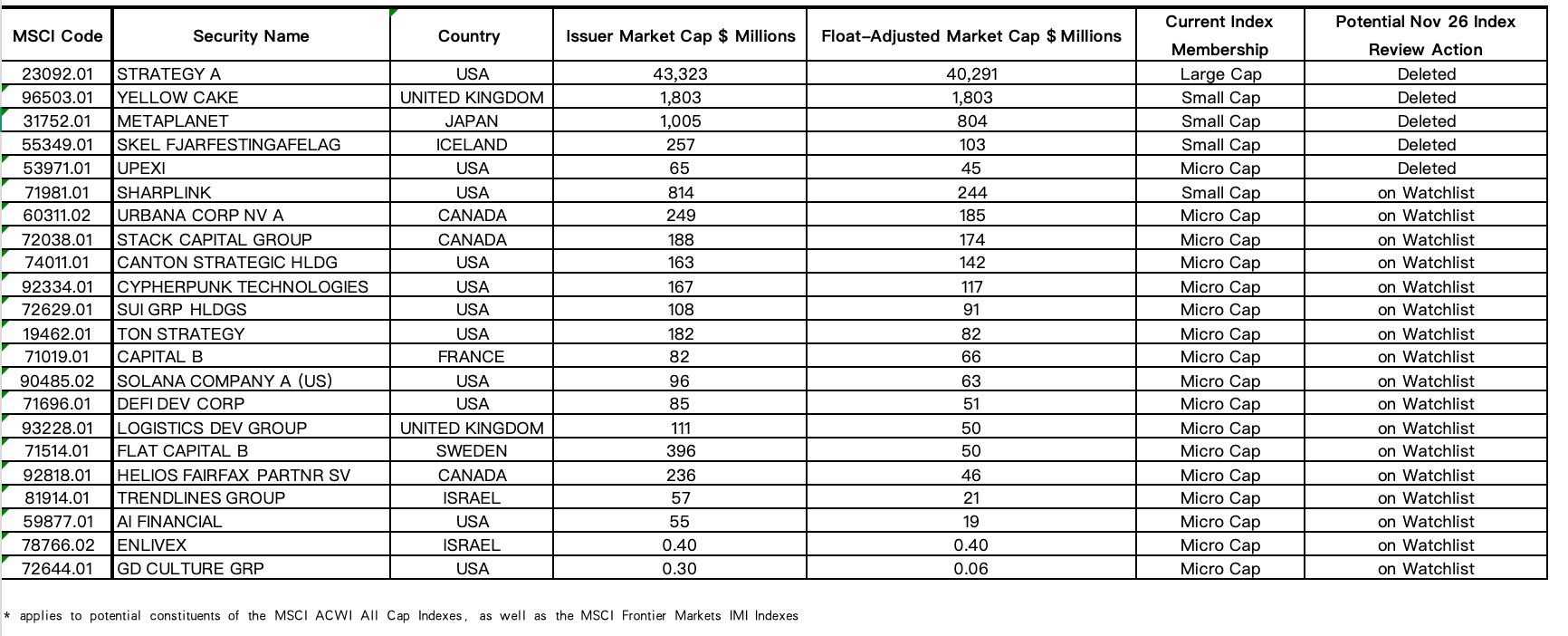
Of 22 companies MSCI identified as potentially affected, 14 were directly related to crypto. Strategy, bitcoin treasury company Metaplanet and SOL treasury company Upexi were among five proposed deletions. Eleven other crypto-related companies, including SharpLink, were on a watchlist. The other two proposed deletions were uranium investor Yellow Cake and investment holding company SKEL—an indication that the screen is not limited to crypto holdings.
Strategy objected, arguing that it still runs a software business and reports its bitcoin business as an operating segment. MSCI said the method addresses companies with financial characteristics resembling investment vehicles, regardless of whether they hold crypto assets. Those are the parties’ positions; the pending review had not settled Strategy’s index status.
The estimated selling is in shares
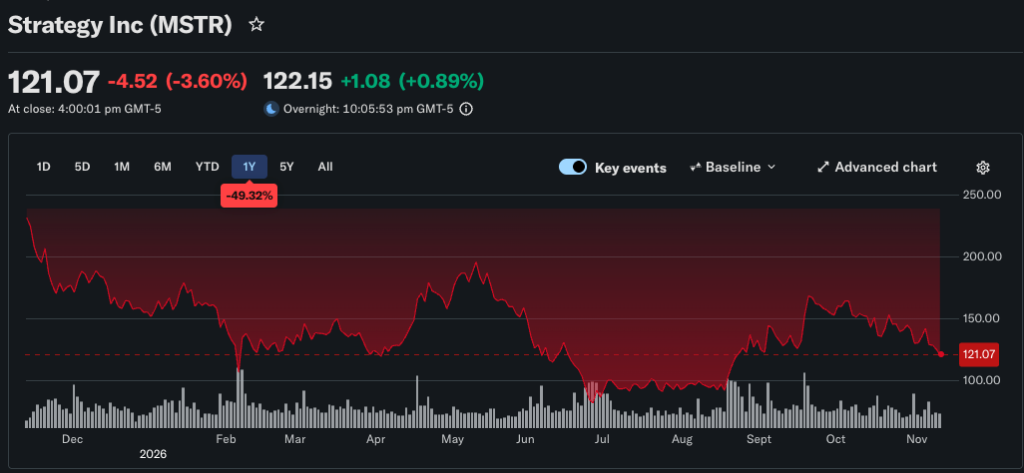
The original report cited Strategy’s estimate that index-tracking passive funds held about 13 million MSTR shares, or 3.1% of its shares outstanding—worth roughly $1.57 billion at the cited $121.07 share price. A JPMorgan scenario that included a wider set of benchmark-linked investors put potential outflows as high as $2.8 billion. Neither estimate establishes how many shares would be sold, when, or at what price.
Strategy disclosed on November 9 that it held 850,364 bitcoin as of November 8, purchased for approximately $64.16 billion in total. Selling MSTR because of an index change would not itself sell those holdings.
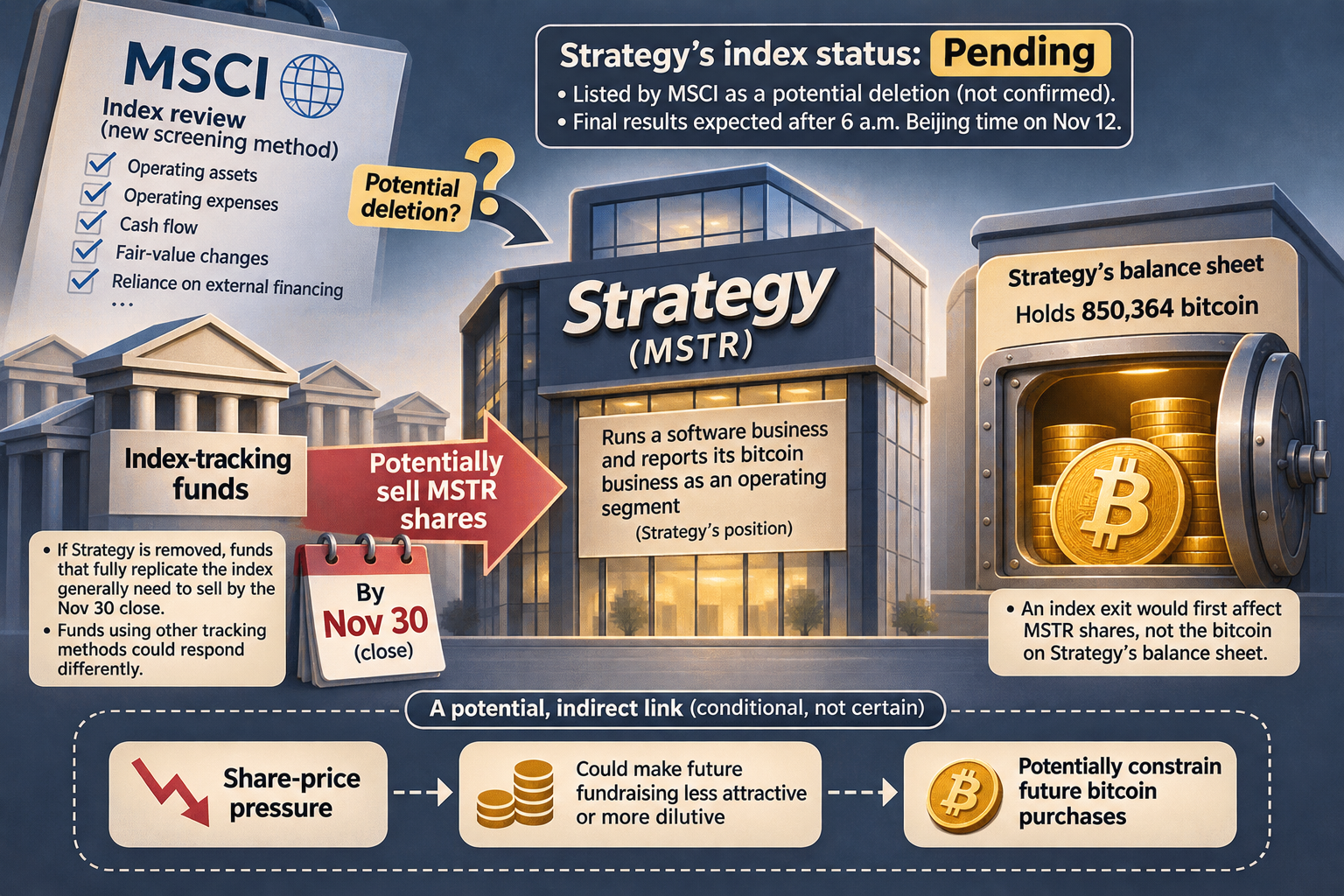
The possible link to bitcoin is indirect. Strategy has used capital raised in public markets to buy bitcoin: between November 2 and 8, it sold 2.05 million MSTR shares for $283.8 million and spent $81.9 million to acquire 1,036 bitcoin, according to the original report. Sustained pressure on its share price could make future fundraising less attractive or more dilutive, potentially constraining future purchases. It does not, on its own, imply that Strategy must sell bitcoin or establish a price impact for the asset.
The review therefore tests how a bitcoin-treasury financing model fits within mainstream equity indexes. At the time of reporting, the index decision—and any resulting trades—remained uncertain.
Source: panewslab.com (originally published 2026-11-11 15:29 UTC+8)