On November 11, 2026, Odaily examined a reversal inside Ethereum’s scaling debate: after years in which independent layer-2 networks were treated as the default home for applications, a series of named protocols had moved core products back toward Ethereum mainnet, while some standalone L2s had begun to shrink or shut down. The piece asks whether that shift changes how ETH is supposed to capture value. The cases below are reported product and operating decisions. They are not a census of every rollup, and they do not by themselves show a single wave of capital rotating out of L2s.
Original reporting: Odaily, November 11, 2026.
The story the rollup years told
At the height of the rollup narrative, a common anxiety in the Ethereum community was that L2s were eating L1 value and that Ethereum was losing global composability. The market logic was straightforward. Mainnet transactions were becoming expensive, so applications, assets and users should move to separate L2s.
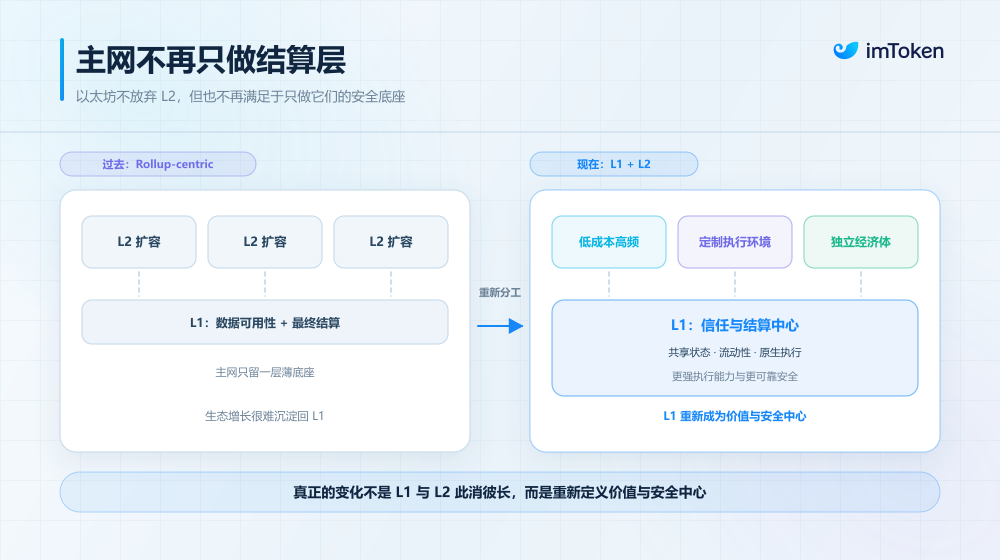
For several years, high mainnet gas made that logic look like standard practice. Many leading protocols either built their own L2 or placed core business on another rollup. The original rollup-centric division of labor was clear: L1 would provide security, data availability and final settlement; L2s would provide aggressive scaling and low fees. When mainnet gas often ran to tens of dollars, Odaily describes that split as close to the only workable answer.
By 2026, the same publication argued, teams were reassessing that choice against infrastructure cost, asset security and liquidity. “Returning to mainnet” here means different things for different projects. It is not one product category.
Who moved, and what job they said mainnet was doing
ENS is the clearest naming and cost case. In 2024, ENS Labs planned Namechain, a dedicated ZK rollup for ENSv2, so that a separate execution environment could lower the cost of domain registration and management. In February 2026, ENS co-founder Nick Johnson said development of Namechain would stop and ENSv2 would be deployed directly on Ethereum mainnet. The stated reason was that L1 scaling had moved far faster than expected two years earlier.
ENS Labs figures reported in the article say that, as Ethereum’s gas limit rose, the average gas cost of registering an ENS name fell by about 99 percent over the previous year, from nearly $5 to under $0.05. An independent L2 would still require nodes and other infrastructure, plus cross-chain resolution, bridging, security audits and ongoing operations. If the job can already be done cheaply on mainnet, a separate rollup can make the product more complicated rather than less.
Synthetix made the argument in public earlier. In June 2025 it published “L2s are Dead, Long Live Ethereum,” saying the earlier L2 scaling path had brought applications liquidity fragmentation and unstable infrastructure. In December 2025 its new perpetual-futures exchange launched on Ethereum mainnet. The later design, discussed below, did not put every computation on L1.
Other 2026 moves, as reported, were narrower:
- In September, Trueo said it would move its primary deployment from Base back to Ethereum L1, citing stronger integration, network effects and neutrality for prediction markets and outcome oracles.
- On October 1, ShapeShift moved the rFOX staking program from Arbitrum to Ethereum mainnet. The practical reason given: most FOX tokens were already held on mainnet, so an extra bridge just to stake was unnecessary.
- In August, Superseed stopped its existing L2 and planned to shift the ecosystem’s core products to Ethereum mainnet. It would no longer depend on an independent chain’s gas revenue to support loan repayment, and would instead pursue that goal through application-layer yield strategies.
- In October, Nillion launched Blacklight L1, moved node operations that had run on Nillion L2 onto Ethereum mainnet, and planned to phase out the older L2.
Odaily’s own limit on these examples is the right one. They do not mean every protocol is leaving L2s. They show more teams choosing infrastructure according to the security, liquidity and execution speed a specific business actually needs.
A chain is not the same thing as a business
Operating stress on some independent L2s was reported alongside those migrations.
On October 2, 2026, Blast, which had once held more than $2 billion in TVL, said it would stop operating. The stated reason: the cost of maintaining the network already exceeded the revenue the L2 produced, and there was no reliable path to economic sustainability.
Abstract then said it planned to shut its network on December 15. The article notes that Abstract had connected more than 144 applications and drawn more than 400,000 users. Those adoption counts were not enough. Insufficient liquidity, a limited DeFi ecosystem and a lack of institutional participation made an independently run consumer chain hard to sustain.
The distinction matters. Attention and registered users are not the same as durable liquidity, fee revenue or a business that can pay for a chain. Odaily’s conclusion is narrower than “L2s failed”: owning a chain is not the same as having a sustainable commercial model. With Ethereum lowering the cost of publishing L2 data to mainnet, and with mainnet performance rising, low gas plus token incentives was becoming a weaker long-term advantage on its own.
Stage labels are a category boundary
Scattering applications and liquidity also puts pressure on the property Ethereum was supposed to keep: global composability.
As of November 2026, ETHBEAT — formerly L2BEAT — had catalogued dozens of L2s of different types. Only a single-digit number had reached Stage 2, and their assets were described as almost negligible. Major rollups including Base, Arbitrum One and OP Mainnet were still at Stage 1. Progress toward Stage 2 had been much slower than expected, while L1 scaling had sped up.
The article attributes a blunt summary to Vitalik Buterin: as mainnet scaling accelerated, the original vision of L2s, and their role in Ethereum, no longer held.
It also refuses a simple moral. Some L2s may stay at Stage 1 for a long time because of regulation, business model or customer control. For institutional applications that must meet specific regulatory requirements, keeping management and upgrade authority can be part of the product. That choice is not automatically a mistake. It does mean something else: a network whose key upgrades and state adjudication remain with a small set of entities should not be treated as a fully decentralized shard of Ethereum mainnet.
One working compromise: state on L1, matching elsewhere
The architecture Odaily highlights is not “everything returns on-chain.” It is a compromise already in use: leave assets and critical state on L1, and send high-frequency or complex computation off-chain or into another execution environment.
Synthetix’s new perpetuals venue is the concrete case. User assets stay in Ethereum L1 contracts. Orders are matched by an off-chain high-performance central limit order book. Fills are written back to mainnet in batches. Users are not asked to bridge a large balance to another chain in order to get speed, and matching is meant to feel closer to a centralized exchange.
The trust problem is not gone. The article says some margin management still depends on the off-chain order book, and the off-chain matching system itself still has to be scrutinized. What mainnet contracts still guarantee is custody and final withdrawal. Users are not placing the safety of all funds on one L2 sequencer and bridge. The implied design rule is not that every calculation must be on-chain for finance to be “on-chain.” It is that some steps need guarantees only chain rules can provide, and others may not.
Further out, the article points to Vitalik’s native-rollup research: use an Ethereum-native ZK-EVM so mainnet can verify a rollup’s EVM execution directly, rely less on external security councils, and make interoperability and synchronous composability among rollups more credible. Schemes such as an Ethereum Economic Zone are described as attempts at tighter synchronous interaction between rollups and mainnet. Both are placed in research and verification, not in production as a finished fix. The shared aim is that a different execution environment should not force users into separate assets, liquidity and trust systems.
L2s are not written off for every job. The article still assigns them a role in high-frequency trading, games, privacy computation and applications that need to control their own execution environment. What it says should change is the older idea that scaling is an L2’s only core mission.
If blockspace is cheap, the fee-burn story gets thinner
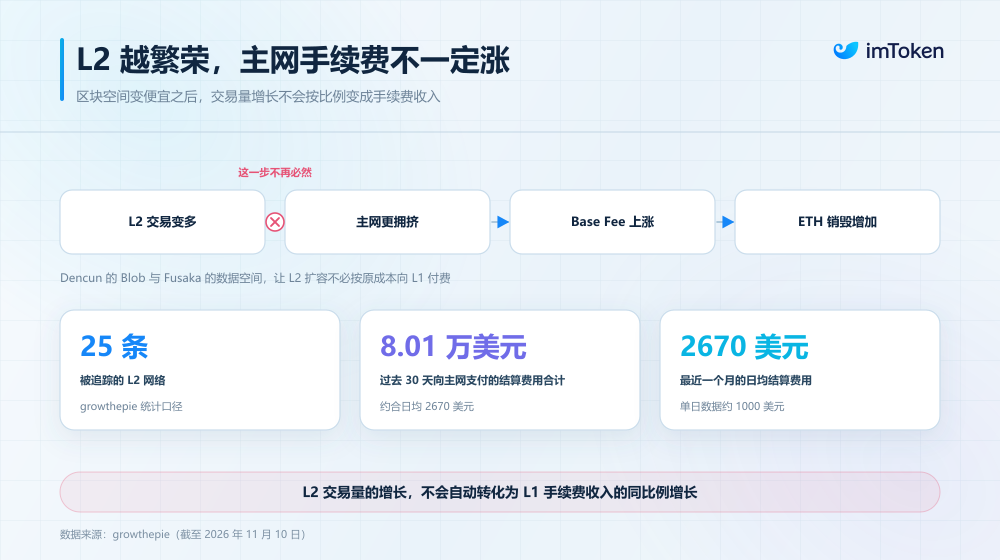
The infrastructure argument leads to a value argument. For several years, a large part of the market’s case for ETH rested on EIP-1559. The base fee is burned. The priority fee is paid to validators. When demand is strong and blockspace is scarce, the base fee tends to rise and more ETH is destroyed. That was a pillar of “ultrasound money”: if activity kept growing, burned fees might offset or exceed new issuance and leave ETH in net deflation.
The tension the article describes sits inside that mechanism. Upgrades including Dencun and Fusaka reduced what it costs L2s to post data to mainnet, while mainnet itself kept raising the gas limit. Cost per transaction, and fee revenue, can fall. A larger ecosystem of transactions does not automatically mean more ETH burned. Propping up a valuation by keeping gas expensive would push costs onto ordinary users and real applications and could hurt the network’s ability to compete over time.
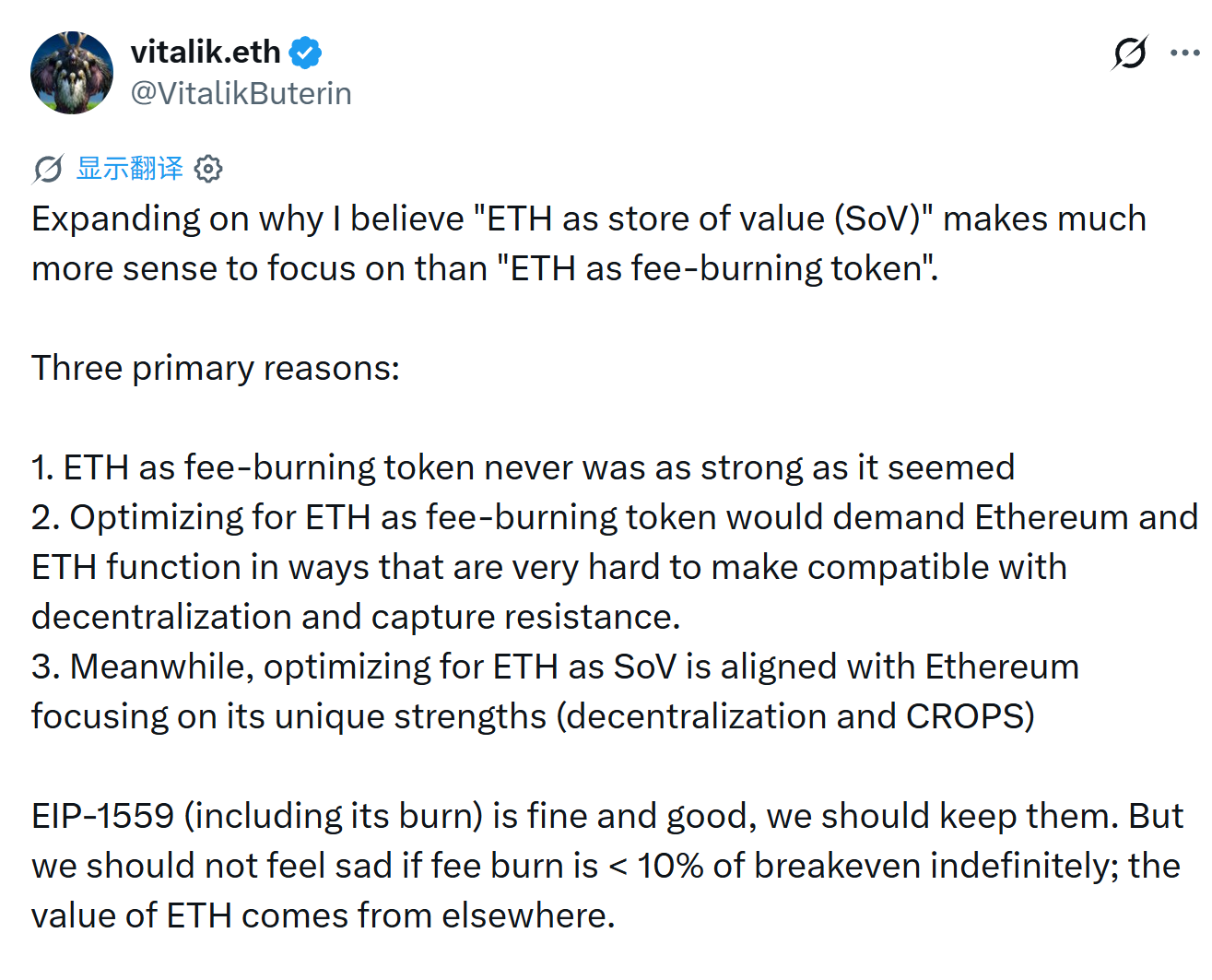
Vitalik’s position, as reported, is specific. He does not reject EIP-1559 or call for the burn to be removed. He treats the mechanism as still reasonable and worth keeping. He argues that ETH as a store of value deserves more of Ethereum’s long-term effort than ETH understood mainly as an asset whose value comes from burning fees. Even if, over the long run, fee burn offset less than 10 percent of breakeven issuance, he did not think holders should treat that as a disappointment, because burn is not the only source of ETH’s value.
Three reasons are given, and they should stay attached to that argument rather than be upgraded into a valuation model:
- The periods of highest burn were driven largely by speculation inside crypto. In 2022, Yuga Labs’ Otherdeed NFT mint burned about $180 million of fees in a single day. That was not external demand in any strong sense. If the crypto market contracted and speculative capacity fell, those transactions and that fee income could disappear with it. Past burn is a weak floor for a long-term valuation.
- Supporting an ETH market capitalization in the hundreds of billions of dollars by requiring persistently high fee revenue could push Ethereum to behave more like a large commercial company: more research spending, more product pivots, more active governance intervention. That sits awkwardly with decentralization and resistance to capture.
- Keeping gas high in order to burn more ETH could shut out the ordinary users who most need privacy, security and open financial services.
What Vitalik is reported to put in place of fee burn is a set of properties the article abbreviates as CROPS: censorship and capture resistance, open source, privacy and security. Together they are framed as stability — the ability to keep operating while AI, traditional finance and other digital infrastructure change. A neutral settlement system that is hard for outside forces to control is treated as more important than a high fee take in any one period.
The article then claims that a stronger L1 reinforces ETH in three ways. These are arguments, not measured outcomes:
- Core state and settlement are the network effect that is hard to copy. Execution can be commoditized and execution environments can be replicated. A shared settlement layer that already holds large amounts of assets, mature financial protocols and deep liquidity cannot be reassembled quickly. ETH’s role as the gas asset, native collateral and settlement asset could strengthen if core financial activity gathers there again.
- Mainnet scaling is an attempt to escape a contradiction: more throughput without hardware requirements for nodes running out of control. If that work matures, Ethereum could move from a low-frequency, high-price settlement network toward higher throughput and lower cost. ETH’s value would not have to depend on an expensive fee per transaction.
- Staking and economic security add another use. ETH is the native resource the network needs to run, the economic collateral of proof of stake, and collateral and liquidity inside DeFi. That stack is a fuller account than fee burn alone.
What a balance point can and cannot claim
Odaily reads the last few years as a scaling experiment and 2026 as a search for a new balance. L2s, in that reading, should not disappear. They remain a way to extend use cases, run differentiated execution environments and serve more users. L1, in the same reading, cannot remain only a data-availability and final-settlement layer. It is being asked to recover execution, a central liquidity role, censorship resistance and economic security so that the most important assets and financial state can sit in one trustworthy environment.
The philosophical reference is Lean Ethereum: subtract redundancy and friction, and put security, censorship resistance and state consensus back at the center of the protocol. The article’s closing line — that a more capable, more unified and more firmly grounded Ethereum is opening its next decade — is a narrative conclusion, not a result established by the migrations above.
What the reported record supports is more limited. Several named teams decided that an independent chain was no longer the best way to buy lower fees, and some L2 operators described costs that revenue could not cover. Stage 2 remained rare as of November 2026, while large rollups were still Stage 1. Hybrid designs can keep custody on L1 without pretending that off-chain matching is trustless. Fee burn remains part of the protocol and a weaker sole explanation of ETH’s long-term role under Vitalik’s stated view. None of that makes every L2 equivalent, none of it proves a sector-wide exit, and none of it is a reason to treat a list of narrative tokens as a single trade.
Source: odaily.news (originally published 2026-11-11 18:26 UTC+8)