PANews’s RWA weekly report, published November 13, 2026, at 18:03 (UTC+08:00), covers developments from November 6–13. Its central contrast is between a growing number of tokenized-finance plans and the narrower evidence of assets in use.
Market size and activity diverge
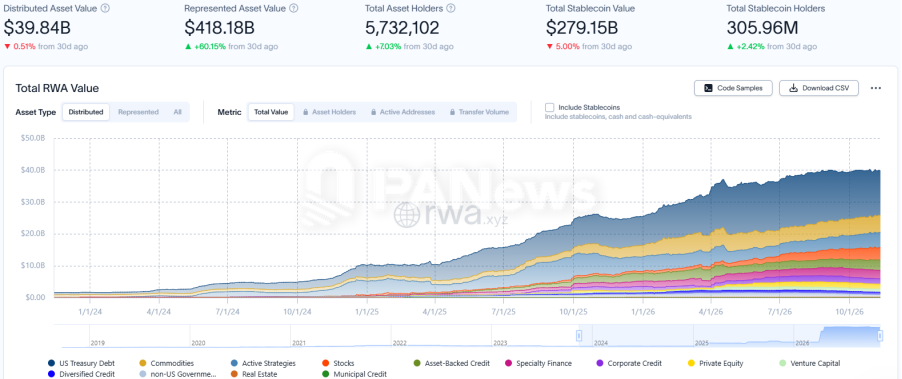
Citing RWA.xyz data as of November 13, the report puts the on-chain RWA market at $39.84 billion, down 0.51% from the same point a month earlier. The number of asset holders rose 7.03% to 5.7321 million over that period. More holders, in other words, did not coincide with a higher total asset value.
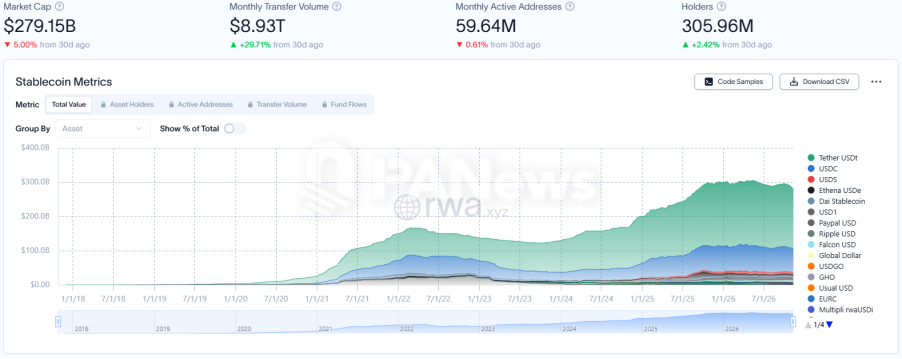
Stablecoin market capitalization stood at $279.15 billion, down 5% from the same point a month earlier. Monthly transfer volume rose 29.71% to $8.93 trillion, while monthly active addresses fell 0.61% to 59.64 million. The reported holder count increased 2.42% to 306 million. Those measures describe different aspects of activity; transfer volume alone does not establish broader adoption.
Tokenized securities: plans at different stages
According to the report, OKX and Intercontinental Exchange’s OKXICE TSV platform was scheduled to launch on November 23 for eligible U.S. users, with more than 70 stock- and ETF-linked assets planned, though not all for the first day. Separately, The Wall Street Journal reported that the New York Stock Exchange had chosen Avalanche for settlement on a proposed round-the-clock tokenized-securities platform. That platform still required regulatory approval, with a fourth-quarter launch targeted.
The report also cites The Wall Street Journal on Payward’s plan to offer tokenized versions of more than 200 British and European stocks through xStocks. These are distinct offerings with different eligibility and implementation details, not evidence that tokenized stocks have become a single, established market.
In institutional products, The Block reported that Deutsche Bank had launched a digital-asset custody service and signed a memorandum with DWS to explore, among other things, a tokenized money-market fund. Securitize and Ethena Labs, also according to The Block, introduced a $100 million liquidity facility intended to let eligible investors exchange BlackRock BUIDL fund interests for supported stablecoins outside traditional market hours. Its reported initial liquidity was $50 million, with a further $50 million available for replenishment within an hour as liquidity is used.
Rules and funding are not the same as adoption
Citing Bloomingbit, PANews says the U.S. Treasury was pursuing a proposal to apply bank-level counterparty due-diligence requirements to stablecoin issuers; its scope and timetable had not been disclosed. New Zealand’s Financial Markets Authority was consulting, not announcing a final decision, on whether qualifying New Zealand dollar-backed payment stablecoins should cease to be treated as financial products. Thailand’s securities regulator likewise proposed daily stablecoin deposit and withdrawal limits of 5 million baht each per customer at regulated operators.
On funding, Bloomberg reported, citing people familiar with the matter, that financial institutions including Goldman Sachs and Citi had committed approximately $270 million to a joint stablecoin project. The report describes a commitment, not a measure of live usage.
The week’s RWA narrative spans market infrastructure, investment products and payment tokens. The reported holder and transfer figures offer activity measures; planned launches, proposed rules and funding commitments still need to be assessed separately from products operating at scale.