As described in a November 11, 2026 account by ross.wei, Tacit Chain is a payment-focused zk-rollup prototype designed to make transactions fast and private. Its proposed use case is an everyday purchase: a merchant needs to see a payment promptly, while the customer should not have to expose their transaction history. The account describes a design and its intended benefits; it does not provide independent evidence of merchant adoption or payment volume.
Why a payment rollup?
The account contrasts Tacit’s approach with two other ways to speed up blockchain payments. Sidechains can provide faster transactions, but their security depends on their operators; it cites Bitcoin’s Liquid network and its federation as an example. State channels, including the Lightning Network, rely on funds locked on-chain and signed updates, but require users to guard against an outdated balance being submitted.

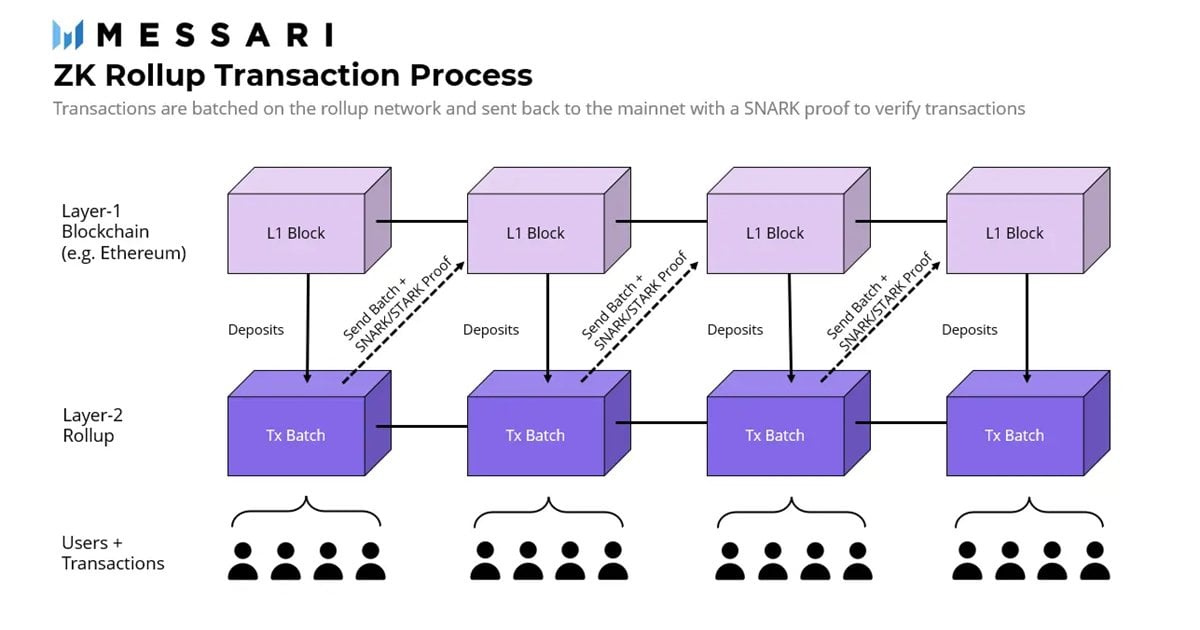
Rollups instead submit transaction batches to a base chain. An optimistic rollup allows time to challenge an invalid batch, which the account says can leave users waiting roughly a week to exit. A zk-rollup submits a validity proof with its batch, avoiding that challenge period. Tacit proposes to use this latter model specifically for payments.

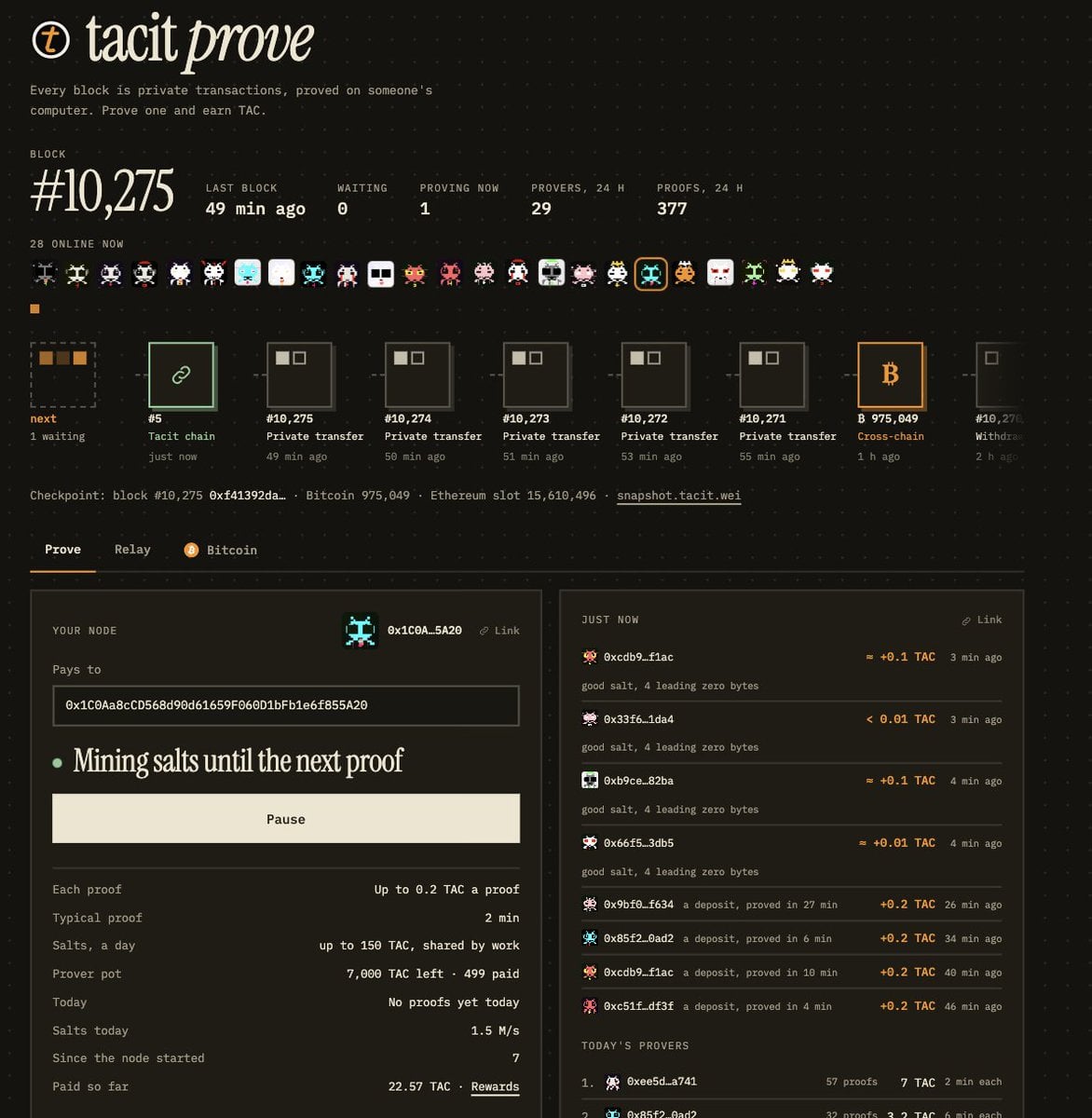
Under the described design, a user’s device proves that a payment is valid without revealing the sender, recipient or amount to the rollup verifier. A second proof checks the processed batch before Ethereum accepts it. A rotating leader orders payments and submits blocks to the TacitBlocks.sol contract. According to the account, holding a 1,000 TAC seat qualifies a participant for a scheduled turn; if the leader does not act, anyone can take over after 10 minutes. GPU-equipped participants can generate proofs for TAC rewards.
The token and exit assumptions
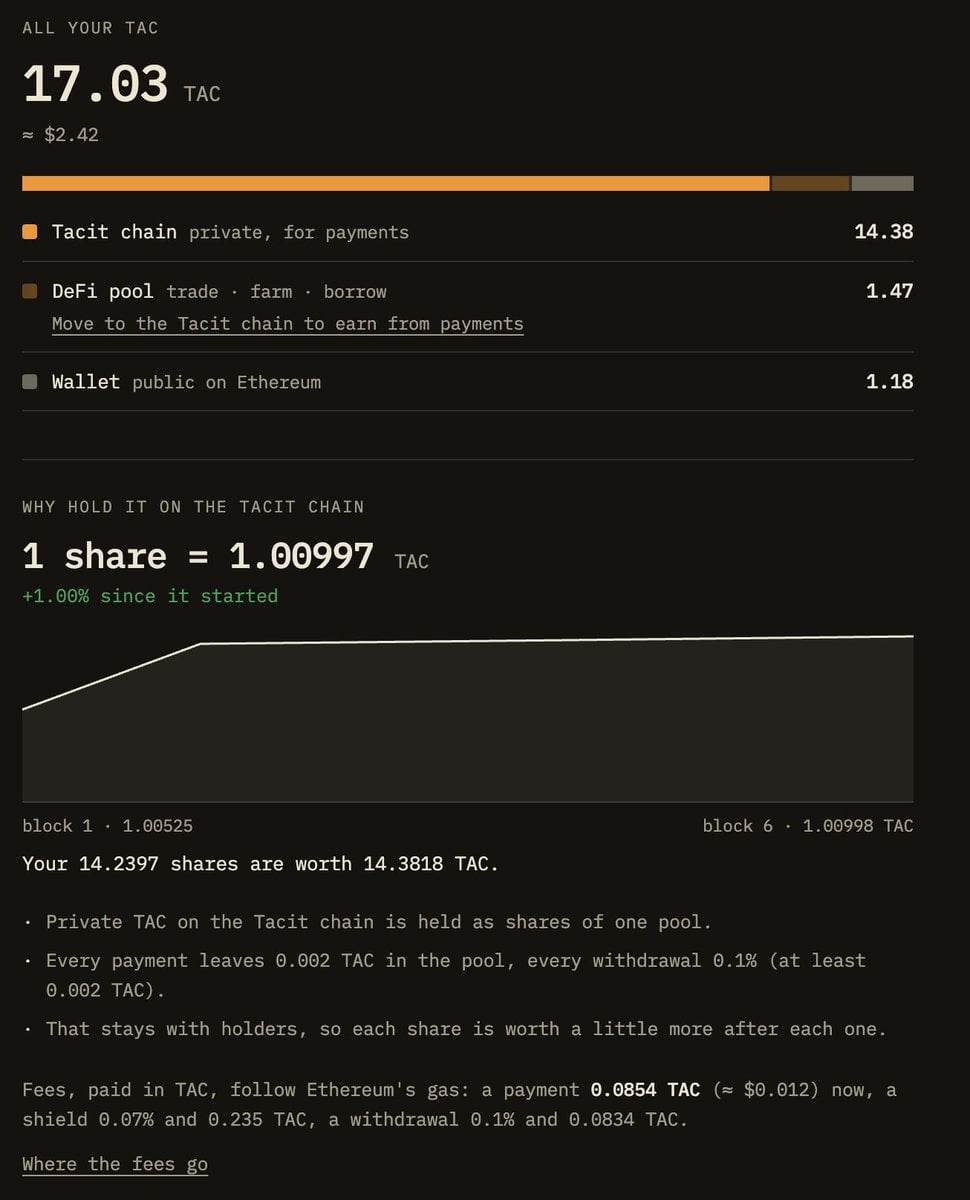
TAC is described as both the rollup’s currency and its fee token. The account says portions of payment and exit fees remain in a shared pool, increasing the value assigned to holders’ “shares.” It also argues that higher usage could spread Ethereum submission costs across more payments. Those are claims about the proposed economics, not evidence that TAC will appreciate or fees will fall in practice.
The account describes entry from Ethereum and bridges connecting to Bitcoin, including a faster Bitcoin route using atomic swaps with liquidity providers. It says users can exit to Ethereum as an ERC-20 form of TAC without an optimistic rollup’s week-long wait. For a forced exit, force() places a request in an Ethereum queue; the described contract rejects a block that skips a request past a one-hour FORCE_DELAY, subject to an additional window. Cross-pool moves and migration depend on a confidential V1 pool, which the account identifies as a separate trust assumption; an ordinary exit to Ethereum does not depend on that pool.
Privacy claims have a defined scope
For encrypted payment memos—the messages that tell recipients what they received—the design uses ML-KEM, a post-quantum standard. The stated aim is to protect memos recorded today from being decrypted by more capable machines later. That specific protection should not be read as a demonstrated guarantee that every part of the system is quantum-resistant.
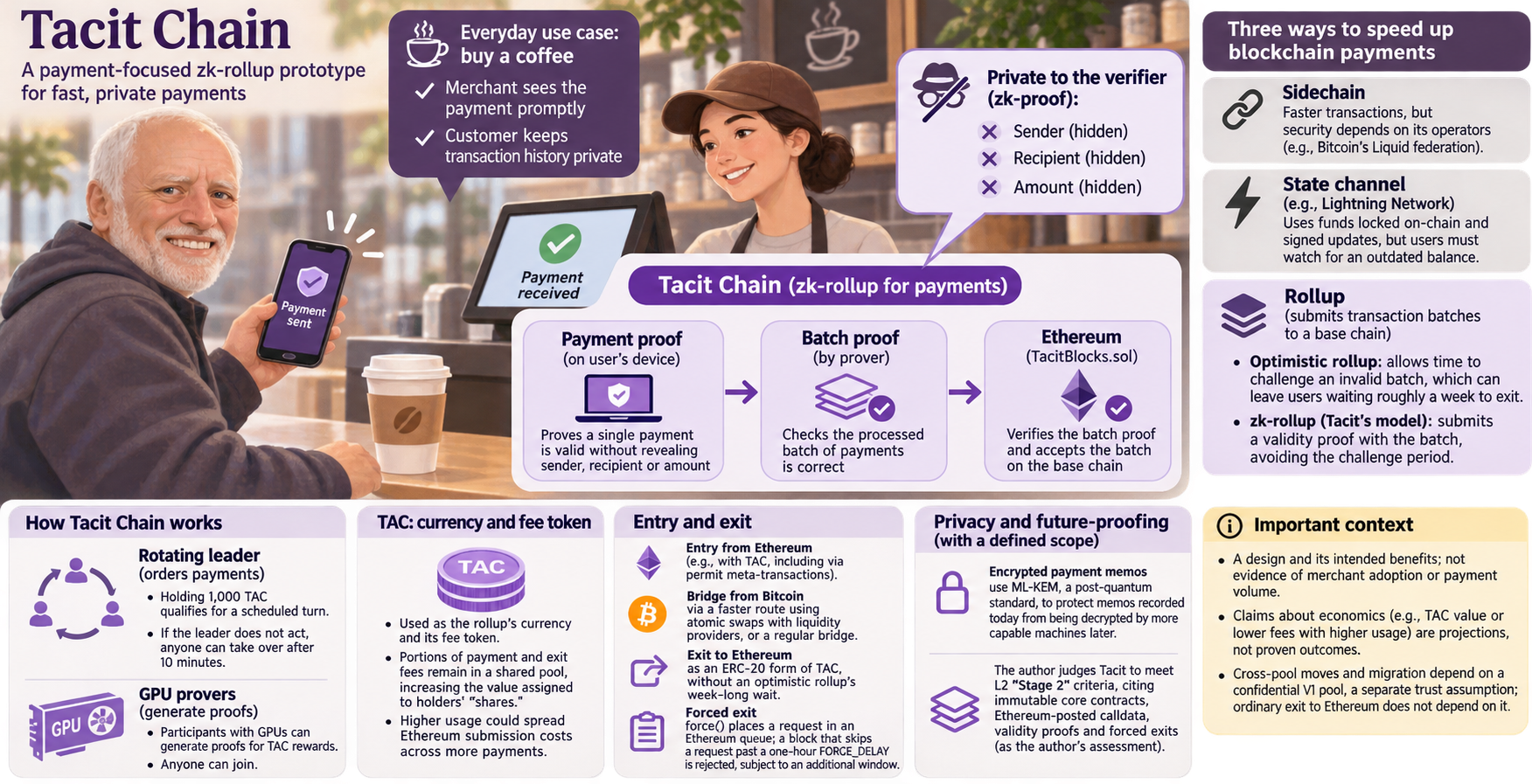
The author also judges Tacit to meet L2 “Stage 2” criteria, citing immutable core contracts, Ethereum-posted calldata, validity proofs and forced exits. That is the author’s assessment, not an independently established classification in the supplied account.
Finally, the account claims a merchant can see a coffee payment when sent, with Ethereum finality in about one minute. It presents roughly 30-second confirmation and costs below one cent as prospective improvements, and describes future programs, internal smart contracts and opt-in migration. The distinction is important: Tacit’s narrative joins private payments, cross-chain access and future-proofing, but the account supplies no measured adoption data with which to test it.