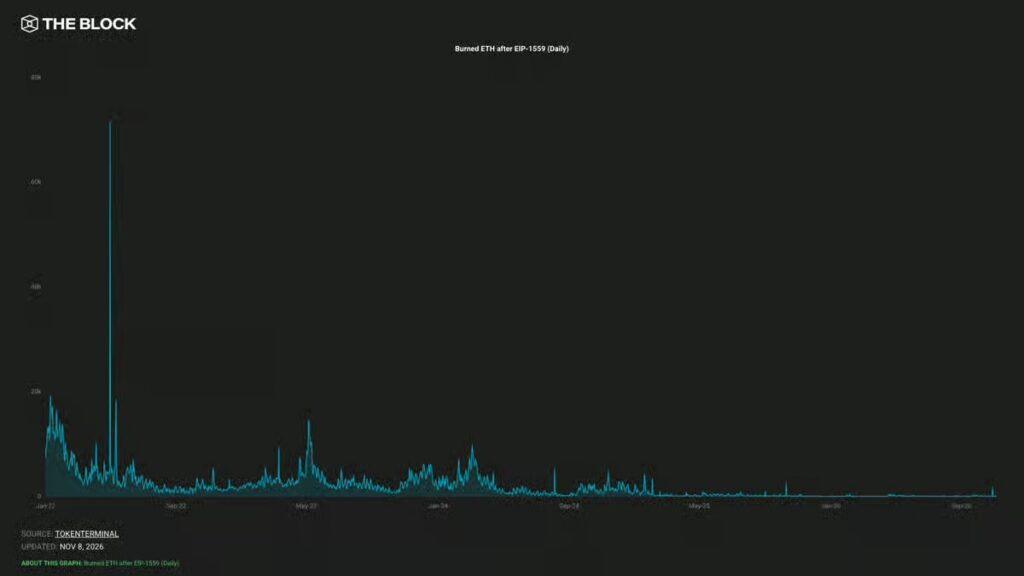
In a report published on November 9, 2026, Vitalik Buterin argued that ETH makes more sense as a store of value than as a token valued primarily by the transaction fees Ethereum burns. The distinction matters for the “ultrasound money” narrative, which gained traction during the 2021 bull market: Buterin supports keeping fee burns, but disputes using them as ETH’s valuation foundation.
Why a burn-based valuation can fail
Ethereum’s EIP-1559 mechanism, introduced in 2021, burns part of transaction fees. Buterin said it works well and should remain in place even if burns offset only some new ETH issuance. In his view, a burn rate that stays below 10% of the break-even level would not mean ETH lacks value.
He described a common valuation model in which a token’s market capitalization equals its annual burn value divided by a discount rate. Burning $1 billion a year at a 4% discount rate would imply a theoretical $25 billion valuation floor. But, he argued, that floor is unreliable when the activity generating fees depends on crypto-market demand that can contract alongside ETH’s price.
As an example, he pointed to the Otherside sale by Bored Ape Yacht Club developer Yuga Labs. Demand for Otherdeed NFTs drove roughly $180 million in fees burned in one day; some buyers paid more than $10,000 in fees. The report put the NFT’s market price at approximately $150 at the time of publication. According to The Block data cited in the report, Ethereum burned about 1.48 million ETH, worth roughly $3.6 billion, during 2022. By the November 2026 report, the year’s burn totaled about 19,200 ETH, worth $43 million.
Buterin said a burn-based valuation floor would require fee-generating demand from outside the crypto economy. He sees growing real-world asset tokenization as a stronger basis for that demand, while cautioning that steadier, established activity is unlikely to reproduce past fee spikes. That is a case for potential use, not evidence that tokenization has already restored earlier burn levels.

What he would measure instead
Buterin argued that Ethereum’s decentralization and continuing work on censorship resistance, privacy and security underpin its value. For someone treating ETH as a store of value, he said, the foremost test is whether the network can endure. He linked that goal to work on post-quantum security, multisignature wallets, the Kohaku privacy project, the FOCIL censorship-resistance proposal and light nodes. He also suggested that assets issued on Ethereum, including tokenized real-world assets, could broaden ETH’s uses as collateral.
Prioritizing burns, he argued, could instead create pressure for more interventionist governance and higher gas fees—potentially excluding users who most need privacy and security. He also questioned a corporate-style model for sustaining ETH’s value through fees. Against an ETH market capitalization of about $270 billion, he offered a hypothetical comparison with corporate research spending: funding Ethereum at a similar scale through protocol grants, he said, would require around 700,000 ETH annually and cut validators’ rewards by two-thirds. That was his illustration of a trade-off, not an enacted funding plan.
The debate also reached staking policy. Five weeks before Buterin’s post, the co-authors of the disputed EIP-8363 proposal withdrew it from consideration for the planned Hegota upgrade, which the report said would follow the delayed Glamsterdam hard fork. The proposal would have increased the share of validator rewards burned as ETH staking grew; it was not adopted. Its proponents argued that excessive staking could threaten ETH’s monetary role, while SharpLink CEO Joseph Chalom and Aave founder Stani Kulechov opposed it.
The resulting distinction is narrower than a rejection of EIP-1559: fees can be burned without making a burst of speculative activity the measure of Ethereum’s long-term value.