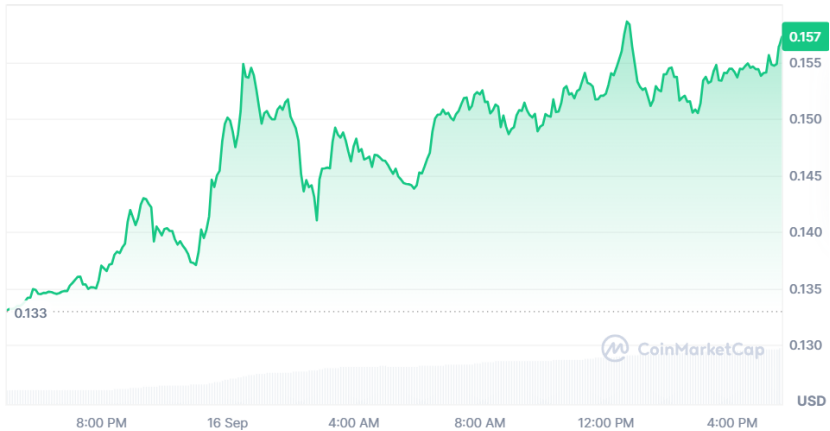
Originally reported by PANews on September 16, 2026, at 18:55 (UTC+8). Its account said ARB had risen more than 15% over the preceding 24 hours after Standard Chartered published its first research report on Arbitrum, despite a broader market decline that PANews linked to a setback for the CLARITY Act.
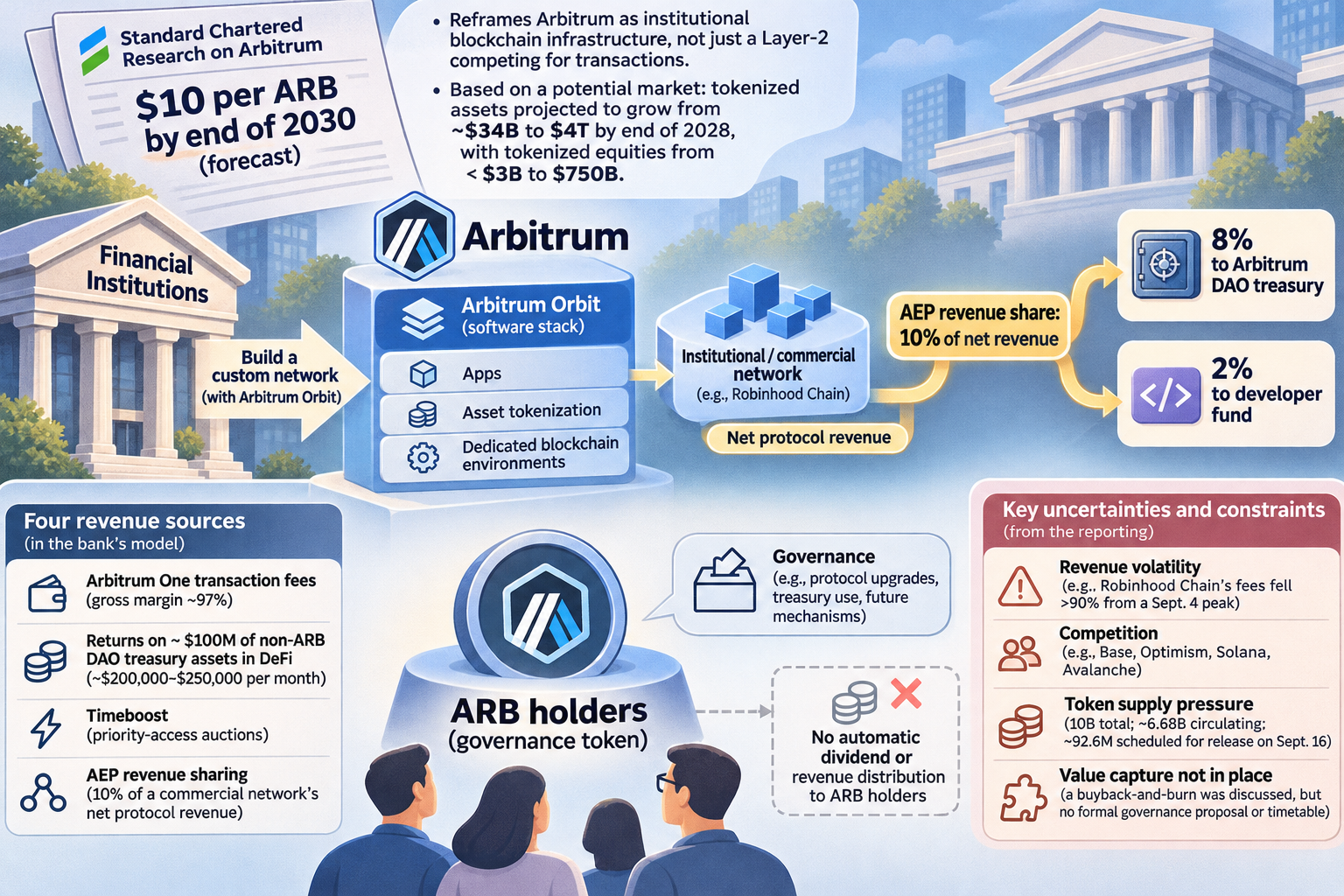
Standard Chartered’s headline forecast was $10 per ARB by the end of 2030, versus a price of about $0.15 at the time of reporting—nearly 70 times higher. The case behind that target is a change in how to view Arbitrum: not simply as a layer-2 network competing for transactions, but as technology that financial institutions could use to build their own blockchain networks. That is a forecast about a potential market, not evidence that the forecast will be realized.
The institutional-infrastructure thesis
According to PANews, Standard Chartered projected that tokenized assets would grow from roughly $34 billion to $4 trillion by the end of 2028. Within that projection, tokenized equities would rise from less than $3 billion to $750 billion. Arbitrum has also described infrastructure for applications, asset tokenization and dedicated blockchain environments as part of its focus.
The bank’s valuation argument depends partly on institutions adopting that infrastructure. PANews reported that Standard Chartered put ARB’s price-to-fees ratio at about 1.3 and said valuation multiples for major layer-1 networks such as Ethereum and Solana could be as much as 25 times higher. A higher multiple for Arbitrum remains a possibility in the bank’s thesis, not an established outcome. Base, Optimism, Solana and Avalanche are among the networks competing for institutional and tokenization use cases.
Where the proposed revenue growth comes from
PANews described four revenue sources in the bank’s model: Arbitrum One transaction fees, with a reported gross margin of about 97%; returns on roughly $100 million of non-ARB DAO treasury assets deployed in DeFi, reported at $200,000–$250,000 per month; Timeboost priority-access auctions; and revenue sharing under the Arbitrum Expansion Program (AEP).
Under the AEP arrangement described by PANews, a commercial network built with Arbitrum Orbit that settles outside Arbitrum’s mainnet pays 10% of its net protocol revenue to the ecosystem: eight percentage points to the DAO treasury and two to a developer fund. This is the mechanism that could let Arbitrum benefit from activity on networks built with its software, rather than only from fees on Arbitrum One.
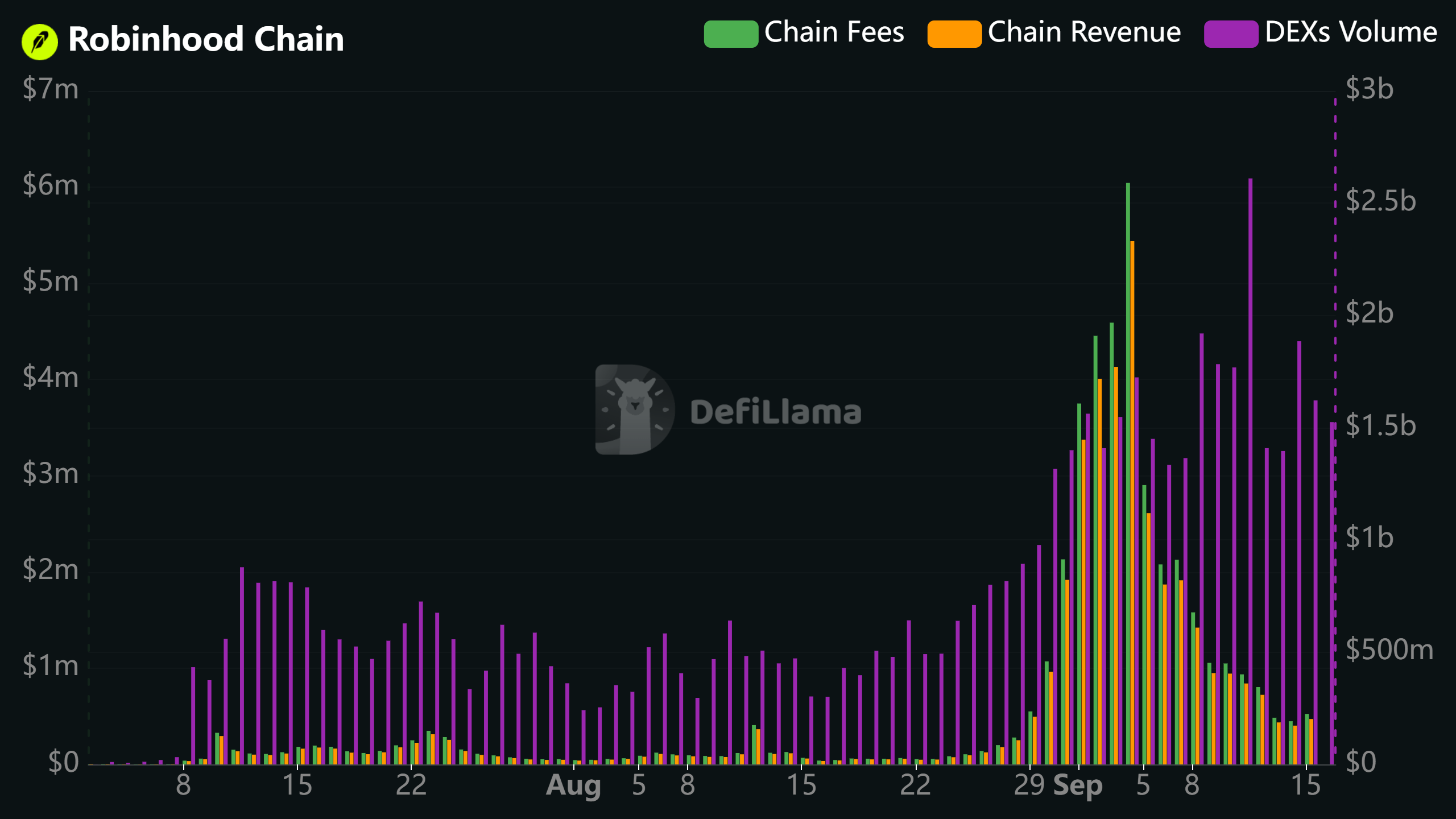
Standard Chartered treated Robinhood Chain as an example. PANews reported that its AEP payments accounted for 35% of Arbitrum DAO revenue in the chain’s first month. Using an estimated $2.8 million in average daily Robinhood Chain fee revenue during the first two weeks of September, the bank projected roughly $5 million in Arbitrum AEP revenue for the month—more than five times the level before the chain’s launch.
PANews challenged that extrapolation. It reported that Robinhood Chain’s daily fees fell more than 90% from a September 4 peak of $6.04 million to around $500,000 by mid-September, with a trailing seven-day average below $1 million. PANews attributed much of the earlier fee spike to meme-coin trading and higher gas costs during congestion; it said DEX volume had not fallen in the same proportion as fees. On that reading, the bank’s monthly AEP estimate risked overstating recurring revenue.
Network revenue is not a payout to ARB holders
The distinction between Arbitrum’s business prospects and ARB’s token economics is central to the forecast. PANews noted that ARB is a governance token: transaction fees and AEP payments go to a DAO-controlled treasury, and holders have no right to a distribution or cash dividend. A possible future buyback-and-burn mechanism was discussed in the research, but PANews said there was no formal governance proposal or timetable for one. Standard Chartered also identified the absence of a value-capture mechanism as a risk.
Supply presented another constraint in the September 16 reporting. Of ARB’s 10 billion total tokens, about 6.68 billion were circulating. PANews said a further approximately 92.6 million ARB, worth around $14 million at the time, was scheduled for release on September 16. It also reported that ARB was down nearly 90% from its historical high and almost 70% over the preceding year.
The institutional-blockchain narrative therefore has two separate tests: whether adoption produces durable revenue for the Arbitrum ecosystem, and whether any of that value reaches ARB holders. Standard Chartered’s $10 target assumes a substantial revaluation; the revenue volatility, competing networks, token supply and missing holder-level value capture described by PANews show why that revaluation was uncertain.
Source: panewslab.com (originally published 2026-09-16 18:55 UTC+8)