
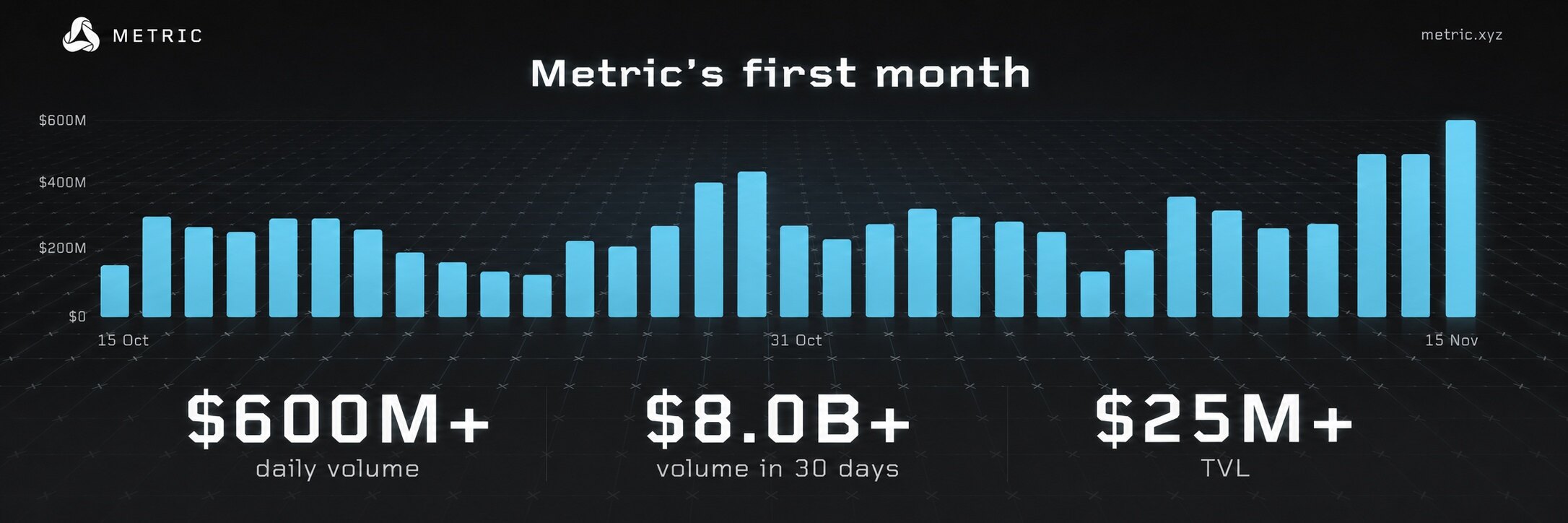
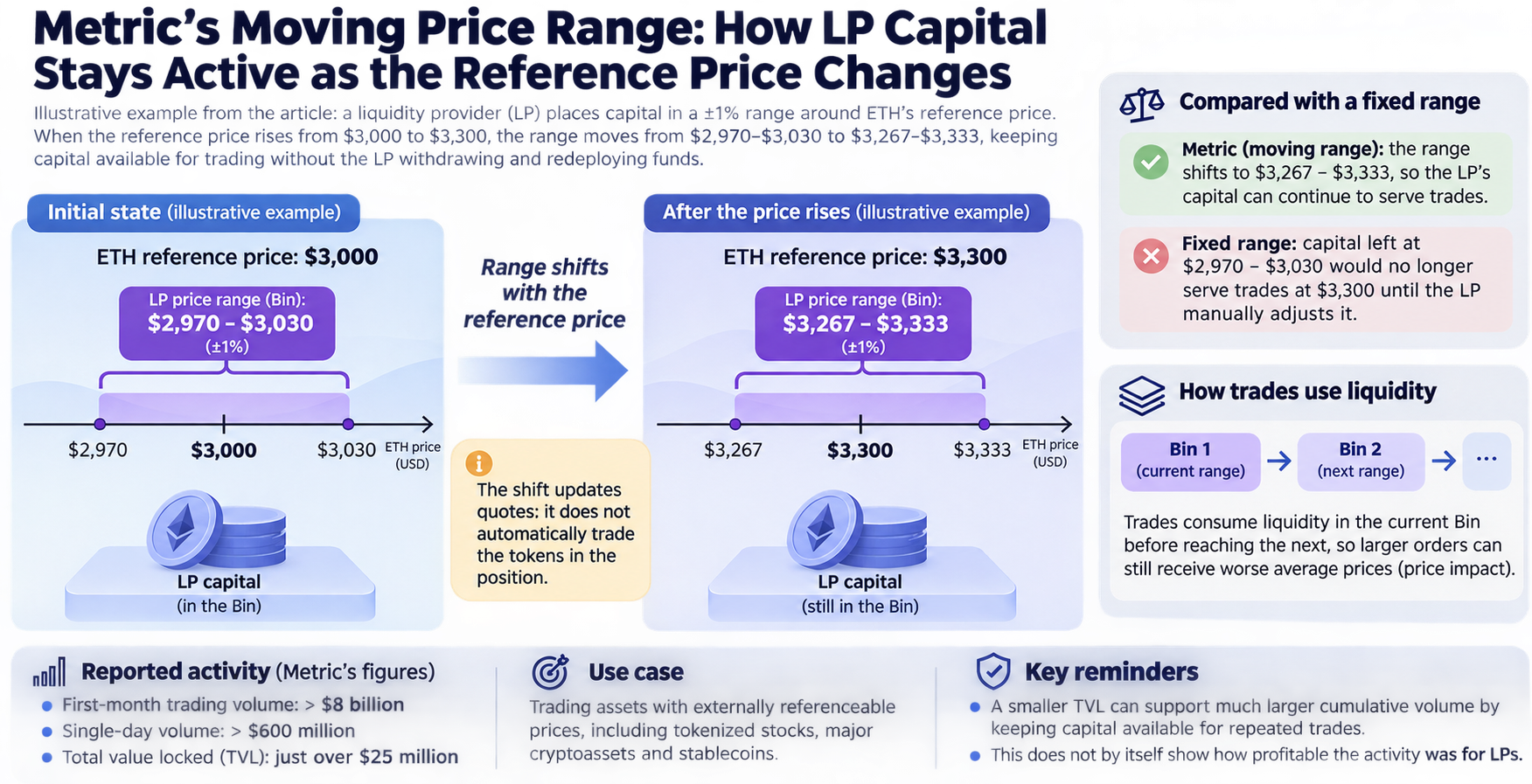
As reported on November 17, 2026, decentralized spot exchange Metric was drawing attention for a striking gap between trading volume and locked capital. Metric said on November 15 that volume in its first month after launch exceeded $8 billion, with more than $600 million traded in a single day, while total value locked was just over $25 million. Those are the project’s reported figures, not a measure of liquidity-provider profit.
Metric’s proposed use case is trading assets with prices that can be referenced outside its pools, including tokenized stocks, major cryptoassets and stablecoins. A tokenized stock illustrates the problem it aims to address: if its on-chain pool keeps quoting an old price after the underlying share price rises, arbitrageurs may buy the underpriced token at liquidity providers’ expense.
How the pools move
Metric separates pricing from liquidity placement. Its Active Pools can use price providers drawing on oracles, on-chain data or custom strategies; its public code includes integrations for Chainlink and Pyth data. Liquidity providers place capital in price ranges called Bins, which move with the reference price. Metric supports private pools run with a market maker’s own capital and public pools that accept outside liquidity.
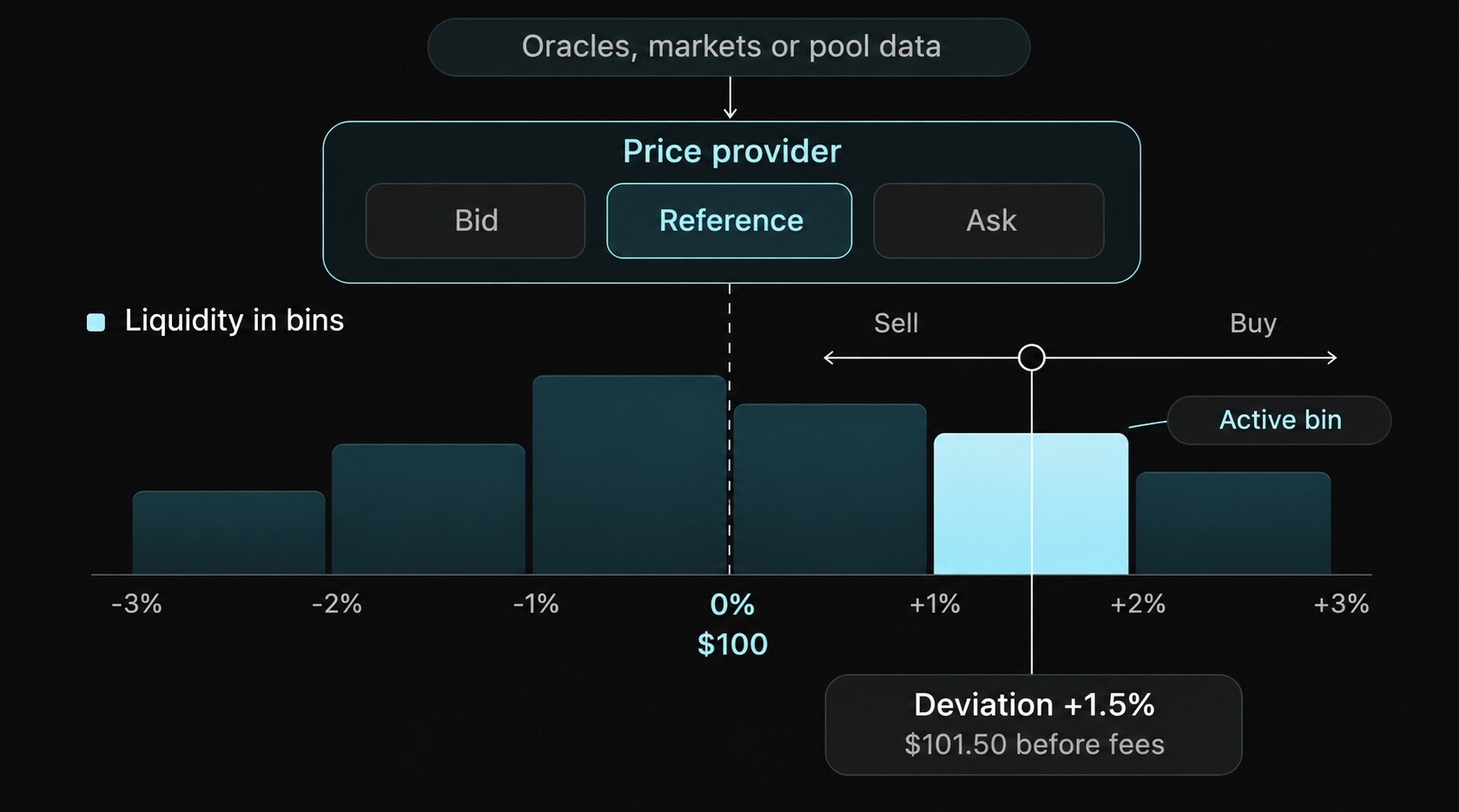
For example, a range set 1% above and below a $3,000 ETH reference price spans $2,970–$3,030. If the reference price reaches $3,300, that range shifts to $3,267–$3,333 without the provider withdrawing and redeploying funds. The shift updates quotes; it does not automatically trade the tokens in the position. By contrast, capital left in a fixed $2,970–$3,030 range would cease to serve trades at the higher price until its provider adjusted it. Keeping capital available for repeated trades is one way a relatively small TVL could support much larger cumulative volume, though Metric’s volume figures alone do not establish how profitable that activity was.
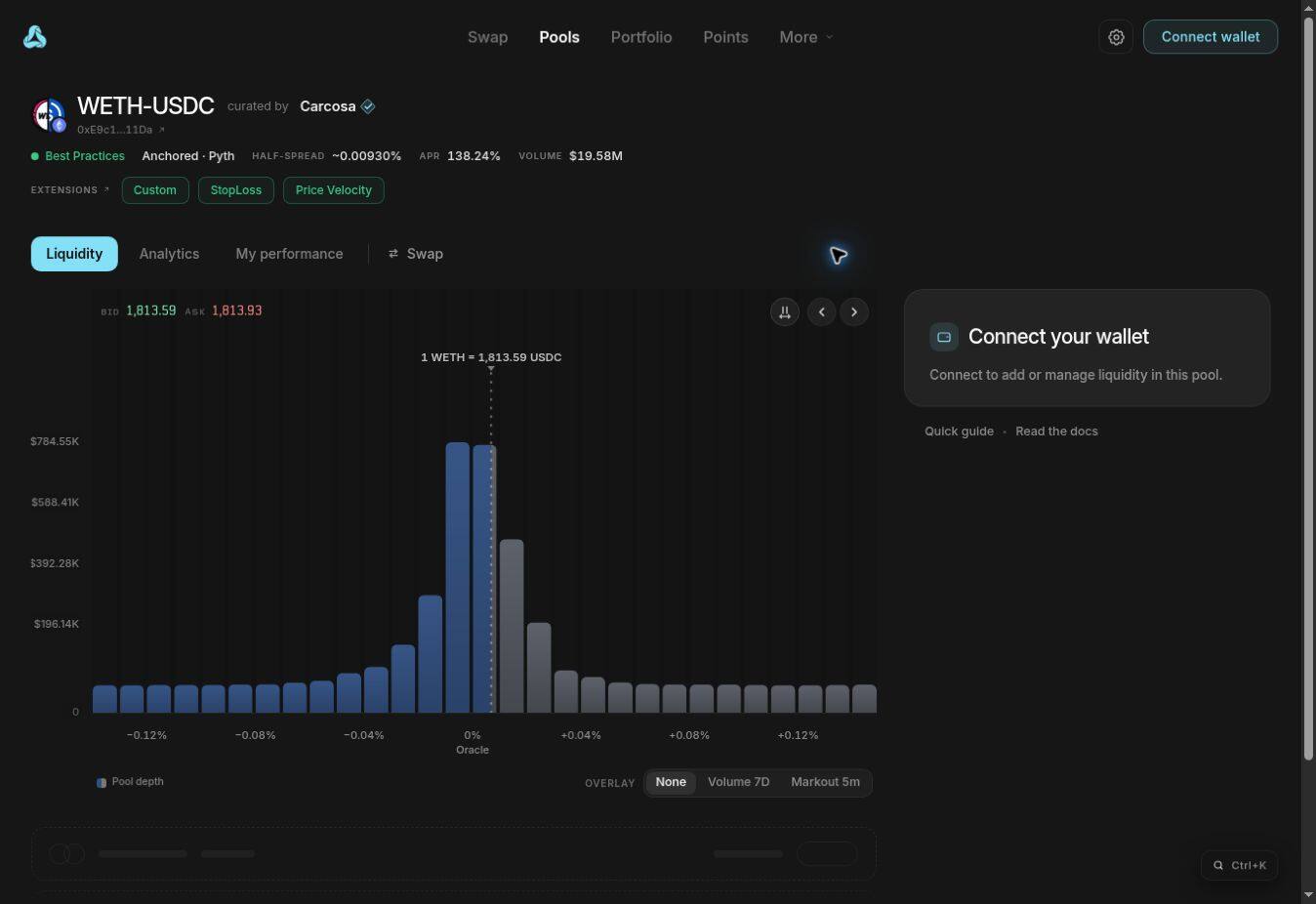
Trades consume liquidity in the current Bin before reaching the next, so larger orders can still receive worse average prices. Trading also changes the assets a provider holds. Fees or trading spreads may be offset by falling asset prices or losses when quotes lag the market. Metric’s Markout APR compares execution prices with reference prices after a trade to help assess whether fills benefited a pool; it can be negative and is not a substitute for the return on the entire position.
Metric CTO Christos Gkolias previously spent three and a half years at Uniswap Labs as an engineering director and also worked at Google. The project’s design targets a specific market-making constraint, rather than proving that every asset with an external price will attract durable liquidity.
Points are not returns
Metric announced a points program on November 13, allocating one million points per week among participants who trade, provide liquidity, manage pools or invite users. It said activity dating back to October 15 would count, including the preceding four weeks. Weekly accounting ends Wednesdays at 8 p.m. Beijing time, with points distributed automatically on Thursdays.
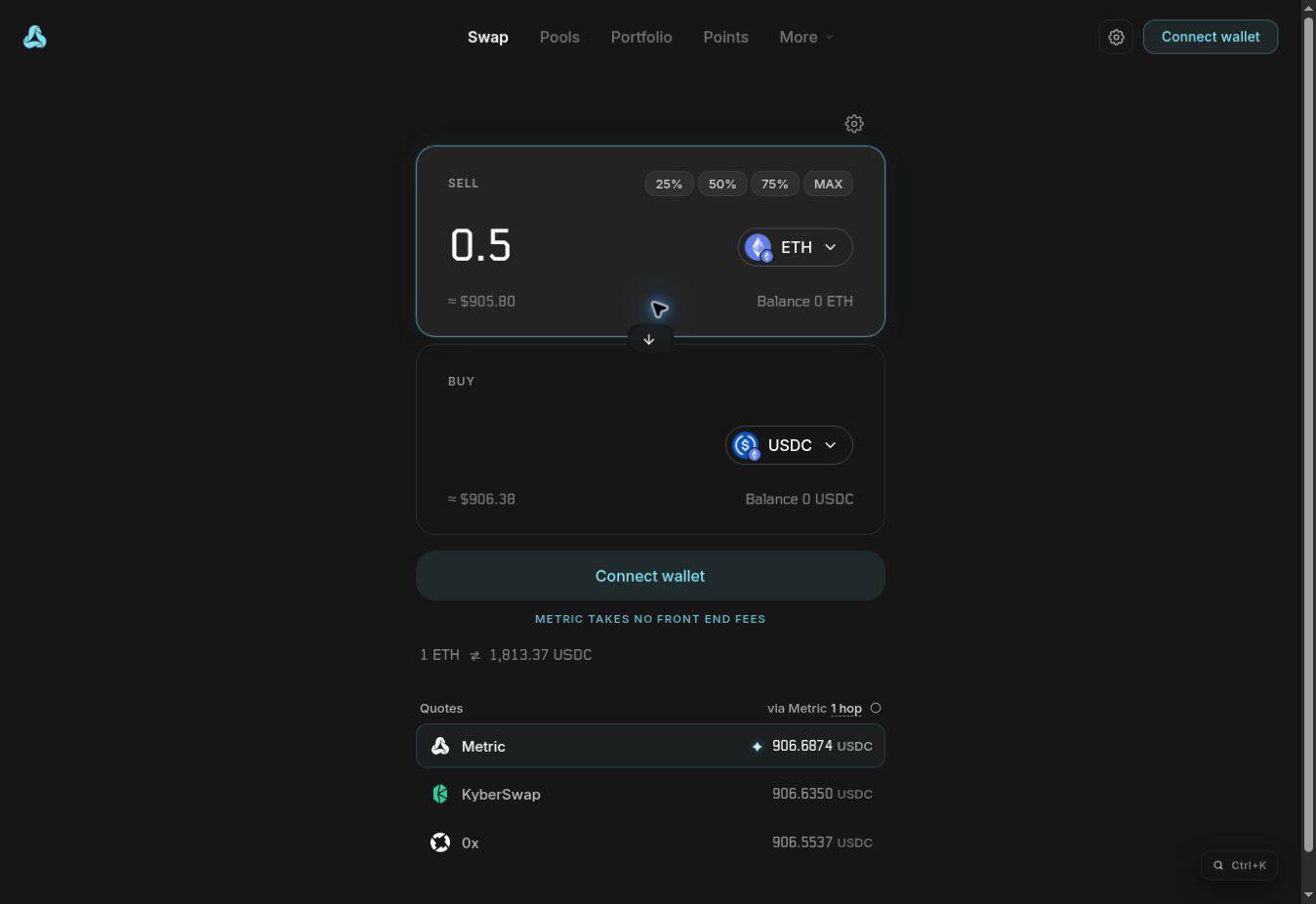
The program distinguishes activity routed through Metric pools from swaps that merely start on its interface: only a Metric route marked as eligible earns trading points. Pool pages display details such as the manager, pricing source, APR, volume and Markout performance. Neither a displayed APR nor a points award establishes a provider’s eventual profit. The reported trading figures show activity; the more consequential test for this narrative is whether liquidity providers can sustain useful quotes without losses consuming their earnings.