On November 11, 2026, imToken published an account on PANews of a shift inside Ethereum: after years in which independent rollups were treated as the default home for apps, assets, and users, several protocols were redeploying core activity on Ethereum L1, and some standalone L2s were winding down. The piece frames that shift as a rebalancing of the rollup-centric roadmap, not as the end of L2s. Original article: PANews.
The story being told
The narrative that dominated the peak rollup years was simple. Mainnet gas was expensive, so applications, assets, and users should move to separate L2s. That story also carried an anxiety: L2s might drain value from L1, and Ethereum might lose global composability.
By the reporting date, the same operators were telling a different story. Running a full independent L2 had stopped looking like the best default once mainnet execution got cheaper. The proposed use case was no longer “leave L1 for scale.” It was “keep assets and critical state where liquidity and settlement already sit, and outsource only the computation that does not need to live there.”
That is a category distinction, not a claim that every L2 token or chain is equivalent. A general-purpose rollup, a consumer chain, an app-specific execution environment, and a hybrid perps venue do not face the same cost, liquidity, or control problem.
Who moved, and what they said they were optimizing for
The clearest named case is ENS. In 2024, ENS Labs had planned Namechain, a dedicated ZK rollup for ENSv2, to cut the cost of name registration and management. In February 2026, ENS co-founder Nick Johnson said development of Namechain would stop and ENSv2 would deploy directly on Ethereum mainnet. The stated reason was that L1 scaling had outrun expectations from two years earlier.
ENS Labs’ figures, as reported: after the gas limit rose, average gas cost for an ENS registration fell about 99% over the prior year, from nearly $5 to under $0.05. An independent L2 still required nodes and infrastructure, plus cross-chain resolution, bridging, security audits, and ongoing operations. If the product already worked cheaply on mainnet, a separate rollup added architecture rather than removing cost.
Synthetix had been an active L2 advocate. In June 2025 it published “L2s are Dead, Long Live Ethereum,” arguing that the earlier L2 scaling path had produced liquidity fragmentation and unstable infrastructure for applications. In December 2025 its next perpetuals exchange went live on Ethereum mainnet.
Later 2026 moves, as reported, were narrower and more operational:
- Trueo said in September it would move its main deployment from Base back to Ethereum L1, citing stronger integration, network effects, and neutrality for prediction markets and outcome oracles.
- On October 1, ShapeShift moved the rFOX staking program from Arbitrum to mainnet because most FOX was already held on L1, so an extra bridge was unnecessary.
- In August, Superseed stopped its existing L2 and planned to put core products on mainnet. The stated design change was to stop relying on an independent chain’s gas revenue to support loan repayment, and to pursue the same product goal through application-layer yield.
- In October, Nillion launched Blacklight L1, moved node operation that had run on Nillion L2 onto Ethereum mainnet, and planned to phase out the old L2.
These are individual infrastructure choices. They are not evidence that every protocol is leaving every L2, and they do not by themselves show capital rotating across a sector.
When an L2’s books do not close
Operating pressure on some independent L2s was reported in the same window. On October 2, Blast, which had previously held more than $2 billion in TVL, said it would wind down. The stated reason was that network maintenance already cost more than L2 revenue, with no reliable path to economic sustainability.
Abstract said it planned to shut the network on December 15. The report notes more than 144 connected applications and more than 400,000 users, and still lists insufficient liquidity, a limited DeFi ecosystem, and a lack of institutional participation as the reasons a consumer chain could not be run sustainably.
The article’s inference is narrow: owning a chain is not the same as owning a durable business. With Ethereum lowering the cost of posting L2 data and raising mainnet performance, low gas plus token incentives were described as a weaker long-term draw. That is an argument about reported cost and revenue, not a measured ranking of every rollup’s adoption.
State on L1, compute elsewhere
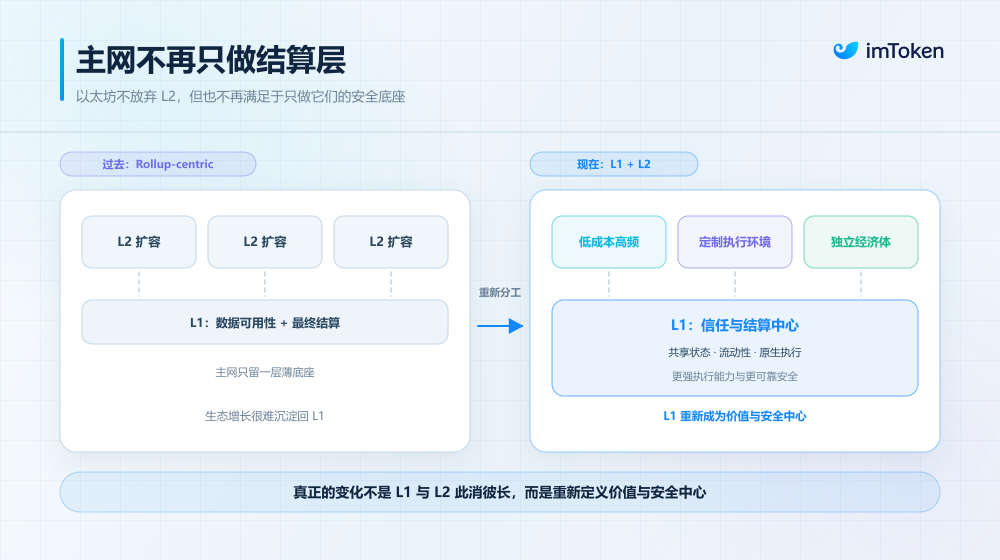
The original rollup-centric split was clear: L1 for security, data availability, and final settlement; L2 for scale and cheap execution. That split was presented as nearly the only workable answer when mainnet gas often ran to tens of dollars.
As of November 2026, ETHBEAT (formerly L2BEAT) had catalogued dozens of L2s of different types. Only a single-digit count had reached Stage 2, and those Stage 2 systems held assets the article describes as almost negligible. Base, Arbitrum One, and OP Mainnet remained at Stage 1. The report treats the slow walk to Stage 2, set against faster L1 scaling, as the backdrop for a line attributed to Vitalik Buterin: as mainnet scaling accelerated, the original vision of L2s and their role in Ethereum no longer held.
Some L2s, the piece says, may stay at Stage 1 on purpose because of regulation, business model, or customer control. Retaining upgrade and management rights can be a product choice for institutional apps that must meet specific rules. The boundary drawn is different: if a few entities keep critical upgrade rights and the power to adjudicate state for a long time, that chain should not be treated as a fully decentralized shard of Ethereum mainnet.
The architectural compromise described is consistent across the examples: leave assets and critical state on L1; send high-frequency or complex computation off-chain or into another execution environment.
Synthetix’s new perpetuals venue is the concrete case. User assets stay in Ethereum L1 contracts. Matching runs on an off-chain central limit order book. Results are written back to mainnet in batches. Users are not asked to bridge large balances onto another chain in order to get speed, and matching is meant to feel closer to a centralized exchange.
The same passage does not call this trustless. Part of margin management still depends on the off-chain order book, and that matching system still has to be examined. What remains on mainnet is custody and final withdrawal, so users are not placing the safety of all funds on one L2 sequencer and bridge. The claim is about which steps need on-chain rules, not about moving every calculation on-chain.
Further out, the article points to research rather than shipped guarantees. Native rollups, as Vitalik has pushed them, would use Ethereum’s native ZK-EVM verification so mainnet can check a rollup’s EVM execution directly, lean less on external security councils, and make more trustworthy interop and synchronous composability possible across rollups. The Ethereum Economic Zone and related designs are described as attempts at tighter synchronous interaction between rollups and mainnet. Both were still in research and validation stages at the time of writing. The shared direction given is that users should not have to accept split assets, liquidity, and trust systems merely because execution environments differ.
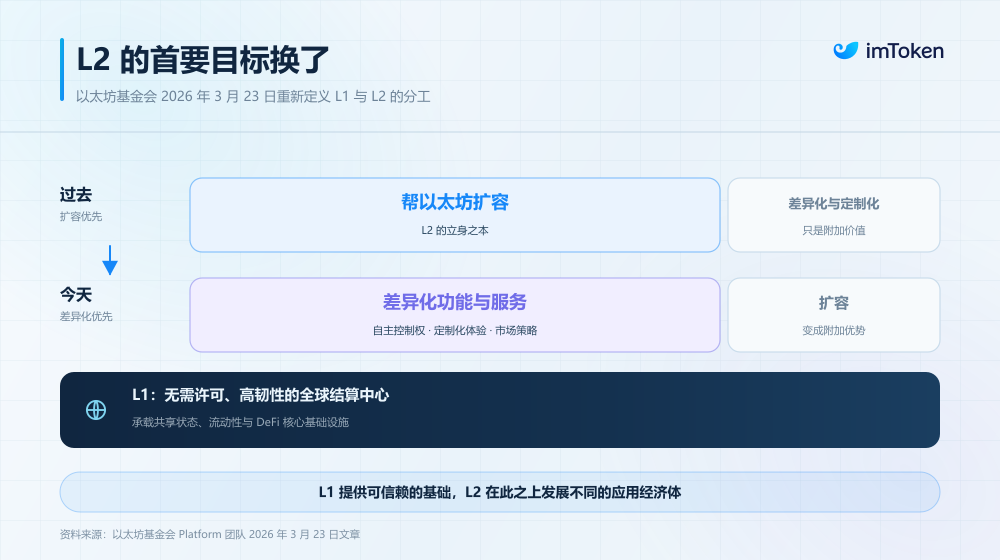
L2s are not written off. The piece still assigns them a role in high-frequency trading, games, privacy computation, and applications that need their own execution environment. What it says should change is the idea that scaling is an L2’s only core job.
If both layers are cheap, fee burn is a weak sole story for ETH
The value question in the source is separate from the migration list. For several years, a common market reading of ETH leaned on EIP-1559: the base fee is burned, the priority fee goes to validators, and tight blockspace can raise the base fee and therefore the burn. “Ultrasound money” treated sustained growth as a path to burn that could offset or exceed new issuance, producing net deflation.
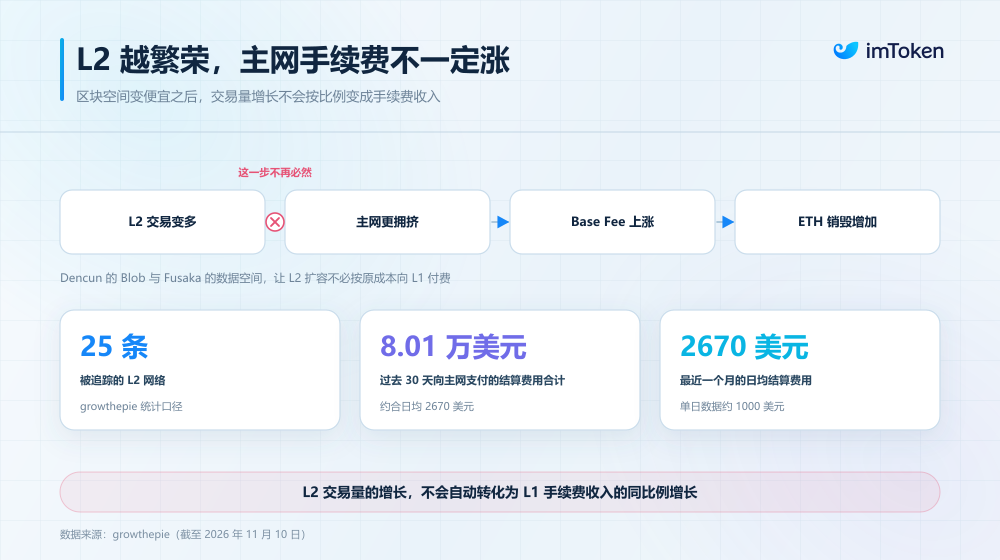
The reported problem is mechanical. Upgrades including Dencun and Fusaka cut the cost of L2 data posted to mainnet, while the gas limit on L1 itself kept rising. Per-transaction cost and fee revenue can fall even if ecosystem transaction volume grows. Burn need not rise in step with activity. Propping up a valuation by keeping gas high would, in this telling, push cost onto ordinary users and real applications and weaken long-term competitiveness.
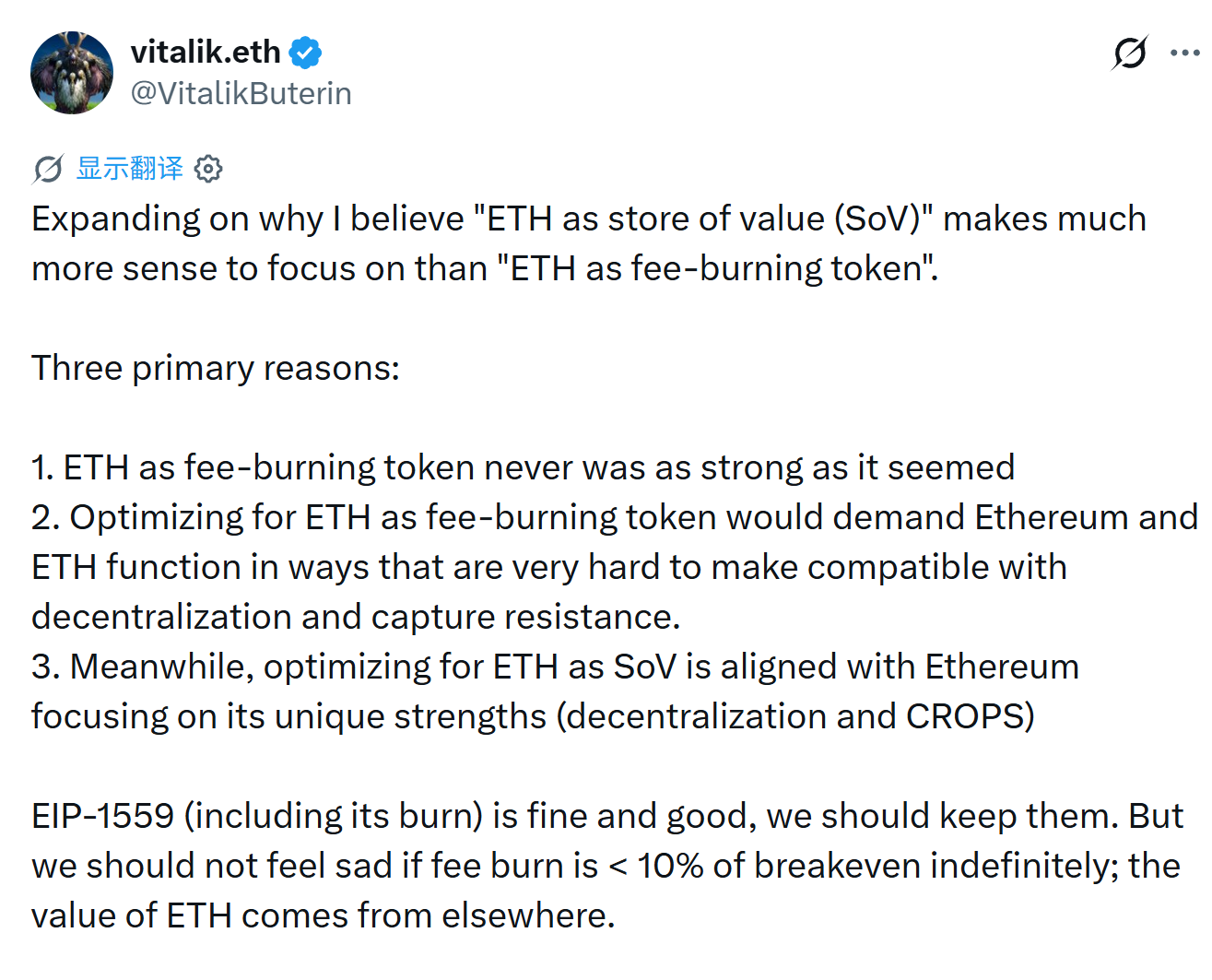
Vitalik’s position, as summarized, is that ETH as a store of value deserves more long-term emphasis than ETH as an asset whose value comes mainly from fee burn. He is not described as rejecting EIP-1559 or calling for the burn to be removed. The mechanism should stay. Even if burn offsets less than 10% of breakeven issuance for a long time, holders should not treat that as a disappointment, because burn is not the only source of value.
Three reasons are given:
- The largest historical burns were heavily internal speculation. Yuga Labs’ Otherdeed NFT mint in 2022 produced about $180 million in fee burn in a single day. That is not framed as outside demand. If the broader crypto market contracts and speculative capacity falls, those transactions and fees can disappear with it. Past burn totals are therefore a poor floor for long-term valuation.
- Supporting a market capitalization in the hundreds of billions mainly through high fee revenue could push Ethereum toward the behavior of a large commercial firm: more R&D spend, product pivots, and active governance intervention. That sits awkwardly with decentralization and resistance to capture.
- Holding gas high in order to burn more ETH can shut out the ordinary users who most need privacy, security, and open financial services.
The alternative base offered is what the article calls Ethereum’s distinctive position: decentralization, plus the properties Vitalik groups as CROPS — censorship and capture resistance, open source, privacy, and security. Those are tied to stability: the network keeps running as conditions outside it change. In a period of faster AI development and shifting traditional finance and digital infrastructure, a neutral system that is hard for outside forces to control is presented as more important than a high fee take in any one phase.
The piece then maps L1 strengthening onto three supports for ETH, still as argument rather than as measured flows:
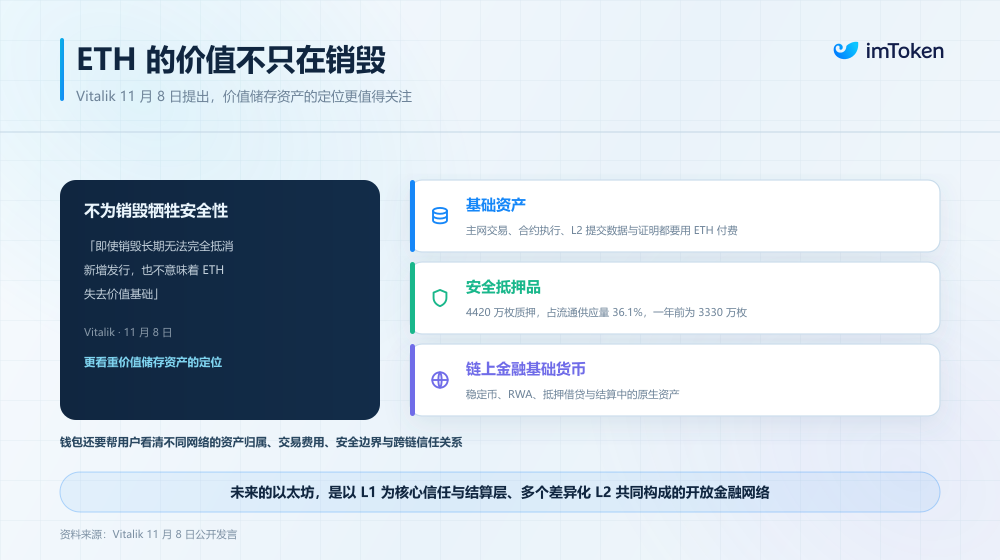
- Core state and settlement as the network effect that is hard to copy. Execution can be commoditized and execution environments replicated; a shared settlement layer that already holds large assets, mature financial protocols, and deep liquidity cannot be rebuilt quickly. ETH as gas asset, native collateral, and settlement asset could be reinforced if core financial activity gathers there again.
- Mainnet scaling so that value does not depend on an expensive single transaction. The technical tension named is higher throughput without an uncontrolled rise in node hardware requirements. If that work matures, the network can move from a low-frequency, high-price settlement chain toward higher throughput and lower cost.
- Staking and economic security as a broader base of demand: ETH as the native resource the network needs to run, as PoS collateral, and as collateral and liquidity inside DeFi. That stack is described as more complete than fee burn alone.
What the 2026 evidence does and does not show
Read as a narrative, the 2026 reporting is an attempt to relocate the center of gravity after a multi-year scaling experiment. L2s remain part of how Ethereum reaches more use cases, more execution styles, and more users. L1 is not left as a pure data-availability and final-settlement floor. The Lean Ethereum line cited in the piece is to subtract redundancy and friction and put security, censorship resistance, and state consensus back at the center of the protocol.
The facts underneath that story are a set of named decisions, a small number of shutdown rationales, ETHBEAT stage counts as of November 2026, ENS Labs’ gas-cost figures, one historical mint-day burn, and a stated view from Vitalik on fee burn versus store of value. They show operators recalculating the cost of a separate chain against a cheaper mainnet. They do not show that attention, funding, and measurable usage have all moved together, or that every rollup faces the same constraint. Fee revenue, TVL, user counts, and long-term ETH demand remain different quantities. None of the reported moves is a forecast of returns.
Source: panewslab.com (originally published 2026-11-11 21:36 UTC+8)