Originally reported on November 13, 2026, by xparadigms of Four Pillars, in a translation published by TechFlow.
“On-chain real estate” can mean owning a share of a building, holding a claim on mortgage payments, recording a property transfer, or trading exposure to a house-price index. Those products share a label, but not the same rights or risks. The distinction matters more than the size of the property market itself.
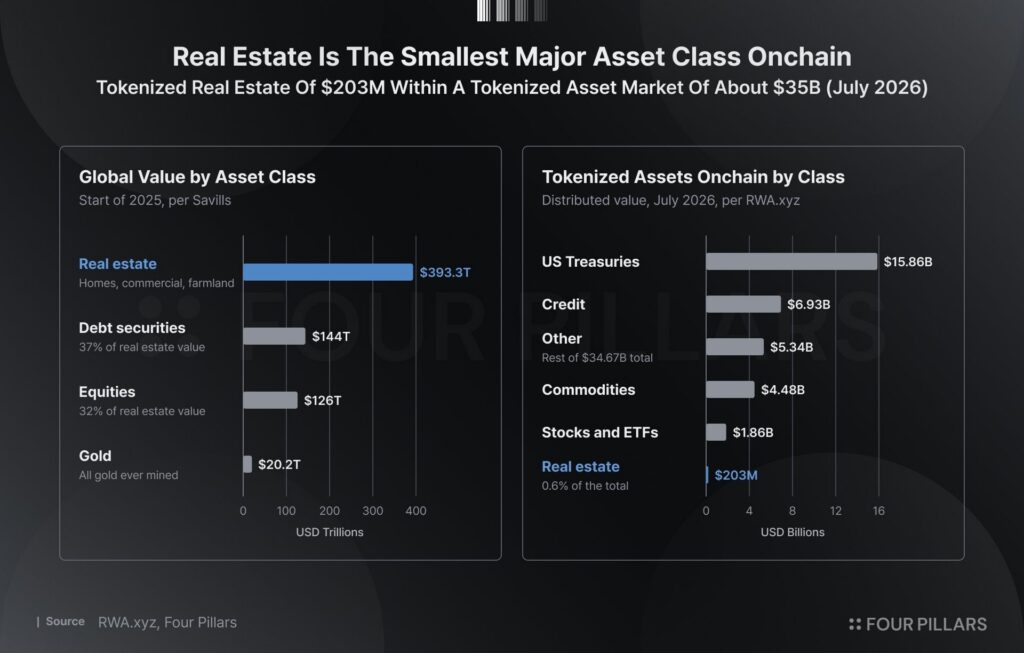
Citing RWA.xyz, the original analysis put distributed tokenized real estate at approximately $203 million as of July 2026, within a tokenized-asset market of roughly $35 billion. It argued that this narrow figure misses a much larger housing-credit business: Figure had recorded about $20 billion in housing loans on-chain, which RWA.xyz classified as private credit rather than real estate.
Five models, different claims
- Fractional ownership offers a share in an entity holding a particular property, with potential rent distributions and proceeds from a sale. The analysis identified property upkeep, platform costs and limited exit liquidity as obstacles. It reported that RealT, Kasa Korea and Funble had ceased operations or entered liquidation.
- Housing credit gives investors exposure to borrowers’ loan payments, rather than ownership of their homes. The article reported that Figure earned $393 million in net revenue and $132 million in net profit in the first half of 2026. Scale is not automatic profitability: it contrasted those figures with Pineapple Financial’s more than $1 billion in on-chain mortgages and $2.1 million in revenue over nine months.
- Title and closing uses blockchain records in property transfers, without itself offering a property investment. The article said Propy was using a $100 million credit facility to acquire conventional title companies.
- Government-backed registration can give token holders a legally registered ownership interest. Dubai’s Prypco Mint was described as open only to UAE residents, with expansion dependent on regulatory approvals.
- Price exposure tracks housing prices without conveying ownership of a building. Parcl offered leveraged contracts tied to city house-price indices. At the time of reporting, USHP—based on an Index Industries house-price index—was planned for the fourth quarter of 2026, not reported as launched. Index Industries had announced a $50 million seed round; the article also reported $100 million in subscription commitments ahead of USHP’s proposed launch. Neither figure establishes subsequent trading activity.
Issuance is not liquidity
The analysis questioned whether advertised property-token yields represented independently verified returns. It said RealT had advertised 6%–16% annual rental returns but stopped most payments before the end of 2025, halted distributions in February 2026 and announced voluntary liquidation in July 2026. It characterized Prypco Mint’s 8%–12% net-return figure as a projection combining rent and expected price appreciation, while noting that Lofty had not published the underlying calculation for its stated 9.2% average rental yield across 111 properties as of May 2026. These are differently constructed claims, not directly comparable realized returns.
Japan illustrated another constraint. The article reported ¥140.8 billion in real-estate security-token issuance in fiscal 2025, but said Osaka Digital Exchange had listed only eight token products by March 2026, with settlement still taking two business days. In the author’s reading, distribution through established financial institutions helped issuance grow without necessarily creating an active secondary market.
The article’s central argument was that standardized debt claims and price indices may be easier to trade or use in other financial products than shares of individual buildings, which still require tenant management, repairs and local legal processes. That remains an argument about possible market structure—not proof that index products will find lasting liquidity or that on-chain credit eliminates lending risk.