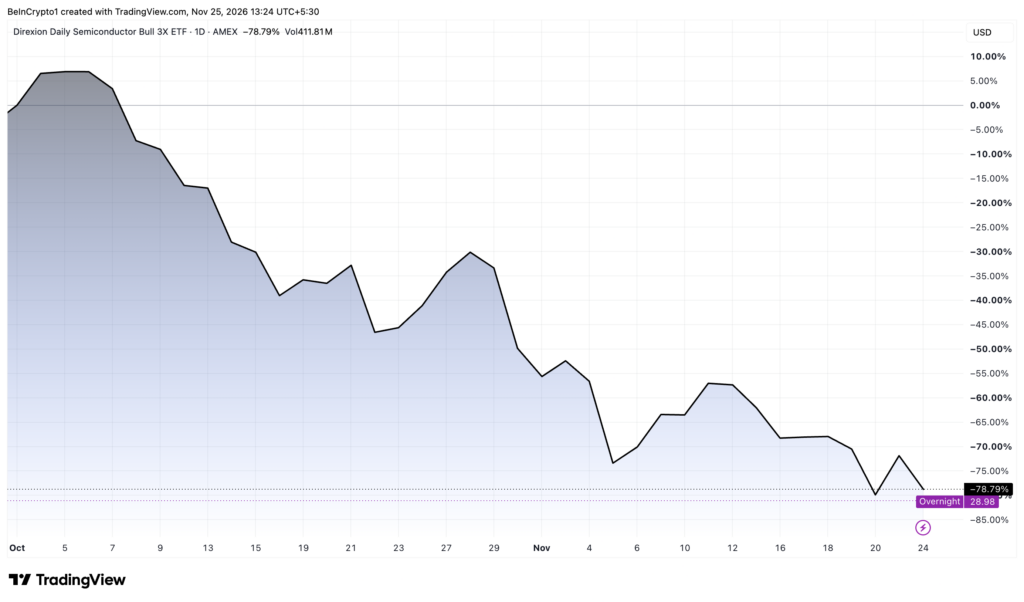
Perpetual futures on SOXL, a leveraged semiconductor fund, traded about $85 billion on crypto exchanges in October 2026, more than contracts tied to any individual stock, according to WuBlockchain. Trading remained heavy during the chip selloff: in the 24 hours to the morning of November 25, the SOXL contract fell about 32% on roughly $18 billion in volume.
Two layers of leverage
SOXL, the Direxion Daily Semiconductor Bull 3X Shares, aims to deliver three times the daily move of a semiconductor stock index. A perpetual futures contract has no expiry and trades around the clock. Traders who use leverage on the contract are therefore borrowing to take a position on a fund that already magnifies daily chip-stock moves.
CryptoQuant had tracked a surge in equity perpetuals volume from April to July. In August, three individual stocks accounted for half of stock perpetuals volume on centralized exchanges. By October, SOXL had overtaken each of them, leading a group of leveraged funds and ETFs whose trading volume rose more than 80% from September.
What the selloff revealed about positioning
The early November decline in chip stocks was linked to investor doubts about the AI trade after Democrats’ midterm wins. Selling resumed in the week of November 25. By the November 24 close, the fund itself had lost about 78% since October 1, distinct from the perpetual contract’s 32% drop over the following 24-hour reporting window.
Volume measures turnover, not bullish conviction. Positions betting on a rise accounted for about 84% of the roughly $22 million in SOXL liquidations over the 24 hours to November 25. Open interest, the value of outstanding contracts, fell about 7% to roughly $870 million over the same period.
Funding nevertheless remained positive: traders holding long positions were still paying those on the short side to keep their contracts open. That suggested a continued bullish tilt even as positions closed, leaving leveraged longs exposed to further forced closures if chip stocks fell again.