
This account was published on November 16, 2026. Its trading results and interpretations are the trader’s claims, not independently established outcomes.
An on-chain trader writing as 3 describes a strategy that sits between narrative trading and infrastructure monitoring: identify a token attracting attention, then watch for signs that firms supporting a trading venue are preparing to handle it. In the account, that approach led to reported combined profits of more than $4 million on cashcat and $2 million on PONS for the trader and their associates. The story illustrates what the trader says they observed; it does not establish that the same signals reliably predict a listing.
Cashcat: from attention to infrastructure clues
The trader says they bought cashcat after Robinhood CEO Vlad followed the token’s account on X. That was an attention signal, not evidence of a listing. Seeking something more concrete, they examined Robinhood’s listing schedules and public APIs, as well as activity involving market maker Wintermute and custody provider BitGo.
According to the account, an earlier review of Robinhood listings had shown Wintermute sending tokens to a Robinhood hot wallet roughly an hour before announcements. The trader cautions that Wintermute activity on Ethereum can have many explanations. They considered its activity on Robinhood Chain more informative and built a tool to monitor a cluster of its wallets. They also tracked BitGo infrastructure and GitHub updates, while a partner prepared a buying bot.
On July 16, as cashcat fell, the trader revisited Wintermute’s wallet activity using a custom EVM explorer. They say this uncovered a newly funded wallet and contracts controlled by a Wintermute multisignature wallet. Three contracts contained a getAllApprovedTokens() function. Initially empty allowlists later added WETH and USDG; trading in that pair began the following day.
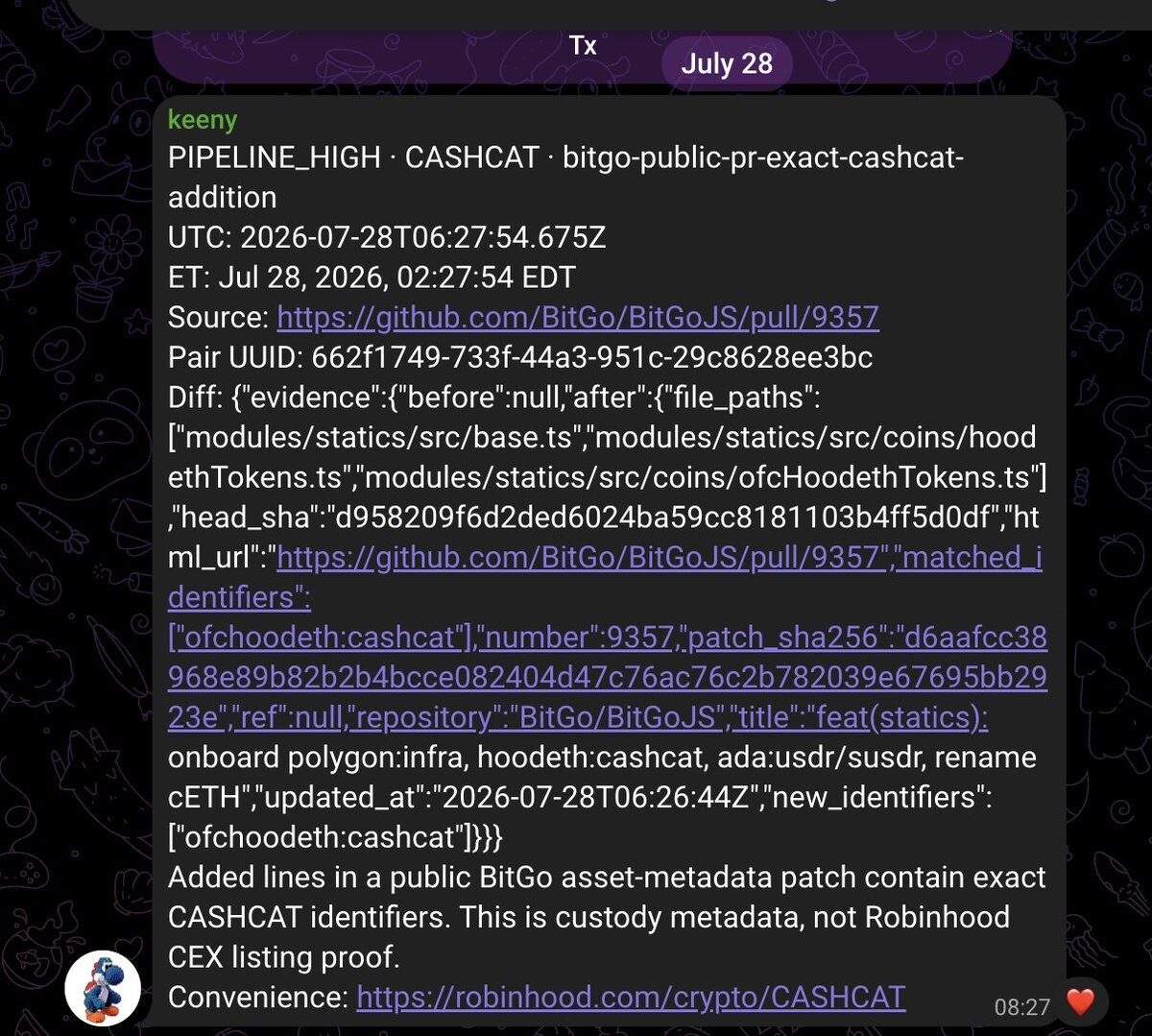
On July 27, the BitGo monitor detected hoodeth:cashcat in a public pull request five seconds after it appeared. The trader viewed this as the first clear cashcat-specific clue, but says BitGo’s many clients made it insufficient on its own to justify a multimillion-dollar position. BitGo updated the pull request on July 28 and, on July 29, published an update containing cashcat alongside 99 Robinhood Chain stock tokens. The trader interpreted that grouping as evidence of a Robinhood-related request; the account does not establish who made it.
By July 29, the trader says they and their partner held 1.5% of cashcat’s total supply. At 17:48 UTC on August 3, their tool detected what they describe as Wintermute authorizing a cashcat/WETH liquidity pool. They began buying in batches. At 18:19, a wallet they suspected belonged to a Robinhood insider placed an unfilled cashcat limit buy order worth $11,000. Its owner was not confirmed. Fearing that other wallet watchers would react first, the pair accelerated their purchases, buying more than $1 million of cashcat and bringing their claimed holdings above 4% of supply.
The trader says on-chain analysts then publicized their wallets. Robinhood listed cashcat three days later. Although the trader says they missed the initial price surge and could have sold better, they report combined profits of more than $4 million. Their earlier expectation of a 200%–300% listing-day rise was a forecast, not a guaranteed or independently verified result.
PONS and the limits of an information edge
The trader says other market participants had begun recognizing Wintermute’s contract pattern by the time PONS appeared. They report buying PONS on August 28 using additional signals they declined to disclose. BitGo added PONS to a support list three days later, according to the account, and Wintermute subsequently began making a market in it. The trader describes a September 2 event as a purported “listing,” but speculates that it may instead have been a Robinhood lure to identify people with advance information. No evidence establishing that alleged purpose is provided.
The trader and friends claim combined PONS profits of $2 million. They also say much of the information advantage described in the account has since been absorbed by the market. The distinction running through both examples is between a token’s narrative appeal, observable preparation by infrastructure providers, and a confirmed venue decision: the first two may attract traders’ attention, but neither alone proves the third.