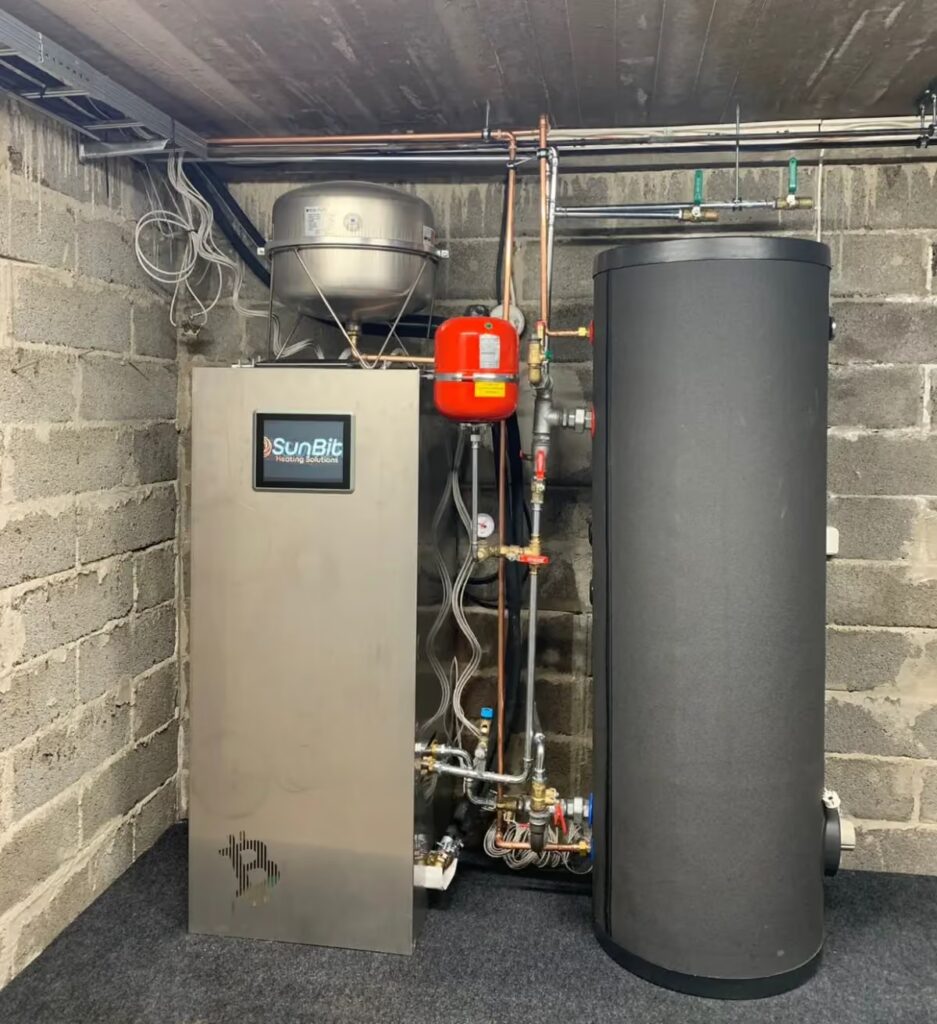
As reported on November 9, 2026, Finnish company SunBit had 30 bitcoin-mining heating systems in operation, according to CEO Elmeri Suomi. All but one were in Finland. The idea is to use heat from a mining machine in place of, or alongside, a conventional boiler while the homeowner keeps the bitcoin it mines.
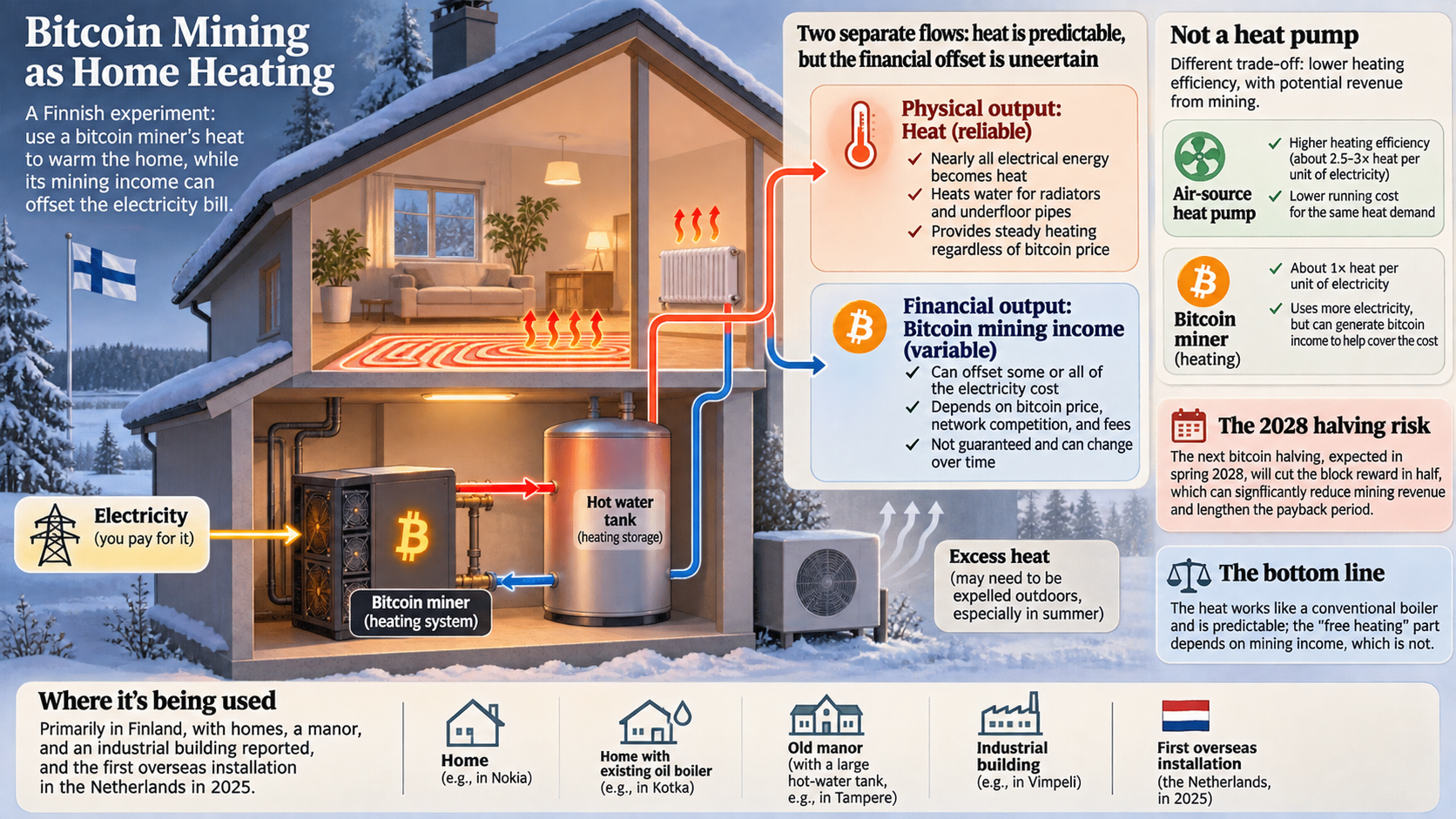
In Nokia, Finland, a 180-square-meter home had disconnected from district heating and was using a SunBit system to heat water for radiators and underfloor pipes. Other reported installations included a home in Kotka that retained its oil boiler, an old manor in Tampere with a 1,500-liter hot-water tank, and an industrial building in Vimpeli. SunBit’s first overseas installation, in the Netherlands, replaced gas heating in 2025.
The distinction between heat and mining income
A miner converts nearly all the electricity it consumes into heat. That makes the heat usable, but does not make the electricity free. SunBit’s case for the system depends on bitcoin income offsetting the power bill; the homeowner pays for the electricity and owns the machine and the bitcoin it produces.
For a modeled Antminer S21 XP Hydro running continuously at roughly 5.3 kilowatts, SunBit estimated annual consumption of about 46,400 kilowatt-hours and an electricity bill of roughly $5,200 at $0.11 per kilowatt-hour. Assuming bitcoin at $82,000 and network hashrate at 1,040 EH/s, its model put annual output at about one-twelfth of a bitcoin. After SunBit’s optional 10% service fee, that was worth about $6,100, before a further 0.5% mining-pool fee. The resulting roughly $900 margin over electricity costs did not pay back the equipment. Nor can an ordinary home necessarily use all the heat: the report said more than half may have to be expelled outdoors, particularly in summer.
SunBit cited one early customer’s pool screenshot as a separate example: an S21+ Hydro miner had produced 0.039 bitcoin over the preceding year, worth about $3,160 at the price then used, while its heat could replace approximately 2,000 liters of heating oil. Suomi said the company could not see the mining data of later customers using private pool accounts.
A different proposition from a heat pump
In SunBit’s comparison, an air-source heat pump delivered about 2.5–3 units of heat per unit of electricity, against roughly one unit from a miner. For a home needing 25,000 kilowatt-hours of heat annually, SunBit estimated heat-pump running costs at about $1,100. It calculated that operating a miner only long enough to meet that heat demand would instead leave about $490 after electricity costs—but only under its mining-income assumptions. The miner’s potential advantage is revenue, not heating efficiency.
Installation was quoted at roughly $20,400–$31,400, with estimated payback of three to six years. Those estimates face a scheduled change: the next bitcoin halving was expected in spring 2028, reducing the block reward from 3.125 to 1.5625 bitcoin. SunBit’s payback calculator did not include that event, and the company did not promise fixed returns.
Holding the report’s other assumptions constant, the halving calculation reduced mining revenue from about $0.13 to $0.07 per kilowatt-hour against electricity costing $0.11. On that basis, continued electricity-cost coverage after the halving would require bitcoin at approximately $131,000. Suomi said the heating function itself would remain, while the payback period could change. That is the limit of the “free heating” narrative: the heat is predictable; the mining income funding it is not.