In an analysis published on November 11, 2026, nikos (@definikos) drew a distinction between borrowing USDC on demand and securing a committed credit line. A payments fintech might be able to borrow $30 million from Aave or Morpho in a transaction, the author argued, but that does not guarantee the same capacity will be available at an agreed price each morning for the next year.
That is a more specific challenge than a general shortage of onchain lending. It concerns whether a fintech can rely on credit to fund recurring payment settlement, including on days when other lenders want their liquidity back.

What the existing markets do not guarantee
The author identified four gaps above the underlying lending protocols:
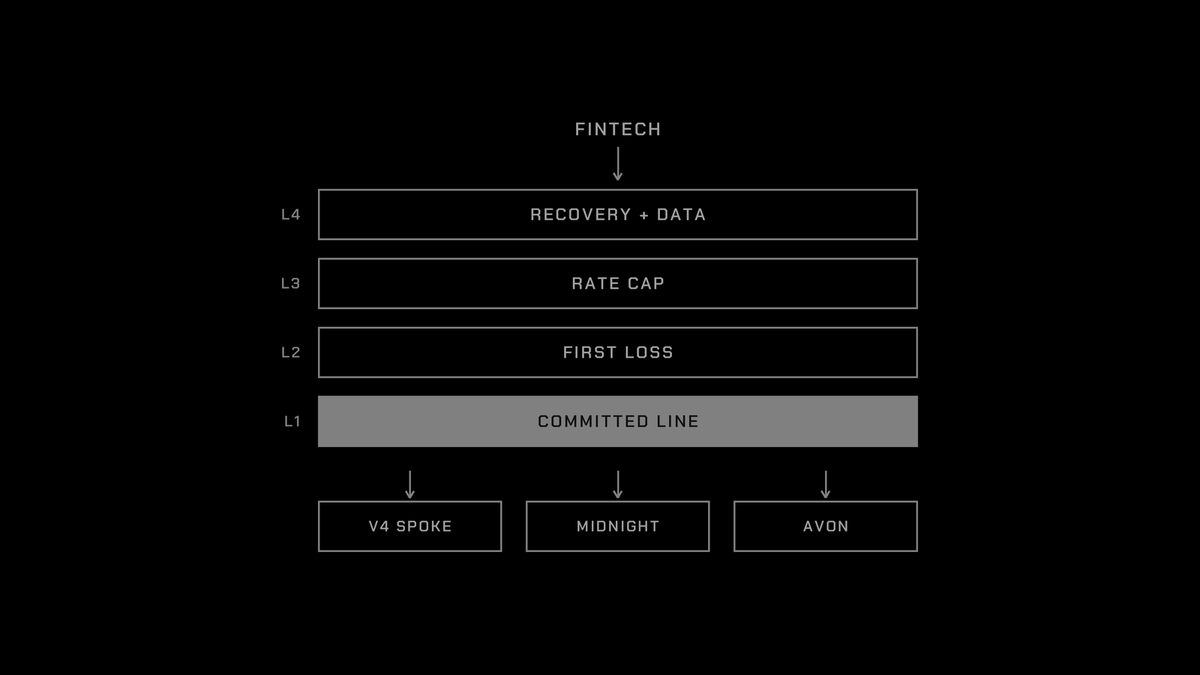
- Committed capacity. An Aave V4 Spoke can cap a borrower’s withdrawals without reserving funds for them. According to the analysis, a Morpho Midnight lender can withdraw a quote before it is used, while Avon routes requests to lenders quoting at the time.
- A first-loss buffer. The author said losses in an Aave V4 Spoke can reach depositors in its Hub; in separate Midnight or Avon markets, lenders within the affected market still bear losses without a dedicated junior layer ahead of them.
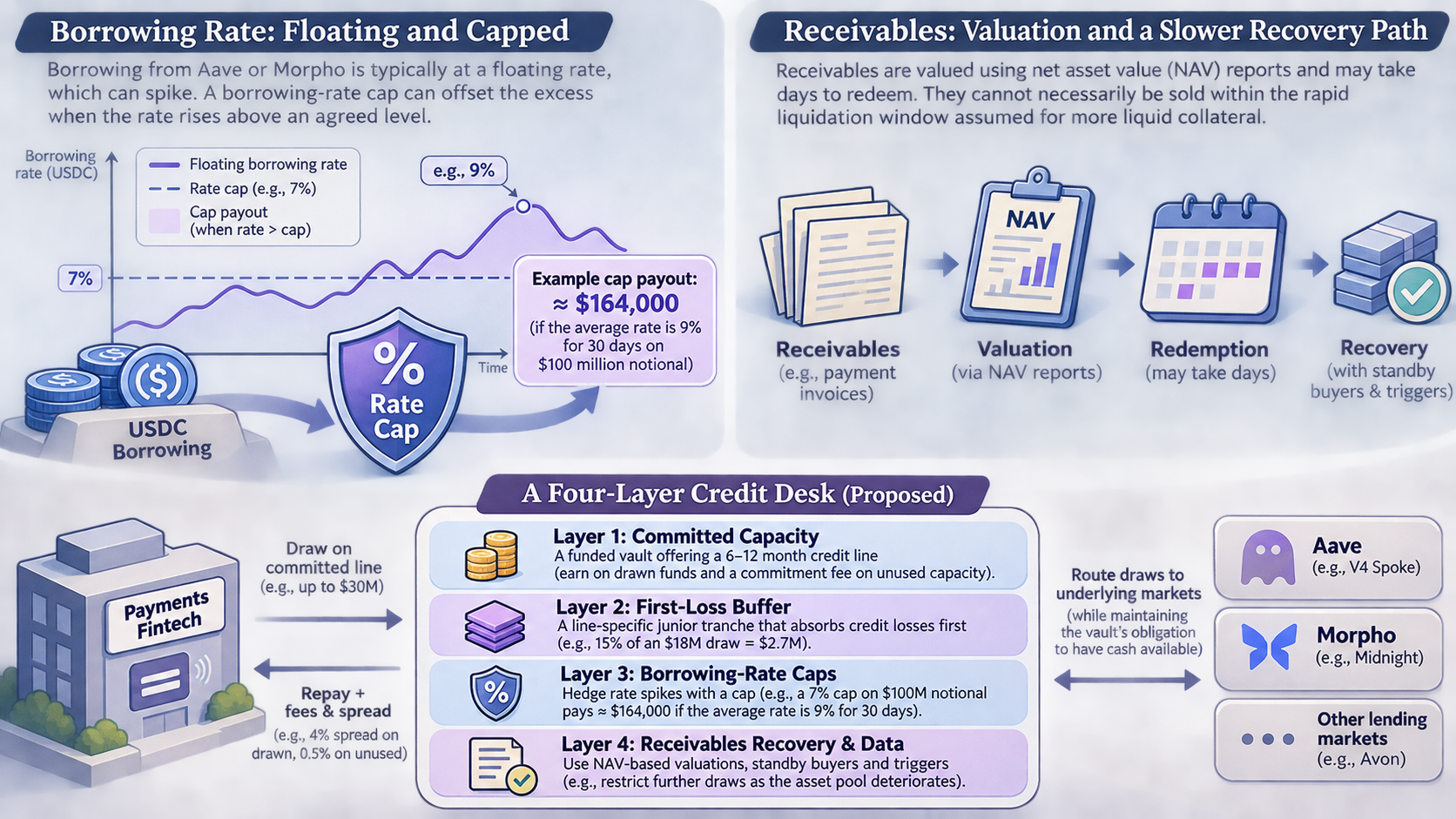
- Protection from floating borrowing rates. The analysis estimated that roughly $600 million of tokenized working-capital credit was being held through positions involving floating-rate USDC borrowing. It argued that a rate spike could pressure those holders to sell, and said a standardized market for caps on Aave or Morpho borrowing rates was missing.
- Recovery suited to receivables. Receivables are valued using net asset value reports and may take days to redeem. They cannot necessarily be sold within the rapid liquidation window assumed for more liquid collateral.
A proposed credit desk—not an existing guarantee
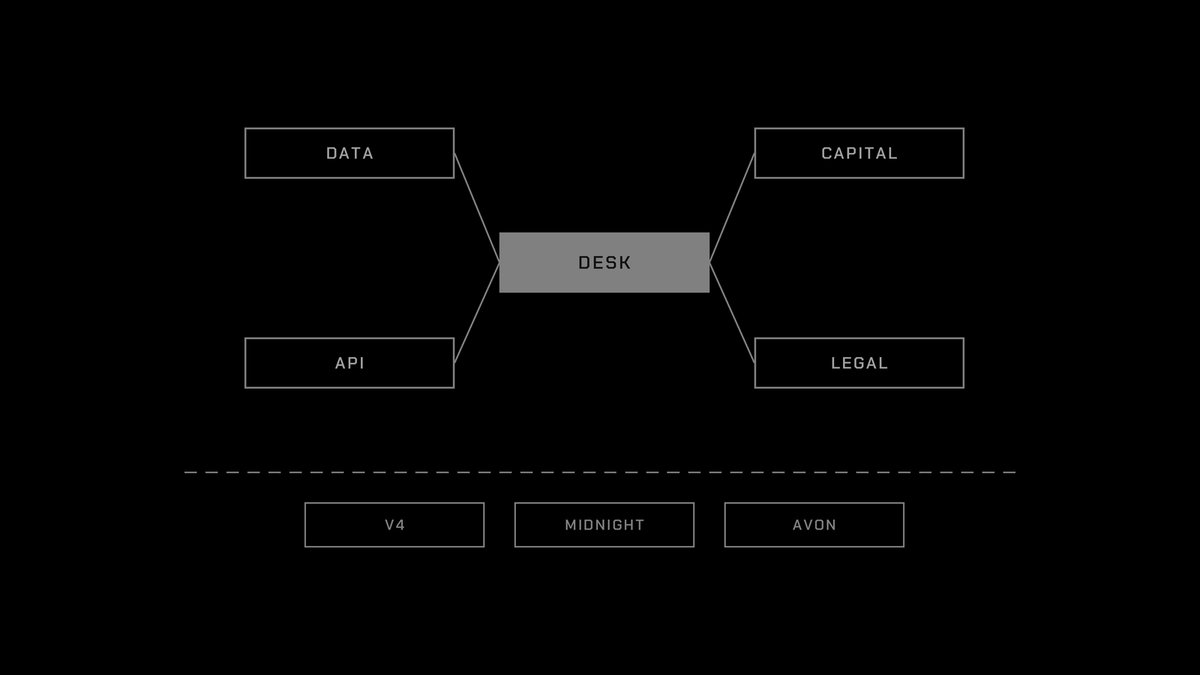
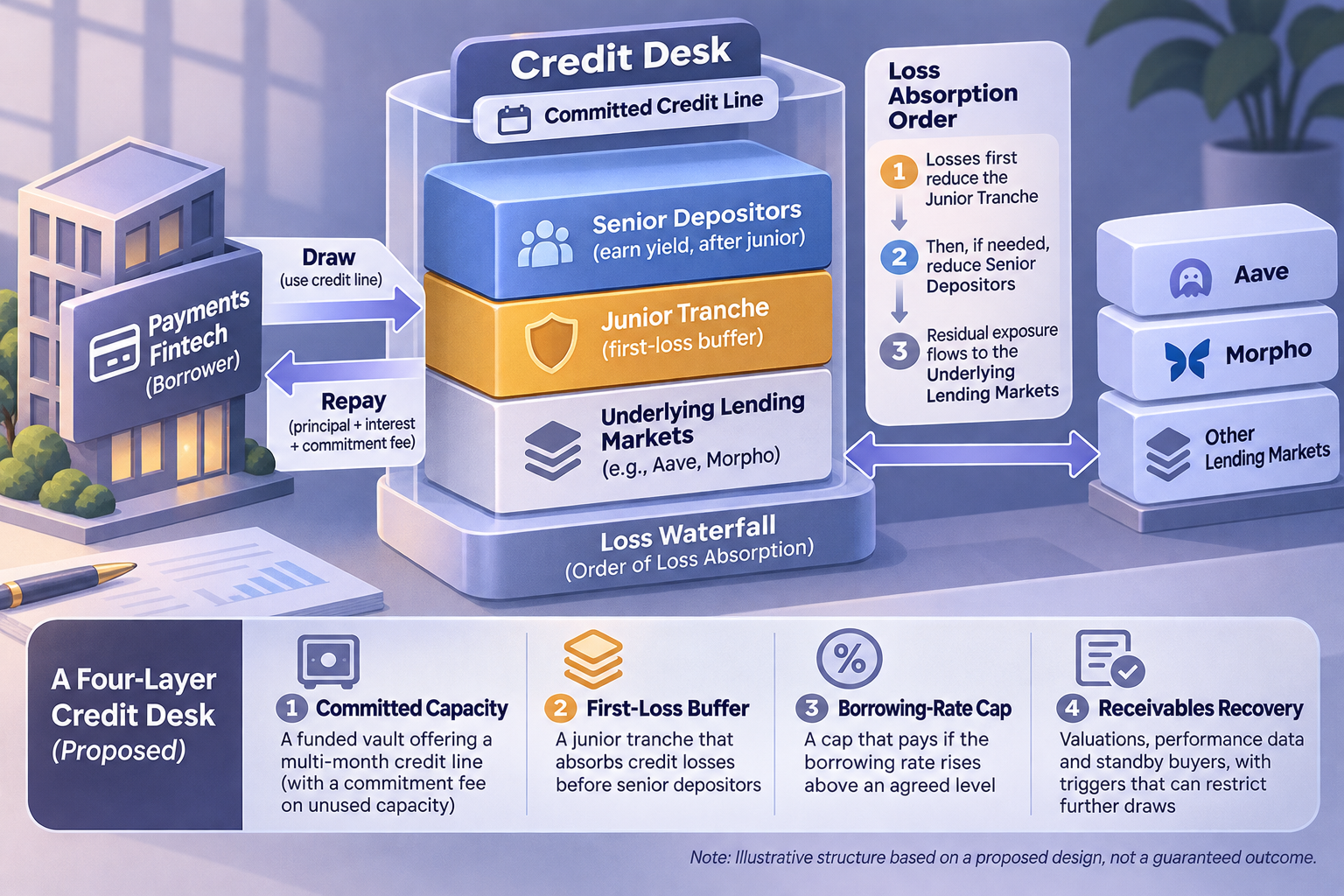
Nikos proposed a four-layer credit desk between fintech borrowers and lending markets. Its first layer would be a funded vault offering a single borrower a six-to-12-month credit line. The borrower would pay for funds drawn and a commitment fee on unused capacity; idle funds could earn floating-rate yield until needed. Routing a draw to an underlying market, however, would not remove the vault’s obligation to have cash available.
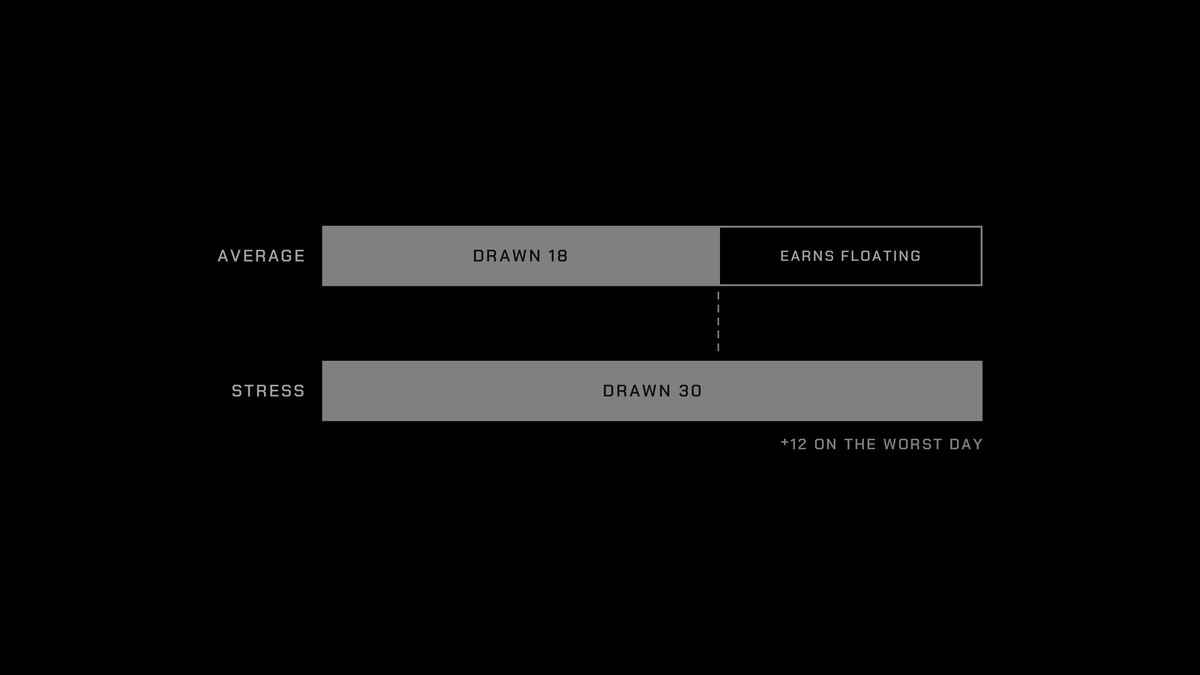
The author’s illustrative $30 million line assumes an average 60% draw, a 4% spread on drawn funds and a 0.5% fee on unused capacity. That produces an additional 2.6% a year on the full line, or $780,000, above the assumed floating-rate base return. The critical test is not the average $18 million draw: the vault would need to withstand a sudden request for the full $30 million.
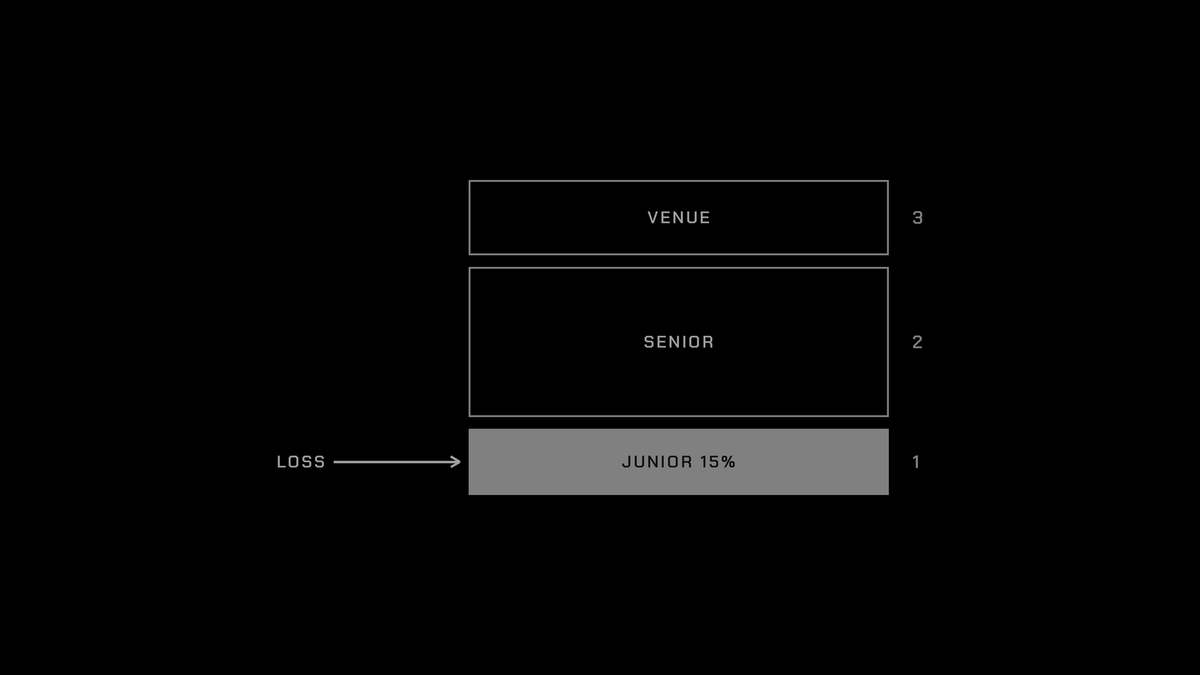
A line-specific junior tranche would absorb credit losses before senior depositors. In the article’s example, a buffer equal to 15% of an $18 million draw would be $2.7 million. Allocating it 60% of a $720,000 spread would add $432,000—an illustrative 16% return on that junior capital above the base rate. A 5% loss on the drawn loan, or $900,000, would consume one-third of the buffer before reaching senior principal. Those figures describe a proposed loss waterfall, not a promised investor outcome.
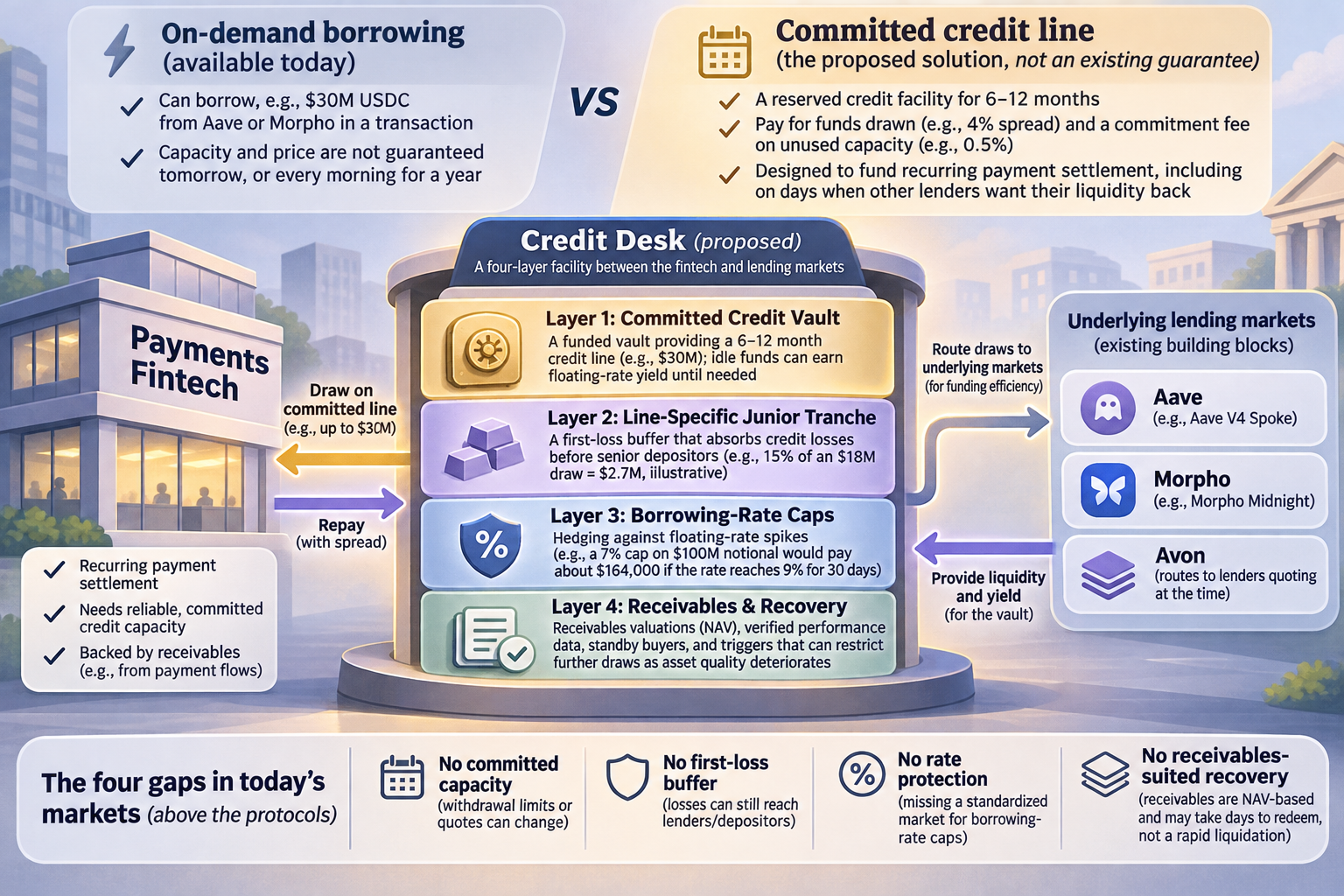
The third layer would offer borrowing-rate caps. Under the author’s example, a cap struck at 7% on $100 million of notional would pay about $164,000 if the relevant average borrowing rate reached 9% for 30 days. The fourth would pair receivables valuations and verified performance data with prearranged standby buyers and triggers that could restrict further draws as an asset pool deteriorates. These are proposed mechanisms; their effectiveness would depend on funding, reliable data and enforceable recovery arrangements.
The constraint beyond smart contracts
The analysis pointed to Wildcat and 3Jane as examples of individual components, not proof that the complete product exists. It reported that lenders in a Wildcat market affected by Kinto’s 2025 default expected to recover 76% of principal. It also described 3Jane’s use of an 85% senior and 15% junior funding split. Neither example, the author said, supplied the fully committed, cross-market fintech facility under discussion.
The proposed desk’s defensible work would therefore be less about contract code than underwriting, access to junior capital and standby buyers, integration with borrowers’ systems, and legal rights over receivables. Those are also its hardest uncertainties. A commitment can fail precisely when withdrawals surge; default recovery may take time and proceed through offline legal processes. The article argues that lending to licensed payment firms offers a possible starting point, while making regulatory review and enforceable credit terms indispensable.