On November 11, 2026, ChainCatcher writer Zhou published a comparison of what major crypto exchanges were putting on their markets. The dates below are the dates in that report, not a later update.
On November 10, 2026, Upbit, described as South Korea’s largest crypto exchange, opened trading in HYPE, the native token of Hyperliquid. Bithumb listed HYPE the same day. Also on November 10, OKX listed xORCL, a tokenized Oracle stock. About a week earlier, HTX had listed 20 U.S. stock tokens and ETFs at once; Gate had opened trading in Taiwanese shares including TSMC and MediaTek; and Bitget had placed Morgan Stanley and India’s Reliance Industries on its perpetual-contract market and said it would open a channel for subscriptions to an Anthropic IPO. Those stock and IPO items were announcements of exchange products. The report does not treat them as completed public offerings or as proof that equity trading had migrated on-chain.
Zhou’s reading of global exchanges’ announcement boards was that new names increasingly resembled a brokerage catalog, and that new native coins had become the minority. That is a description of listing menus, not a count of volume or of assets already moved.
Two product menus, not one sector
The report places two listing strategies next to each other. Binance and several global peers were adding tokenized traditional assets: stocks, ETFs and stock-linked perpetuals. Upbit and Bithumb were adding native crypto spot markets at a faster pace. These are different categories. A tokenized stock is a representation of an existing equity. A native coin is not a share of the same market. Listing activity on one menu does not, on the figures Zhou cites, show that funds had rotated from native crypto into tokenized stocks, or the other way around.
The article also argues that Korean exchanges were not simply more attached to native crypto. From 2017, Korean regulation had kept finance and crypto apart: financial institutions were limited in holding and operating crypto assets, and crypto exchanges had little room to enter traditional finance. Derivatives had still not been opened inside the domestic system. Upcoming tokenized securities were assigned to the securities system rather than to crypto exchanges.
What Binance had stopped putting on spot
By the end of 2025, Binance had set a sequence running from Alpha to futures to spot. Binance disclosed that, as of April 2026, 99 of 200 tokens shown on Alpha had entered futures, and only 35 had reached spot. In the report’s account, speculative demand for new tokens stayed on Alpha and in futures, and spot listings slowed sharply.
Binance Research counted 87 new spot projects on Binance in 2025. Figures from flexe.io, as cited by ChainCatcher, showed only 26 new tokens on Binance spot in 2026 through November 11. The same statistics said Binance had announced 49 delistings in 2026 and had put 64 tokens under a monitoring tag, compared with 27 delistings and 42 monitoring tags in 2025. Fewer additions and more removals meant Binance’s own spot main board was contracting quickly. That is a statement about Binance’s listing actions, not about every exchange.
The report also points to the market those listings sat in. CoinGecko data cited there showed crypto’s total market capitalization down 20.4% in the first quarter of 2026, and centralized-exchange spot volume down 39.1%.
Regulation is presented as a further constraint, not as a published enforcement finding about any single coin. In June 2026, Binance withdrew its MiCA license application before the Greek regulator made a formal decision. A compliance monitor assigned by the U.S. Financial Crimes Enforcement Network was still in place when the article was published. Zhou’s judgment is that, for an exchange dealing with regulators in many jurisdictions, covering the spot main board with large numbers of high-risk new coins is an easy point of scrutiny.
Tokenized stocks were a larger addressable market, and still a very small on-chain one
The shift the report treats as more important is Binance’s move toward traditional financial assets on-chain. After Abu Dhabi’s ADGM Financial Services Regulatory Authority approved an issuer prospectus, Binance launched bStocks, tokenized securities linked to U.S. stocks and ETFs. From late September 2026, new underlyings were being added in batches almost every week.
Other global venues were expanding the same kind of product, which does not make their tokens equivalent to one another or to native coins. In March 2026, OKX received a strategic investment from ICE, parent of the New York Stock Exchange, at a reported valuation of $25 billion. Tokenized stocks then began to list in batches, and stock perpetual contracts continued to be added. The report states the sequence; it does not demonstrate that the investment caused the listings. Bitget’s stock perpetual underlyings had reached 408. Gate and HTX were also expanding equity-type assets.
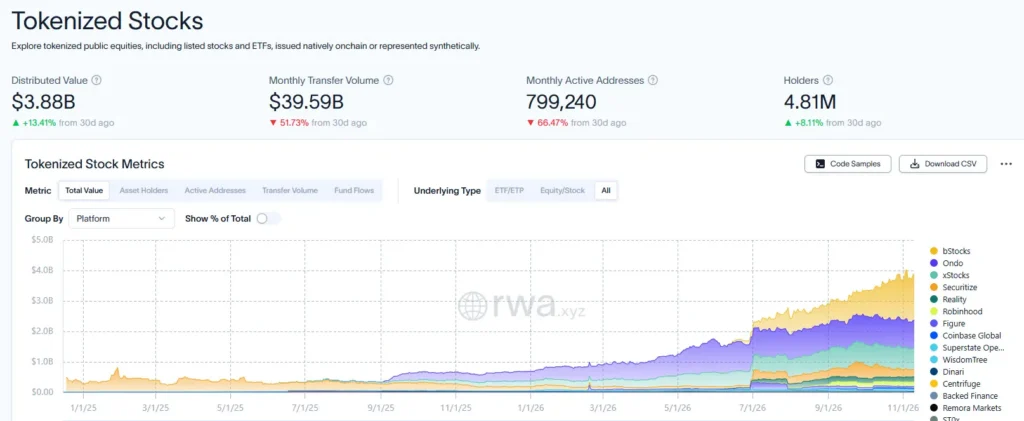
Measured adoption was still small beside the market being invoked. RWA.xyz data cited for November 10, 2026 put the total value of on-chain tokenized stocks at about $3.88 billion. Bloomberg data in the article put global equity market capitalization in the third quarter of 2026 at about $165 trillion. Crypto’s total market cap was about $2.59 trillion, so global equities were more than 60 times crypto, while tokenized stocks were still under one ten-thousandth of the global stock market. Zhou’s point is about the size of the pool exchanges were aiming at: even a small slice of equities, moved on-chain, would be a much larger pool than native crypto assets. The November 2026 article does not show that slice had been moved, and it does not report revenue from bStocks or from peers’ stock products.
Upbit was listing inside a spot-only business
ChainCatcher calls Korean exchanges possibly the last substantial place where native assets still dominated centralized-exchange listings. Over the full year the counts had crossed. In 2025, Binance’s 87 spot listings were clearly above Upbit’s 59. In 2026 the comparison had reversed: Binance was at 26, while South Korea’s Maeil Business, as cited in the report, counted 59 newly opened Upbit won pairs by mid-August, matching the prior full-year figure in under eight months.
The latest three months were sharper still. From official announcements, ChainCatcher counted from the beginning of August 2026 through the November 11 report. Binance had announced four crypto-asset listings: MARSCOIN, 牛来, HYPE and PREDICT. PREDICT’s opening was later postponed. In the same stretch, Upbit listed 39 assets and Bithumb listed 29.
Upbit’s pace through the first three quarters was already heavy. New trading markets became denser quarter by quarter, with nearly 100 opened in the first three quarters. On the won market, the pace at one point reached about 16 a month, more than double the monthly average of the first half. The report does not state that first-half average as its own number.
The article traces the constraint to rules that predate the 2026 burst. In 2017 the Financial Services Commission issued administrative guidance limiting financial institutions’ holding and operation of crypto assets. The separation was still in place, and crypto exchanges still struggled to cross into traditional finance. Korea had not established an onshore crypto derivatives market inside the system, so users who wanted derivatives went to overseas platforms. In January 2026 the National Assembly passed a tokenized-securities bill, placing those instruments under the Capital Markets Act and giving circulation to securities firms and over-the-counter intermediaries. The related law was to take effect on February 4, 2027. Peers abroad could offer contracts and U.S. stocks. Korean exchanges were left with crypto spot, and their income followed from that limit.
Filings on the Financial Supervisory Service’s electronic disclosure system showed that, in the first quarter of 2026, trading-platform fee income was 97.49% of revenue at Dunamu, Upbit’s operator, and close to 99.99% at Bithumb. The market those fees depended on was weak. CoinGecko figures in the article said that in the second quarter of 2026, combined turnover at Korea’s five major won exchanges was down about half from a year earlier, and Upbit’s was down 54%. With fees close to the only revenue source, new listings were the most direct way to draw trades.
The same listings were also a share contest in a market already split between two firms. CoinGecko data for September 2026 gave Upbit 65.44% of volume among Korean exchanges and Bithumb 26.87%. In that duopoly, listing more assets, and listing them faster, was a way to keep users on one’s own venue. The report presents that as competitive logic. It does not show that each new ticker produced durable volume.
Korea had moved to the end of the listing chain
New coins on Upbit were seldom meeting the market for the first time, and Zhou again treats that as a result of regulation.
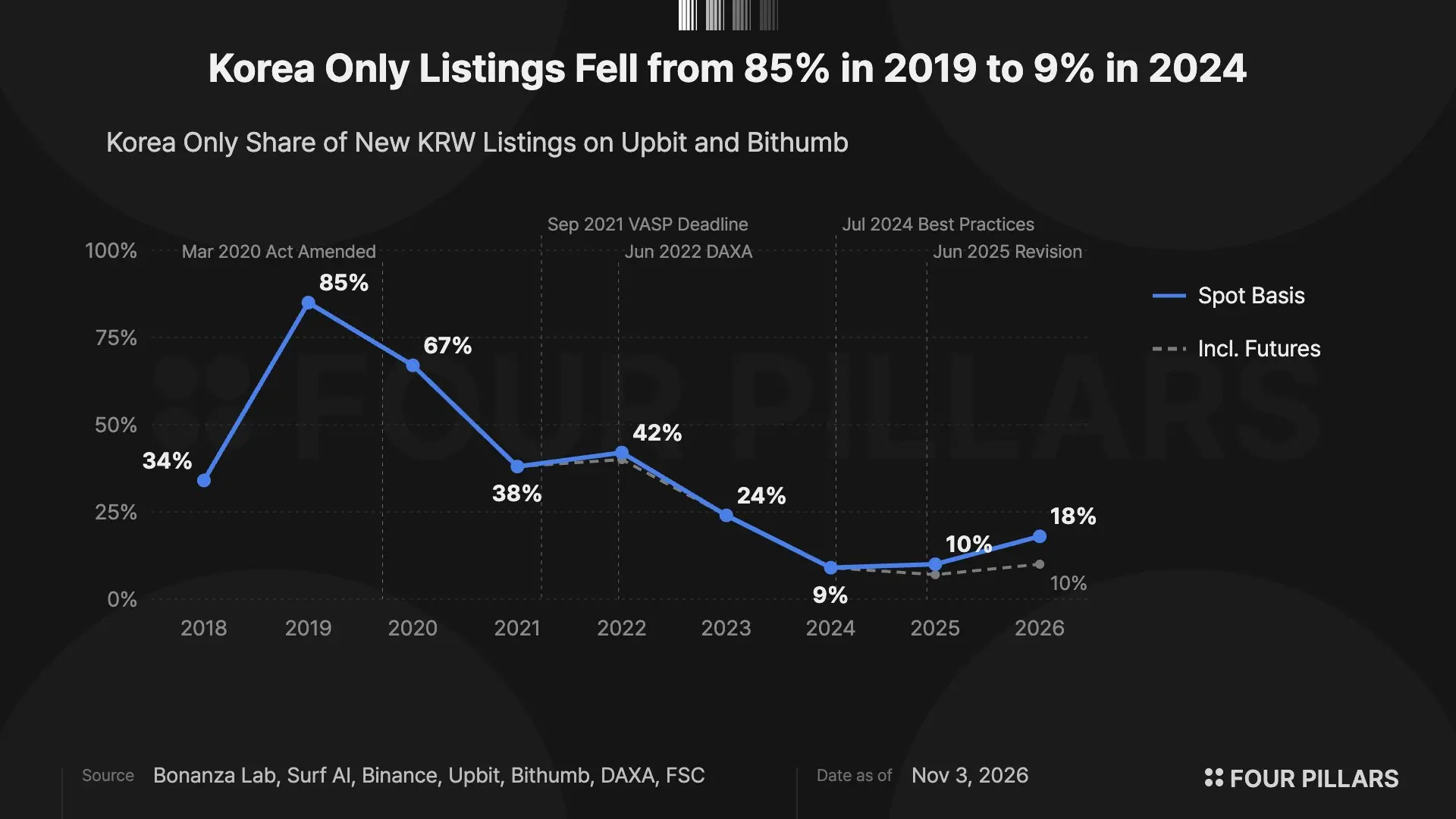
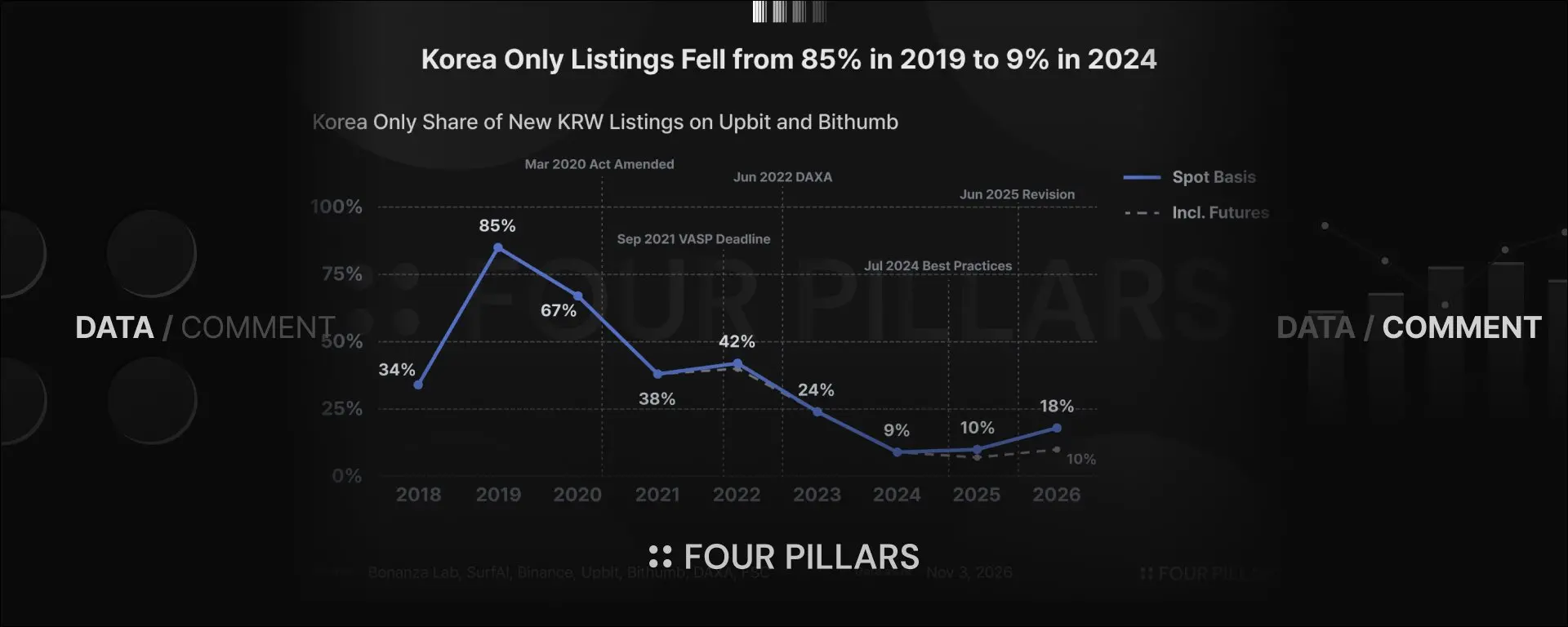
Four Pillars researcher tranks, cited in the article, measured the share of new won-market listings on Upbit and Bithumb that went live in Korea before spot markets on Binance, OKX, Bybit and Coinbase. That Korea-first share fell from 85% in 2019 to 9% in 2024. The article lines the decline up with the regulatory framework taking shape, rather than claiming a single cause. In March 2020, the revised Specified Financial Information Act required exchanges to register and meet anti-money-laundering duties, with a registration deadline of September 2021. In the quarter associated with that deadline, Korea-first listings fell from 19 a quarter to 3, and the full-year share fell to 38%. In 2022, five won exchanges formed DAXA and set common listing-review standards. Listing best-practice rules that took effect in July 2024 said an asset traded for two years on a qualified overseas exchange could be treated as meeting white-paper and disclosure requirements. By 2024 the Korea-first share was 9%. In 2026 it had risen again to 18%, but to 10% if assets that had already traded on overseas futures markets were also excluded.
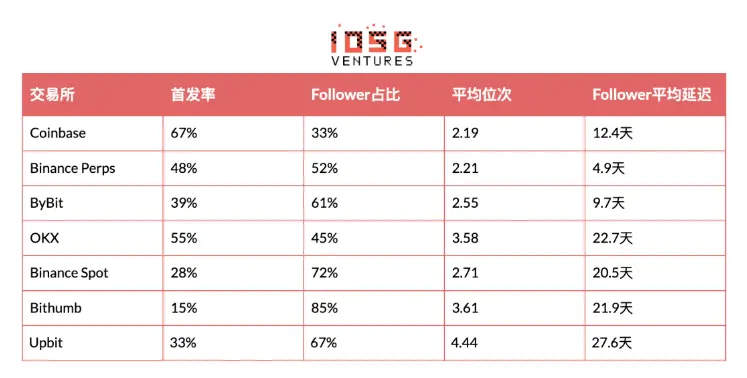
Listing in Korea only after overseas trading had become the default path. IOSG Ventures had earlier described the chain as early price discovery on Coinbase and Bybit, a liquidity check on Binance futures, confirmation on Binance spot after a pullback, and Korean exchanges at the end. On average, Upbit listed about 28 days after the first-listing exchange. HYPE, which reached Korea on November 10, 2026, had been open for Binance spot trading since September 24, a month and a half earlier.
Being last also meant taking the last stretch of the move. IOSG data in the report put the entry premium when a token reached Upbit at 27.4%, and the decline 30 days after listing at 25.7%, the deepest figure in that comparison. The article does not give the matching percentages for the other exchanges.
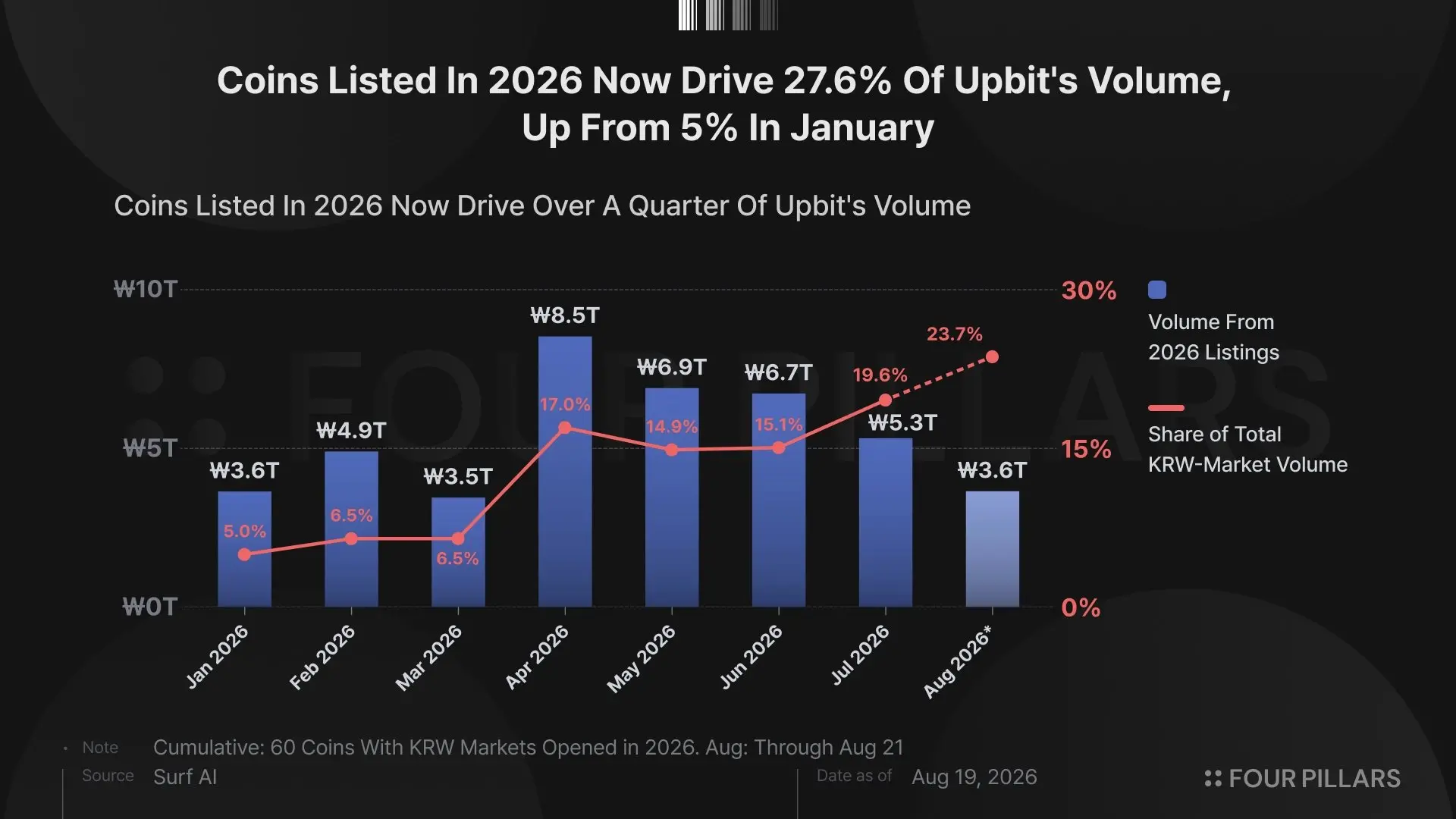
Four Pillars figures suggested the defense was using up Upbit’s own scarcity. Newly listed coins rose from 5% of Upbit’s total volume in January 2026 to 27.6% in August. The view relayed from Four Pillars is that the scarcity of an Upbit listing premium was being spent on defending volume in a weak market. That 27.6% is a share of volume, not a listing delay. The delay figure in the report remains about 28 days.
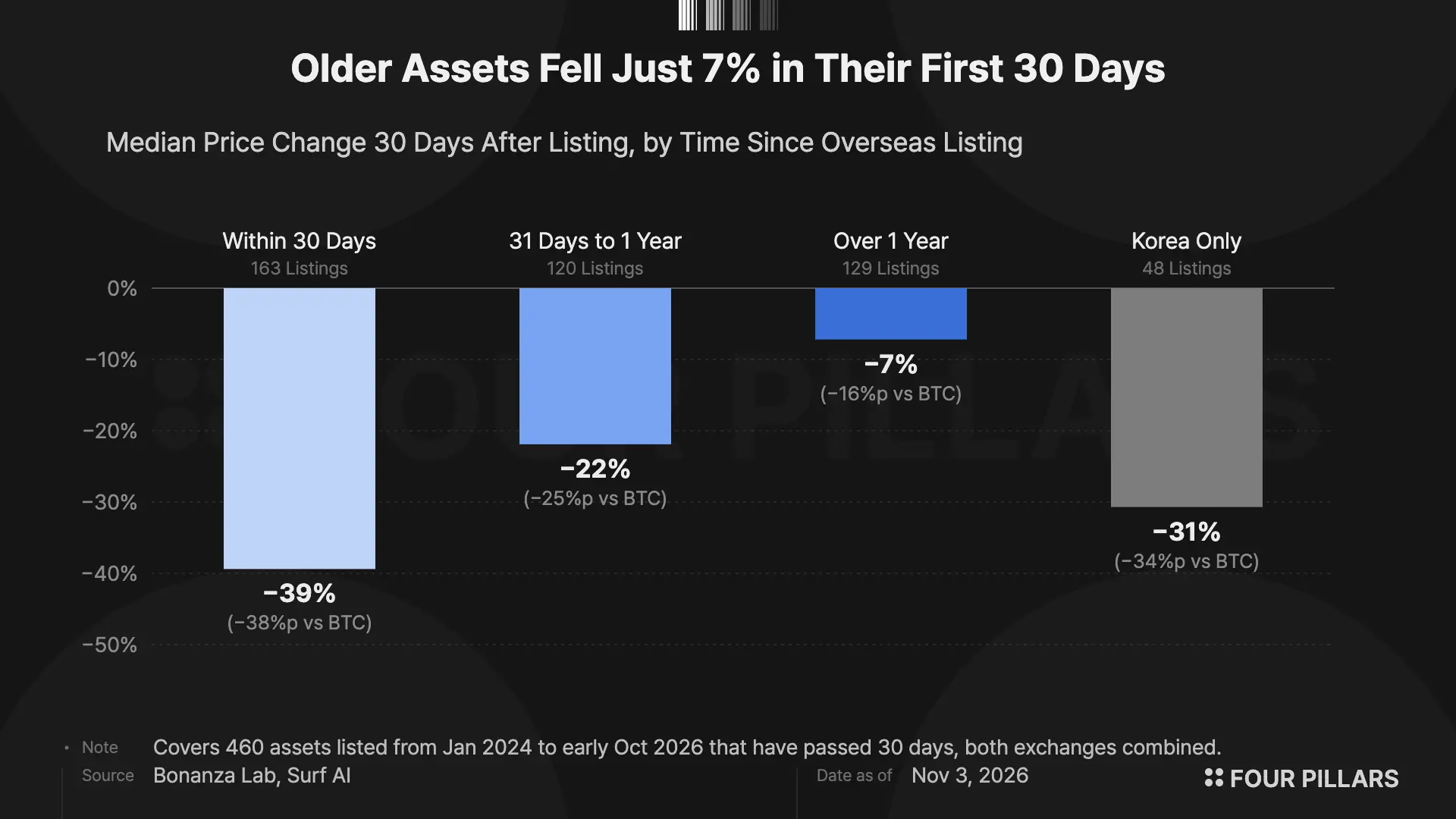
Older coins were a larger part of what the two Korean exchanges listed. In 2025, 47% of the new coins were followed within 30 days of an overseas listing. In 2026, assets already traded overseas for more than a year were the largest category, at 31%. CRV and RSR, each traded overseas for more than six years, reached the won market that year. Those older assets were easier on holders and weaker as attention. In tranks’s count, assets with more than a year of overseas trading had a median decline of only 7% in the 30 days after listing, but a median first-day share of Upbit volume of only 5.7%. Coins followed within 30 days of an overseas listing had a median first-day volume share of 10.3%.
A wall under discussion is not a wall already removed
Zhou’s closing view is that this pattern might not last long. The stated challenge for Korean exchanges was to find trading demand and revenue beyond new coin listings. The report says the firms themselves had noticed.
At the DICON digital-asset policy conference in Yeouido, Seoul, on November 10, 2026, Dunamu vice chairman Kim Hyung-nyeon (金亨年) spoke about tokenized stocks. He said it was deeply painful that representative Korean shares such as Samsung Electronics and SK Hynix could be tokenized and traded only on overseas exchanges. He also said that if the regulatory system were designed properly, Dunamu would do its utmost to become a global player representing Korea.
Policy, as reported that day, was a study and a legislative timetable, not a completed change. The chairman of the Financial Services Commission — the article does not name the officeholder — had said the commission would, together with a Digital Asset Basic Act, study whether to loosen the finance-crypto separation and by how much. Ruling Democratic Party lawmaker Min Byung-deok (闵丙德) said the law had to pass in that regular session of the National Assembly, no later than January 18 of the following year, and argued for fully allowing institutions and corporations to invest in virtual assets.
The projection at the end of the report is conditional. If the wall between finance and crypto came down, Korean exchanges would likely follow global peers into contracts and tokenized stocks, and native crypto assets might not keep even that last listing foothold. The November 11, 2026 article does not say the separation had already been lifted, and it does not say Upbit or Bithumb were then offering those products.
Original article by Zhou, ChainCatcher, published November 11, 2026: https://www.chaincatcher.com/article/2303885