Reported November 10, 2026. This is a rewrite of reporting by Wenser for Odaily星球日报 (@OdailyChina), published at 17:36 (UTC+8) on November 10, 2026. It is not a new development. Original article.
The story being told
Odaily framed a short sequence as Injective’s turn toward institutional-grade financial infrastructure. The named participants were Injective Labs, Canary Capital, the validators who produce blocks, and the institutions the chain said it wanted to reach: banks, trading firms, and institutional applications.
On the evening of November 6, Injective Labs chief executive Eric Chen and Canary Capital founder and chief executive Steven McClurg appeared together in Times Square and rang the opening bell for INJC, a staking-type INJ exchange-traded fund, as it listed on Nasdaq. Odaily was explicit about the boundary. This was not an IPO of Injective’s own shares, and not a conventional fund simply arriving on an exchange. The report presented it as the first time ordinary brokerage accounts were given a channel to buy the INJ token, with staking yield planned to be counted in net asset value. “Planned” is the word the source uses; it does not show that yield was already flowing into the fund’s NAV.
The same piece set that bell inside a longer arc: a project that began in a university dormitory in 2018, later a YZi Labs graduate — YZi Labs was formerly Binance Labs — and, eight years on, a presence on Wall Street. Separately, Injective on November 8 published a five-year mainnet retrospective. Odaily also described the chain that halted as one that had run for eight years. Those are the source’s timeframes; it does not explain how the eight-year project arc and the five-year mainnet review fit together.
What was scheduled before the halt
The institutional pitch, as Odaily summarized official messaging, was meant to fit a moment when traditional markets and crypto markets are tightly linked. The dated steps in the report were:
- November 2. Injective launched Institutional Rail. Officials called it a direct channel for banks, trading firms, and institutional applications to block-producing validators, and stressed predictable inclusion time plus a receipt before a block is produced.
- November 5. The INJ ETF went live.
- November 6. The Nasdaq opening bell for INJC.
- November 8. The five-year mainnet review treated the Nasdaq listing as a highlighted result and pointed ahead to targets that included $10 billion of real-world assets on-chain and quantum-resistant security. Those were stated goals, not a measured stock of assets in this report.
Institutional Rail, in the source, is a product description. The article does not disclose a volume of bank or trading-firm flow across it. The $10 billion RWA figure is a target from that review, not evidence that the assets were already on-chain.
The halt, and two accounts of why
Three days after the bell, on the evening of November 9, Injective’s mainnet stopped producing blocks for more than four hours. Odaily wrote that about half an hour later, YZi Labs’ official account posted congratulations on the Nasdaq bell, and YZi Labs managing partner Ella Zhang followed with her own note. The writer called the contrast jarring: congratulatory messages were spreading while the chain was down.
According to Injective official node monitoring, as cited by Odaily, the latest block was height 191,016,661, produced at 21:04 Beijing time. Odaily measured the outage from that point to the later all-clear as about 4 hours and 24 minutes.
Upbit, Coinone, and Kraken each announced that they had paused INJ deposits and withdrawals because block production had stopped. Spot trading was not affected. Each said it would announce when deposits and withdrawals resumed after stability was confirmed.
The cause was not given in one consistent account.
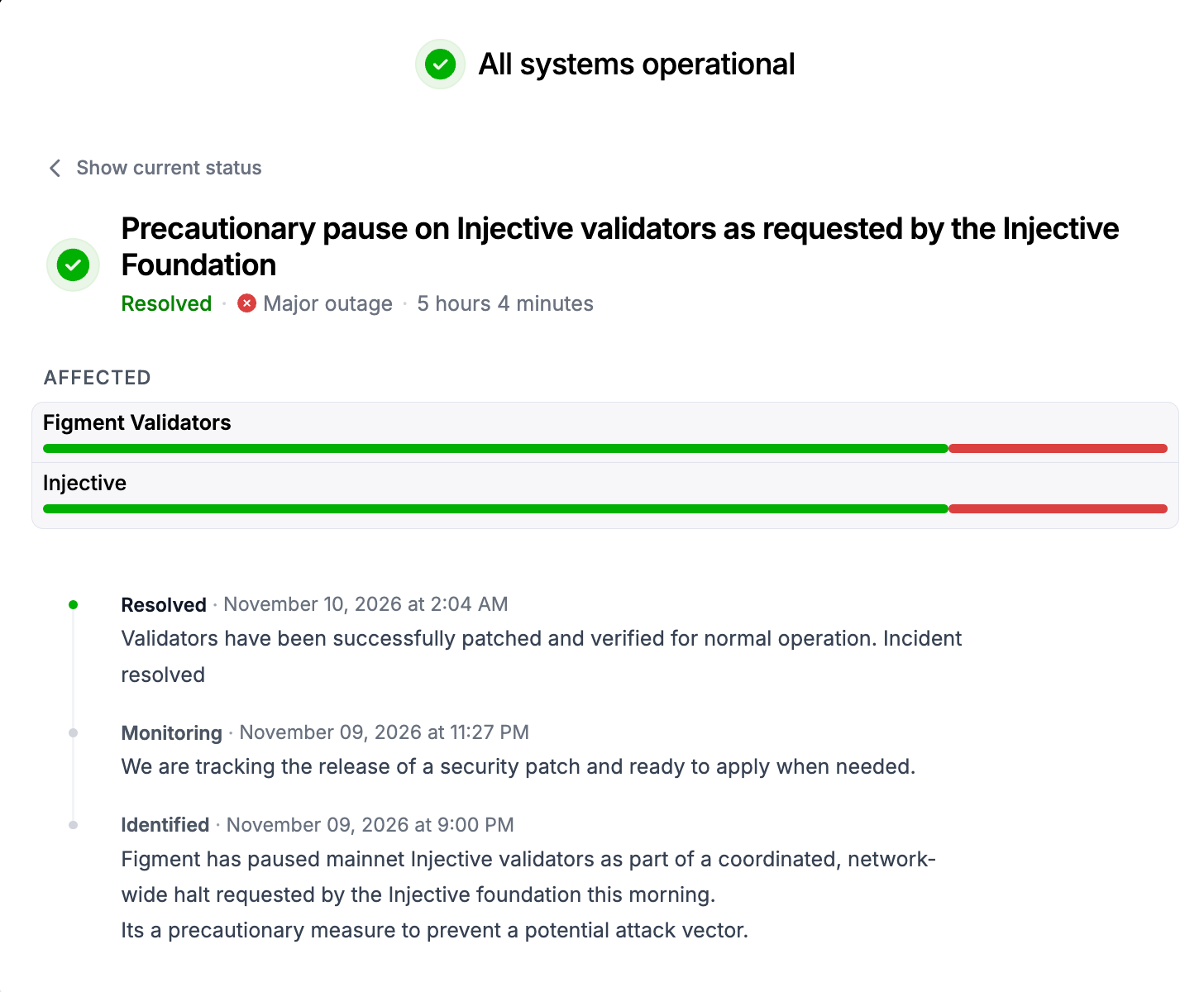
On validator Figment’s incident page, Odaily reported, the first explanation was that, at the request of the Injective Foundation, mainnet validators were paused under network-wide coordination as a precaution against a potential attack path. The note was later changed to say a security patch was being tracked and prepared for application. At 2:04 a.m. on November 10, the conclusion on that page was that validators had finished the patch and returned to normal. Read that way, the roughly 4-hour-24-minute halt was a precautionary security-patch update.
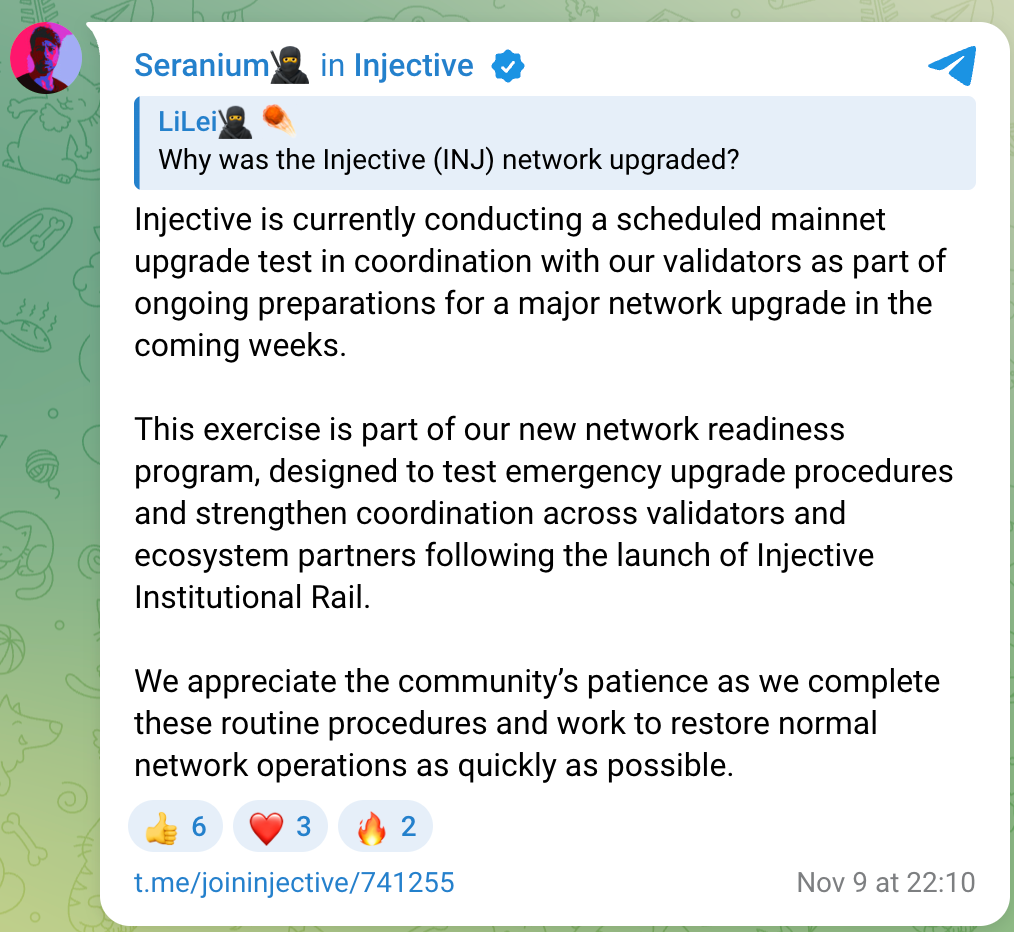
An Injective Telegram community administrator, as relayed by Odaily, did not match that account in full. The message said Injective was coordinating with validators on a scheduled mainnet upgrade test and continuing preparations for a major network upgrade in the coming weeks. The drill was described as part of a new network-readiness plan: a test of emergency upgrade procedures, and an effort to tighten coordination among validators and ecosystem partners after the institutional channel went live.
Odaily’s reading was that the public reasons did not line up — one framed the stop as attack prevention and a security patch, the other as a planned upgrade drill — and that Injective had not unified its account. Those remain two reported statements. The source does not establish a single confirmed root cause.
Attention, a price that held, and what was not shown
INJ did not, on Odaily’s account, sell off with the halt. Before and after, the price was described as holding around $7.9 to $8.1. That is a price observation from the report. It is not evidence that institutional capital had arrived, and it is not a forecast.
On the day of publication, November 10, Odaily noted that Injective had released “INJ lands on Wall Street” brand placements on New York taxis. That is distribution of the listing story. It sat beside a separate operational fact: a multi-hour halt, and deposit and withdrawal pauses at three exchanges, while spot trading continued.
The category line is the useful one. INJC, as described, is a staking-type ETF meant to open brokerage access to the INJ token and to count staking yield in NAV. It is not equity in Injective Labs. A claim to be institutional-grade infrastructure is not the same thing as continuous block production, and not the same thing as assets already committed by banks. Nothing in the report shows capital rotating into a broader real-world-asset or ETF basket. One listing, one bell, and one outage are not a sector trend.
Odaily’s close was cautious rather than alarmist: for a chain aiming at traditional markets, a technical halt near an ETF launch might not by itself be decisive, but persuading traditional institutions to commit real liquidity and balance-sheet exposure to INJ and INJC would still require more stable technical performance. The piece said the eight years already elapsed left the next eight worth watching. That is the reporter’s expectation, not a measured adoption curve.
Source: Wenser, Odaily星球日报 (@OdailyChina), November 10, 2026, 17:36 (UTC+8). https://www.odaily.news/post/5213849.