Historical source context: This article rewrites a PANews piece by Frank of MSX, published November 5, 2026, at 19:00 UTC+8. Regulatory developments, product availability and planned launches below reflect that report’s publication context.
The stock-tokenization narrative is no longer only about putting shares on a blockchain. In the account presented by Frank of MSX, it is increasingly about exporting crypto’s trading architecture—perpetual contracts, stablecoin settlement and continuous order books—to traditional assets.
The report’s central development was a November 3 announcement by Commodity Futures Trading Commission Chairman Mike Selig that single-stock perpetual contracts could begin trading on regulated US exchanges under joint CFTC and Securities and Exchange Commission oversight.
That is a different proposition from simply extending stock-market opening hours. It brings a crypto-associated derivatives structure into the US securities framework. But it also raises an important distinction: trading continuous exposure to a stock’s price is not the same as owning or trading the underlying share.
What stock perpetuals change—and what they do not
Perpetual contracts remove the scheduled expiration found in conventional futures. Traders can maintain long or short exposure without rolling a position solely because its contract expires. Periodic funding payments between long and short holders help keep the derivative’s price aligned with a reference price.
The source contrasts that structure with several established alternatives:
- Margin trading and short selling depend on broker financing, available stock borrow, borrowing costs and regulatory requirements.
- Options, including zero-days-to-expiration contracts, involve time decay, more complex pricing and liquidity split across strikes and expirations.
- Dated futures require rolling positions to maintain exposure, introducing transaction costs and changes in basis.
Removing expiry does not remove funding costs, margin requirements or liquidity risk. Nor does a stock perpetual necessarily involve delivery of an actual share.
The source distinguishes two product approaches. Synthetic perpetuals, such as the Binance USDT-settled and Coinbase USDC-settled products it describes, provide directional stock-price exposure without underlying share delivery. Other systems connect perpetual trading with tokenized equities or securities collateral, including the approaches described for MSX, Kraken’s xStocks-based offering and Ondo.
These belong to an overlapping market narrative, but they are not interchangeable products.
The reported US regulatory route
According to the article, Selig described single-stock perpetuals as securities futures under the Commodity Futures Modernization Act of 2000. They would therefore fall under both the Commodity Exchange Act and federal securities laws.
A venue offering them would need CFTC registration as a designated contract market, alongside SEC notice registration as a national securities exchange permitted to trade securities futures products.
The report places the announcement within a broader sequence:
- March 11, 2026: The SEC and CFTC signed a memorandum of understanding on cooperation covering financial innovation, market oversight and investor protection.
- May 29: The CFTC approved KalshiEX’s BTCPERP bitcoin perpetual contract.
- November 3: Kalshi began offering perpetuals referencing Amgen (AMGN), McDonald’s (MCD), Qualcomm (QCOM) and Costco (COST), with maximum leverage of approximately 4.9 times, according to the source.
The significance is regulatory access, not proof that US stock trading has already become an unrestricted, around-the-clock market.
Crypto venues had already broadened the asset menu
The article describes a product expansion that preceded the US announcement.
MSX began public testing of tokenized US-stock perpetuals on August 11, 2025. Hyperliquid introduced HIP-3 in October 2025, opening perpetual-market creation to third-party developers and enabling markets beyond crypto assets, including equities, indices, commodities and foreign exchange.
During 2026, the report says:
- Binance launched TSLAUSDT on January 28, followed on February 9 by contracts referencing MSTR, AMZN, CRCL, COIN and PLTR, using USDT margin and settlement with 24/7 trading.
- Ondo Finance announced Ondo Perps on February 3 and launched the platform in July, pursuing traditional-asset perpetuals and exploring tokenized securities as collateral.
- Kraken introduced xStocks-based perpetuals on February 24 for eligible non-US users in more than 110 countries and territories, with leverage up to 20 times.
- Coinbase launched stock perpetuals on March 20 for eligible non-US users, settling in USDC.
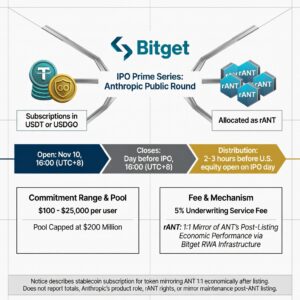
- Bitget also offered stock and ETF perpetuals with USDT settlement and near-continuous trading.
Those access restrictions and settlement differences matter: the presence of a stock ticker does not make every offering equivalent to a US-regulated security or available to US investors.
Trading volume supports the narrative—but has limits
Citing The Block, the article says perpetuals generated approximately 75% of centralized crypto-exchange trading volume in 2025, totaling nearly $49 trillion.
For the third quarter of 2026, it cites TokenInsight figures showing approximately $12 trillion in volume across the tracked exchange sample, down 27.5% quarter over quarter and marking a third consecutive quarterly decline. Spot volume fell 55% to $2 trillion, while derivatives volume declined 17% to $10 trillion.
Derivatives nevertheless increased their share of total volume to 83%, up 10 percentage points from the previous quarter.
Across nine exchanges, the report recorded $2.1 trillion in combined stock and commodity perpetual volume: approximately $1.61 trillion in stock perpetuals, or 77%, and approximately $491 billion in commodity perpetuals.
These figures document substantial trading activity. They do not, by themselves, establish how many people hold tokenized shares or demonstrate a transfer of capital out of crypto. The source also cautions against explaining traditional-asset expansion solely through declining crypto volumes: exchanges can reuse existing derivatives engines, stablecoin settlement systems and margin infrastructure across additional markets.
Weekend prices are signals, not official stock prices
A central claim in the article is that stock perpetuals can provide a form of “shadow price discovery” while conventional exchanges are closed.
Using Coinbase as an example, it describes reference pricing that draws on external sources such as Pyth and Blue Ocean ATS during normal trading periods. During weekends and some closures, an internal index combines an exponential moving average of perpetual mark prices with available tokenized-stock quotations. Price-deviation limits and transition mechanisms are intended to reduce disruption when external prices resume.
Funding payments and cross-platform arbitrage can help narrow discrepancies. But neither guarantees an accurate forecast of the next cash-market opening.
A weekend perpetual price remains a venue-specific derivatives quote—not an official Nasdaq or New York Stock Exchange share price. When cash equities are closed, traders cannot continuously hedge through the underlying stock market. Funding costs, margin requirements, thin liquidity and reopening gaps remain material risks.
The report discusses possible future participation by firms such as Citadel Securities, Jane Street and Virtu under appropriate regulatory conditions; it does not establish that those firms had joined these markets.
Traditional finance’s response was still taking shape
The source reports that ICE, the NYSE’s parent company, announced a partnership with Trade[XYZ] on October 29 to bring Hyperliquid-based perpetual markets to the United States.
Under the proposed arrangement, ICE would operate a new regulated trading and clearing framework and make a strategic investment in Trade[XYZ], which would contribute market design and product technology. Planned coverage included equities, indices, crypto, commodities and foreign exchange. The business still required regulatory approval.
Other developments described in the article also had distinct scopes and timelines:
- An April 10 SEC approval for Nasdaq’s five-day, 23-hour trading schedule, expected to launch December 6, 2026.
- A September 17 temporary, conditional SEC innovation exemption for eligible tokenized-securities venues to trade certain National Market System stocks through permissioned automated market makers and liquidity pools.
- An October 28 CFTC announcement of a December 15 industry roundtable on continuous derivatives trading, including infrastructure, staffing and operational readiness.
At the source’s publication date, the December milestones were still ahead.
The broader narrative is convergence rather than replacement: crypto venues were expanding the assets their systems could trade, while traditional institutions were considering longer hours and different market structures. The unresolved question was whether those systems could combine continuous access with reliable pricing, clearing and regulatory safeguards—not simply whether stocks could acquire token wrappers.