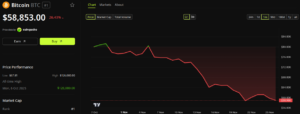
As of November 25, 2026, at 5:26 p.m. UTC+8, Bitcoin was struggling to reclaim $60,000. On November 23, it had jumped 5% in half an hour to nearly $64,600 after news of Jensen Huang’s reinstatement at Nvidia. The gain disappeared in less than six hours. Glassnode called Bitcoin a “canary in the coal mine”: it surrendered its gains before the Nasdaq followed, and its correlation with the Nasdaq 100 reached its highest level since September 2022.
US spot Bitcoin ETFs recorded $232 million in net outflows on November 24, their sixth consecutive day of withdrawals. Net outflows over 20 trading days totaled $4.3 billion, one of the largest such stretches since the funds launched. US spot Ether ETFs lost a net $64.0249 million on November 24, extending their outflow streak to eight days.
Why $53,200 mattered
Bitcoin’s realized price, a measure of the market’s average cost basis, stood at roughly $53,200. Glassnode saw signs of capitulation: nearly 90% of long leverage above the realized price had been cleared. In its assessment, a daily close below the June low of $58,500 could put $53,200 in reach.
That cost basis was a reference point, not a proven floor. Élízer Ndinga, head of research at 21Shares, said Bitcoin had fallen below its realized price in every past bear market, typically bottoming 24% to 61% beneath it. He cited roughly $43,800 as a possible low but stressed that it was an extrapolation, not a prediction that Bitcoin would reach it.
Options trading showed strong demand for downside protection. According to Glassnode, the previous week’s put-to-call volume ratio reached 1.7, the highest since June 2022. Measured by open interest, the ratio was the highest since May 2021. Options dealers were short gamma between $58,000 and $64,000, meaning their hedging could amplify price moves. In the adjacent $56,000–$58,000 and $64,000–$66,000 bands, hedging was more likely to dampen them.
Traders disagreed on how far a decline could run
The $62,000–$66,000 zone, formerly an area of concentrated buying, had become resistance. Analyst Lennaert Snyder said Bitcoin had stalled at a $63,400 daily gap during the New York session and disclosed a short position opened at $63,300. Trader Ted Pillows characterized the November 23 rally as short covering rather than a durable recovery.
Trader Killa identified resistance at $64,000–$65,000 and saw a possible $48,000–$66,000 range over the following weeks. Closer to the market, traders were watching $58,000–$58,500. Killa said holding $57,700, the low of the preceding advance, could still allow a rebound. Max Trades identified potential long liquidations below $59,300, while trader wulf pointed to buy orders below $55,000.
Longer-range scenarios depended on different assumptions:
- Michaël van de Poppe, founder of MN Capital, put the probability of a V-shaped recovery below 30%, citing the need to reclaim the 21-week, 21-day and 200-day moving averages. He said a strong monthly close would change how he viewed a subsequent pullback.
- Darius Dale, founder of 42 Macro, said Bitcoin could reach $38,400 if the S&P 500 fell more than 20% from its October high before Christmas.
- Benjamin Cowen, founder of Into the Cryptoverse, pointed to a $35,000–$39,000 balanced price. Unlike realized price, this measure also accounts for holding periods and movements of long-dormant coins. Cowen saw the next four to seven weeks as the most vulnerable period. If Bitcoin avoided a new low then, he said, bearish sentiment could ease in early 2027, leaving room for a rebound between March and June.
The US dollar index held above 104, around its highest level since March 2025, as the Trump administration’s plans for another tariff push added to inflation concerns. The next scheduled test was the October US personal consumption expenditures release at 9:30 p.m. UTC+8 on November 25. Markets expected annual core inflation to rise to 3.2%; that was a forecast, not a released figure. The November 26 Thanksgiving closure of US equity markets was also expected to thin liquidity. Signs of a more durable Bitcoin recovery would include renewed ETF inflows, net buying on Coinbase and a sustained hold above $60,000.
Ether slips below $1,700
Ether was down about 6.5% for the week and 65% from its August 2025 peak of $4,946. Trader Bayard saw room for a rebound toward $1,900–$2,000 after the prolonged decline but said that, without a recovery above the 21-day moving average, it would remain a technical bounce. Cooler inflation, lower oil prices and falling US Treasury yields would provide a more favorable backdrop.
The $1,650–$1,722 band had become an obstacle. Trader Alex Marzell identified $1,722 as the level to reclaim and said holding $1,650 could allow a retest of $1,770; losing it could expose $1,540. Several traders described $1,500 as a floor dating to 2023 while allowing for a brief dip to $1,350. Peter Brandt offered a more extreme conditional view: if Ether could not hold $1,383, he saw insufficient buying support to rule out a fall below $500.
Chip stocks lead Asia-Pacific losses
The equity sell-off was particularly sharp in hardware stocks associated with the AI trade. Overnight, the Nasdaq fell 1.48% and the Philadelphia Semiconductor Index lost 7.88%. South Korea’s KOSPI then closed down 6.16%, with SK Hynix losing 11.05% and Samsung Electronics 9.87%. Overseas investors were concerned that the high-bandwidth memory and broader memory-chip cycles were peaking. Goldman Sachs and UBS attributed the repositioning to tighter liquidity and stretched valuations.
Japan’s Nikkei 225 lost 2.78% and fell below 58,000. SoftBank Group dropped 14.83% and Tokyo Electron 12.53%; Kokusai Electric, Ibiden, Kioxia and Murata Manufacturing each lost more than 14%. The selling was not uniform: Sony gained 4.42%, Toyota 2.87% and Fast Retailing 2.53%. Drugmakers Ono Pharmaceutical and Astellas rose 10.71% and 6.49%, respectively.
In Hong Kong, the Hang Seng Index fell 1.14% and the Hang Seng Tech Index 2.56%. Biren Technology lost more than 24%, Iluvatar CoreX more than 18% and Hua Hong Semiconductor more than 17%. GigaDevice and Gpixel each fell more than 13%. SMIC lost 7.55% after CICC cut its target price by more than 30%, citing lower sector valuations and uneven customer demand. Battery makers also declined: CATL lost 12.23%, while CALB and Lopal each fell more than 7%. Market analysts pointed to declining industry concentration and weakening market share among battery leaders. Handset suppliers, nonferrous metals and brokerages also weakened; CICC shares fell 7.06%.
On the mainland, the Shanghai Composite fell 2.03%, closing below 3,500. The Shenzhen Component lost 3.24%, the ChiNext 4.19% and the STAR 50 5.12%. More than 4,900 stocks declined across Shanghai and Shenzhen. Semiconductors, printed circuit boards and robotics led losses, with Nata Opto-electronic Material and Brite Semiconductor down more than 10%. Pharmaceutical distributors, retailers and lower-valued banks drew buying interest. CICC attributed the adjustment mainly to external shocks and saw room for an uneven recovery over the medium term.
Crypto calendar and market snapshot
- Sophon: The mainnet was scheduled to shut down, with users instructed to withdraw assets before November 25.
- Scheduled unlocks: Approximately 266 million Humanity (H) tokens valued at $3 million, 19.55 million ChainOpera AI (COAI) tokens valued at $3.4 million and 228 million Plasma (XPL) tokens valued at $10.4 million.
- Upbit volume: BTC, EGLD, XRP, BIGTIME and SKY ranked first through fifth by 24-hour trading volume.
- Top-100 gainers by market capitalization: BTW led with a 22.4% gain, followed by SKY at 3.5%, XMR at 0.9%, and WLFI and JST at 0.5% each.