
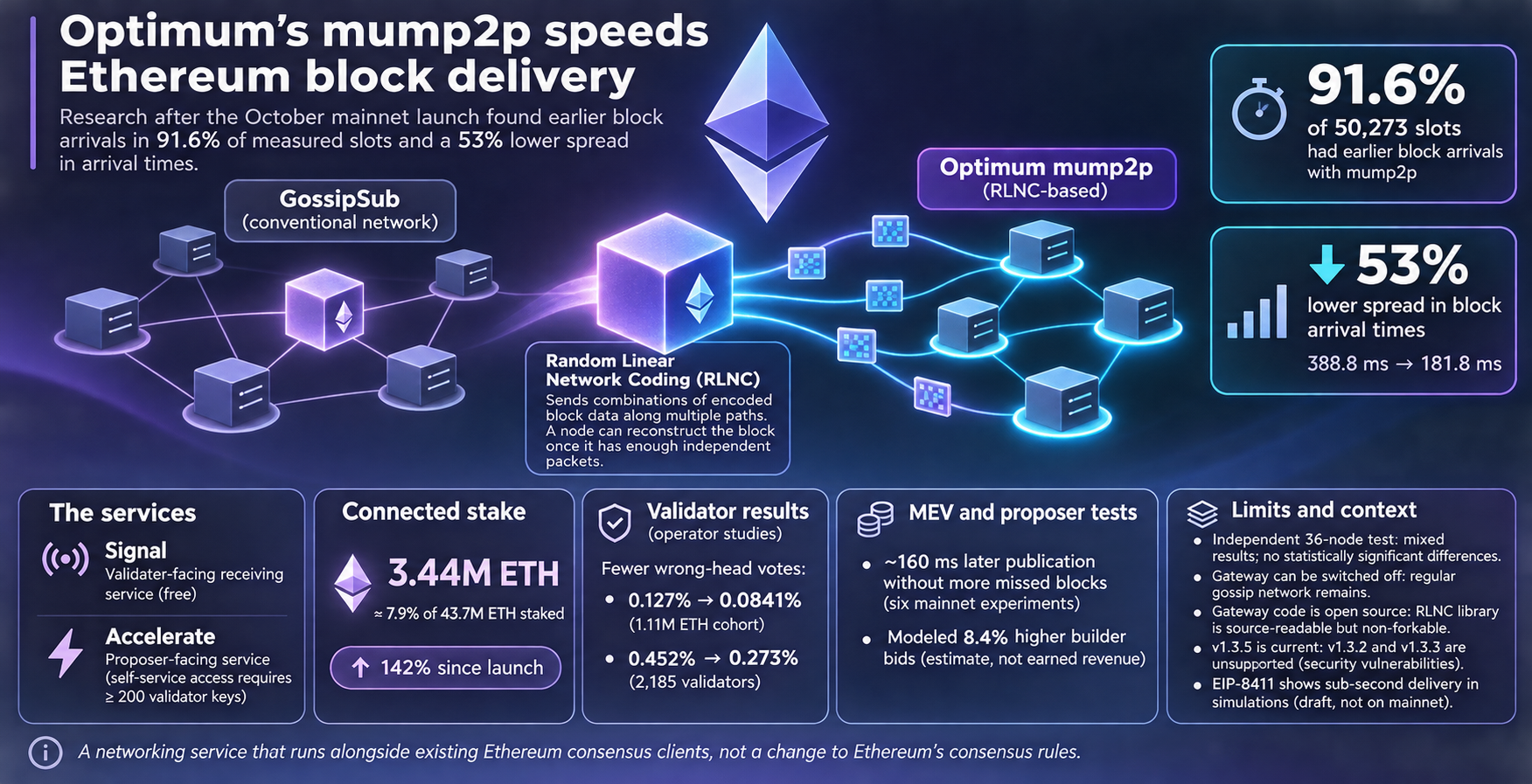
As reported on November 23, 2026, Optimum’s mump2p service was delivering Ethereum blocks earlier than the conventional GossipSub network in 91.6% of measured slots, according to research published after its October mainnet launch. The result concerns a networking service that runs alongside existing consensus clients, not a change to Ethereum’s consensus rules.
What the measurements show
DeFiLlama Research examined 50,273 Ethereum slots from November 4–11, comparing 372 gateways running mump2p with 194 public Xatu nodes monitoring GossipSub traffic. It found that the spread in block arrival times fell 53%, from 388.8 milliseconds to 181.8 milliseconds. That measures how consistently blocks reached different nodes; it does not mean average delivery time was cut in half.
Optimum uses Random Linear Network Coding to send combinations of encoded block data along multiple paths. A receiving node can reconstruct a block once it has enough independent packets. Optimum calls its validator-facing receiving service Signal, which is free, and its proposer-facing service Accelerate, whose self-service access requires at least 200 validator keys.
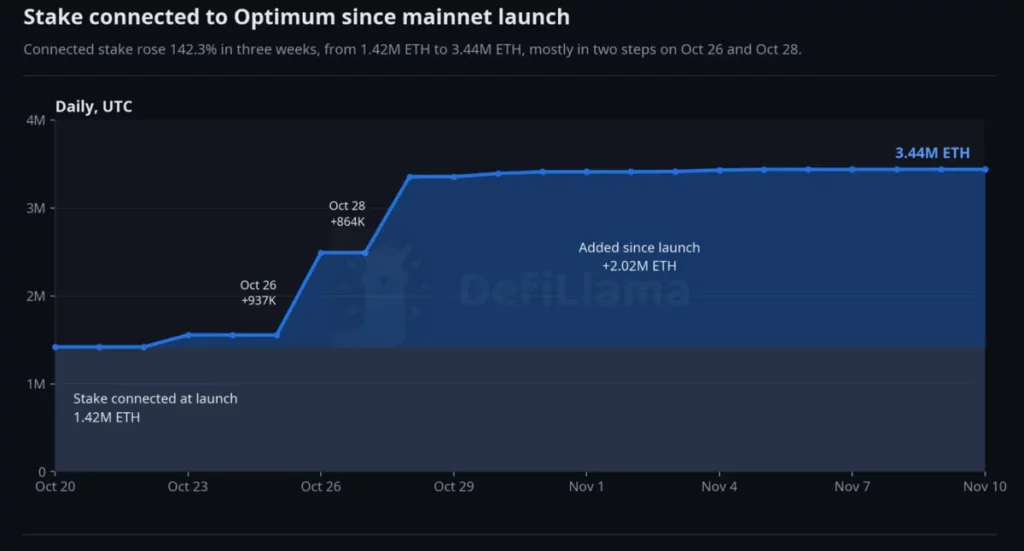
By November 10, participating providers operated 3.44 million ETH in connected stake—about 7.9% of the 43.7 million ETH then staked and 142% above the amount at launch. Optimum calls this measure Total Value Boosted: it is stake operated by connected providers, not ETH deposited into Optimum contracts. Participants included Blockdaemon, Everstake and P2P.org. Ether.fi required all 12 of its node operators to install the gateway, accounting for roughly 1.4 million ETH, or 41% of reported connected stake.
Validator results and limits
Optimum reported that wrong-head votes—attestations for an earlier chain head—fell from 0.127% to 0.0841% in a cohort representing 1.11 million ETH, comparing study periods in June and September. A separate Blockdaemon study of 2,185 validators found a decline from 0.452% to 0.273%. Neither observation establishes the same benefit for every operator.
Optimum also tested whether proposers could wait longer to select MEV-Boost builder bids without increasing missed blocks. Across six mainnet experiments, it reported no rise in orphaned or locally built blocks while publishing roughly 160 milliseconds later. Its modeled 8.4% increase in builder bids was an estimate, not earned revenue. Likewise, Optimum’s estimate of more than 460 ETH in possible additional rewards across roughly 3,100 blocks during the October 30 market disruption was hypothetical and depended on later bid selection not adding propagation risk.
Independent findings were less conclusive. A 36-node mainnet test discussed on Lido’s research forum found earlier arrivals on three of six Ethereum clients, little change on others and slower results for Nimbus; none of the measured differences was statistically significant. Optimum said acceleration across the wider network could also benefit untreated nodes and proposed a revised test arrangement.
Operators can switch off the gateway and continue using Ethereum’s regular gossip network. Optimum says the gateway code is open source, but its underlying RLNC library is source-readable and cannot be forked under its licence. Its release notes identify v1.3.5 as the current gateway version and say v1.3.2 and v1.3.3 are unsupported because of security vulnerabilities. Separately, EIP-8411 researchers have reported sub-second median delivery in 500-node simulations of a 1 MiB execution payload; that proposal remains a draft, not a mainnet deployment.