Source article published November 5, 2026, at 15:40 UTC+8. The developments and planned launches below reflect the reporting available at that time.
The narrative around bringing stocks into crypto markets is moving beyond putting shares on a blockchain. Its next question is whether traditional assets will adopt the trading structures that crypto platforms popularized: perpetual futures, stablecoin margin and continuously operating order books.
According to the Odaily source article, CFTC Chairman Mike Selig announced on November 3, 2026, that single-stock perpetual contracts could begin trading on regulated U.S. exchanges under joint CFTC and SEC oversight. The article reports that Kalshi began offering contracts linked to Amgen (AMGN), McDonald’s (MCD), Qualcomm (QCOM) and Costco (COST) that day, with maximum leverage of approximately 4.9 times.
The significance is not that these products turn every stock into a token. Rather, a derivatives structure established in crypto markets is entering the U.S. securities regulatory framework. Understanding that distinction is essential to separating the broader narrative from what investors actually trade.
What a stock perpetual provides—and what it does not
A perpetual contract offers long or short exposure without a scheduled expiration date. Unlike a conventional futures position, it does not require periodic rolling simply to maintain exposure.
Funding payments between long and short positions help keep the contract price near a reference price. When a contract trades above its reference index, positive funding generally makes longs pay shorts; when it trades below, negative funding generally reverses that relationship.
Removing expiration does not remove trading costs or risk. Funding, margin requirements, liquidity and price gaps still matter. Nor does a stock-linked perpetual necessarily involve ownership or delivery of the underlying shares.
The source distinguishes two product routes:
- Synthetic stock perpetuals: Contracts such as Binance’s USDT-settled and Coinbase’s USDC-settled products provide exposure to share-price movements without physical stock delivery.
- Products built around tokenized securities: The article places MSX, Kraken’s xStocks-based offering and Ondo’s exploration of tokenized securities as collateral in this category. Their structures differ, but they connect derivatives more closely with tokenized-asset systems.
These categories should not be treated as interchangeable. Stock-price exposure, tokenized securities and collateral accepted by a derivatives platform describe different functions.
Why platforms want to extend the model
Perpetuals already account for a substantial part of crypto trading activity. The article cites The Block as estimating that they generated about 75% of centralized crypto exchange trading volume in 2025, totaling nearly $49 trillion.
For the third quarter of 2026, the article cites TokenInsight figures showing a more difficult environment for the exchanges it tracked:
| Measure | Reported Q3 2026 result |
|---|---|
| Total trading volume | About $12 trillion, down 27.5% quarter over quarter |
| Spot volume | About $2 trillion, down 55% |
| Derivatives volume | About $10 trillion, down 17% |
| Derivatives share of total volume | 83%, up 10 percentage points |
Total volume had declined for three consecutive quarters in that sample. Yet derivatives had gained share because spot activity fell more sharply.
Separately, across nine exchanges covered by the report, stock and commodity perpetuals generated approximately $2.1 trillion in third-quarter volume. Stock perpetuals accounted for roughly $1.61 trillion, or 77%, while commodity perpetuals contributed about $491 billion.
These figures support the article’s argument that traditional assets had become an important area of product expansion. They do not establish that declining crypto volume alone caused that expansion. Platforms already operating derivatives engines, stablecoin settlement and margin systems also had infrastructure they could extend to additional assets.
Trading volume is evidence of activity, not a measure of underlying stock ownership or proof that every product has durable adoption.
How the product landscape developed
The source describes a sequence of launches spanning crypto-native platforms and traditional financial institutions:
- August 11, 2025: MSX began public testing of U.S. stock-token perpetuals, extending its tokenized-stock spot offering into derivatives.
- October 2025: Hyperliquid introduced HIP-3, opening perpetual-market creation to third-party developers and expanding the range of markets beyond crypto into stocks, indices, commodities and foreign exchange.
- January 28, 2026: Binance launched TSLAUSDT stock perpetuals. On February 9, it added contracts including MSTR, AMZN, CRCL, COIN and PLTR, using USDT margin and settlement with round-the-clock trading.
- February 3: Ondo Finance announced Ondo Perps, covering plans for stocks, ETFs and commodities and exploring tokenized securities as collateral. The article reports that the platform launched in July.
- February 24: Kraken introduced xStocks-based perpetuals for eligible non-U.S. users in more than 110 countries and territories, with 24/7 trading and leverage of up to 20 times.
- March 20: Coinbase launched stock perpetuals for eligible non-U.S. users, settled in USDC.
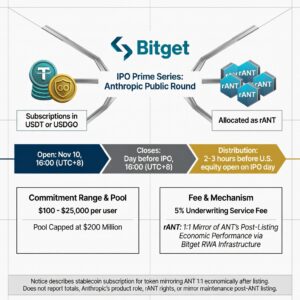
The article also describes Bitget’s USDT-settled stock and ETF perpetuals, covering assets including Nvidia, Apple, Tesla and Microsoft, with near-continuous trading.
Eligibility, settlement assets and trading schedules differ across these offerings. Their expansion should not be read as universal availability, particularly for U.S. users.
U.S. regulation and ICE’s proposed entry
The regulatory timeline reported by Odaily begins with a March 11, 2026, SEC–CFTC memorandum of understanding on coordination in financial innovation, market oversight and investor protection. It then identifies the CFTC’s May 29 approval of KalshiEX’s BTCPERP bitcoin perpetual contract as a preceding step toward regulated perpetual trading.
For single-stock perpetuals, the article reports Selig’s explanation that the products fall within the securities-futures framework of the Commodity Futures Modernization Act of 2000. They therefore must comply with both the Commodity Exchange Act and federal securities laws.
Venues offering them require CFTC registration as a designated contract market, alongside SEC notice registration as a national securities exchange authorized to trade securities futures.
A separate development involves traditional exchange infrastructure. On October 29, ICE, the parent company of the New York Stock Exchange, announced a partnership with Trade[XYZ] to bring Hyperliquid-based perpetual markets to the United States, according to the source.
Under the proposed arrangement, ICE would operate a new regulated market and clearing structure and make a strategic investment in Trade[XYZ]. Trade[XYZ] would contribute market design and product technology, with planned coverage spanning equities, indices, crypto, commodities and foreign exchange.
That proposal still required regulatory approval. It was a plan for a dedicated U.S.-compliant trading and clearing system, not evidence that an existing onchain market had automatically become a regulated U.S. venue.
Weekend prices are signals, not official stock prices
The strongest market-structure argument for stock perpetuals concerns periods when the underlying equity market is closed.
A continuously operating derivatives market can express traders’ reactions to weekend news before stock exchanges reopen. But those prices remain venue-specific derivatives quotes—not official Nasdaq or NYSE share prices, and not guaranteed forecasts of Monday’s opening trade.
The article uses Coinbase’s methodology to illustrate how such markets construct reference prices. During regular trading periods, external sources including Pyth and Blue Ocean ATS inform the index. During weekends and some closures, an internal index incorporates an exponential moving average of perpetual mark prices and available tokenized-stock quotes. Price-deviation limits and transition mechanisms aim to reduce disruption when external feeds resume.
Funding payments and cross-platform trading can also help narrow discrepancies. The source gives a hypothetical example: if an Nvidia perpetual trades at $200 on one venue and $203 on another, traders might buy the cheaper contract and sell the more expensive one, provided their specifications and liquidity are sufficiently comparable.
That is not necessarily risk-free arbitrage. On weekends, the underlying stock market cannot provide continuous cash-equity hedging. Funding differences, margin needs, liquidity and reopening gaps remain relevant. A funding mechanism also cannot independently guarantee an accurate price when the reference market is closed.
The article’s description of this activity as “shadow price discovery” is therefore useful: it captures an additional channel for market expectations without confusing that channel with the underlying stock market.
Convergence remains a process, not a completed outcome
Several other milestones in the source point toward longer trading hours and alternative market structures:
- The SEC reportedly approved Nasdaq’s 23-hours-a-day, five-days-a-week rule change on April 10, 2026, with a launch expected on December 6.
- On September 17, the SEC reportedly introduced a temporary, conditional innovation exemption allowing eligible tokenized-securities venues to trade certain U.S. National Market System stocks through permissioned automated market makers and liquidity pools.
- On October 28, the CFTC announced a December 15 roundtable on round-the-clock derivatives trading, including market structure, tokenization, infrastructure, staffing and operational readiness.
At the source’s publication date, the December launch and roundtable were still prospective.
The broader story is not simply that crypto will replace traditional exchanges—or that tokenization alone produces an always-open market. Crypto platforms bring experience with continuous trading, stablecoin settlement and global distribution. Traditional institutions bring regulatory permissions, custody, clearing and institutional relationships.
Stock perpetuals sit at the intersection. Their expansion shows how a crypto-associated trading mechanism can reach traditional assets. Whether that develops into deeper, reliable, round-the-clock liquidity depends on more than product announcements: the reference-price systems, hedging channels, clearing arrangements and operational infrastructure must work across both worlds.
Original source: Odaily, published November 5, 2026, at 15:40 UTC+8.