Source publication: November 6, 2026, at 17:36:56 (UTC+8). This retrospective summary preserves the reporting context of PANews’ daily roundup.
Crypto’s expansion stories were running into different kinds of constraints in PANews’ November 6 roundup: AI infrastructure faced regulatory and financing uncertainty, Zilliqa questioned the economics of an independent blockchain, and Pump.fun’s hiring pointed toward markets beyond memecoins. Meanwhile, stablecoin distribution expanded through Samsung Wallet, even as security incidents highlighted the risks surrounding access and custody.
AI: market pressure is not evidence about AI-token adoption
The roundup’s closing-market report put the Nasdaq Composite’s decline at 5.52%, its largest one-day fall in 19 months. It estimated that the seven largest technology companies lost roughly $1.04 trillion in combined market value. Other sections carried different index moves, so the figures across the roundup should not be treated as a single consistent market snapshot.
The regulatory explanation was attributed rather than established: investors were reportedly concerned that Democratic election victories could bring tighter restrictions on AI infrastructure. CryptoQuant analyst Axel Adler Jr. argued that continued equity selling could force funds to reduce risk and put additional pressure on bitcoin.
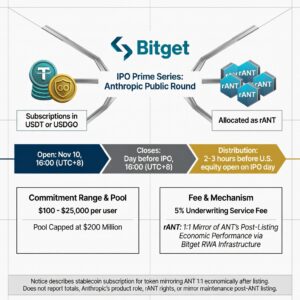
Financing uncertainty also featured. Reuters, citing four people familiar with the matter, reported doubts about whether Anthropic could complete its planned November listing timetable. Sources said a prolonged decline in AI-related assets could lead to a delay; Anthropic declined to comment.
Separately, OpenAI published a community compact and policy blueprint describing its data centers as “compute campuses.” Its commitments included paying the full cost of electricity and associated infrastructure, publishing water and power usage data, and providing independent noise studies. These were stated commitments and policy proposals—not evidence of completed implementation.
Together, these reports concern the financing, regulation and operating costs of AI infrastructure. They do not establish adoption or demand for crypto AI tokens.
Pump.fun: recruitment signals ambition, not a product launch
Pump.fun co-founder alon said developer Baton Corporation was recruiting business-development staff for perpetual futures, prediction markets and trading terminals.
He linked the roles to expanding the social graph within the Pump.fun app by attracting traders across memecoin primary markets, perpetuals and prediction markets. DEGEN NEWS characterized the post as his first mention of prediction markets.
The distinction matters: the supplied report described hiring and strategic intent. It did not establish that a prediction-market product had launched or disclose adoption figures for one.
Zilliqa: an institutional L2 thesis follows an L1 reassessment
Zilliqa said nine years of operating an independent Layer 1 had not delivered the expected results, citing insufficient usage, funding and liquidity. It also said recent security incidents underscored the cost of maintaining a standalone chain.
The team announced plans to become Zilliqa Institutional Layer, an Ethereum Layer 2 aimed at regulated institutions. The ZIL token would remain, and holders were told they did not need to act at that stage. Technical details were to be announced in advance, with any swap or migration governed by official website announcements.
This was a proposed change in positioning and infrastructure—not evidence that institutional customers had already adopted the network.
Stablecoins: distribution reach versus demonstrated use
According to Decrypt, Samsung Wallet introduced stablecoin accounts for eligible US Galaxy users, supporting USDC on Solana across approximately 82 million compatible devices.
Built with Bastion and Coinbase, the service offered fee-free transfers and bank-account withdrawals in more than 60 countries. Credit-card funding carried a 4% fee, and the service was not available in New York.
The compatible-device count described potential distribution, not active users, account balances or transaction volume. That distinction separates an expanded access channel from measurable adoption.
Security remains an operating constraint
Binance sought the return of 8,425.997 ETH and 74,559,805.2 ARB frozen following its hot-wallet attack. Its ArbitrumDAO proposal remained at the forum-discussion stage, with Snapshot and on-chain governance still required. The estimated process was about 49 days, potentially longer if legal restrictions applied, and requested no new DAO spending.
Separately, Bitquery linked thefts from 430 iPhone-user wallets since mid-October to one group, with losses of approximately $4.16 million. The report said there was no evidence that wallet applications such as Trust Wallet were themselves vulnerable; it identified tools capable of stealing seed phrases from compromised iPhones as the principal risk.
Across these stories, announcements, accessible devices and proposed market entries describe opportunity. They should not be mistaken for completed execution, sustained usage or resolved security risks.